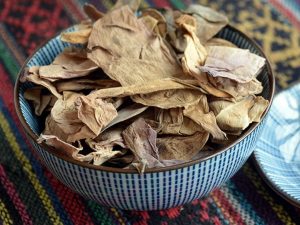
Chrysanthemum seedlings, a name in traditional Chinese medicine. These are the tender stems and leaves of the chrysanthemum plant Dendranthema morifolium (Ramat.) Tzvel., belonging to the Asteraceae family. They are cultivated throughout the country, with the largest-scale cultivation of medicinal chrysanthemums found in Henan, Anhui, and Zhejiang. They have the efficacy of clearing the liver and improving eyesight. They are primarily used to treat headaches, dizziness, and corneal opacities.

Chrysanthemum Seedlings
Disclaimer: These statements have not been evaluated by the Food and Drug Administration (FDA). This product is not intended to diagnose, treat, cure, or prevent any disease. All references in this article to TCM syndrome differentiation, herbal medicines, teas, and decoctions are intended to promote TCM culture and are provided solely for educational and reference purposes.
Chrysanthemum seedlings, a name in traditional Chinese medicine. These are the tender stems and leaves of the chrysanthemum plant Dendranthema morifolium (Ramat.) Tzvel., belonging to the Asteraceae family. They are cultivated throughout the country, with the largest-scale cultivation of medicinal chrysanthemums found in Henan, Anhui, and Zhejiang. They have the efficacy of clearing the liver and improving eyesight. They are primarily used to treat headaches, dizziness, and corneal opacities.
Chinese Name : 菊花苗
Aliases : Yuying
Authentic Producing Area : Henan, Anhui, Zhejiang
Nature, Flavor & Meridian Tropism : Sweet and slightly bitter in taste; cool in nature; enters the Lung, Liver, and Gallbladder meridians
Benefits & Efficacy
Benefits
Clears the liver and improves vision.
Indications
Headaches, dizziness, and opacities in the eyes.
Usage and Dosage
Internal use: Decoct in water; 6–12. External use: Use an appropriate amount; decoct in water for steam baths or washing.
Precautions
Not yet established.
Relevant Discussions
*Ben Cao Qiu Yuan*: “Clears heat from the liver and gallbladder, strengthens liver qi, improves vision, and removes opacities; treats headaches, dizziness, and the sensation of fainting.”
Applications
Related Compatibility
1. For chronic headaches with dizziness and oppression, dry and falling hair, and phlegm accumulation in the chest: Pound white chrysanthemum shoots into a fine powder. First, perform moxibustion on both Fengchi acupoints (two sets of seven moxa cones each). Then, on an empty stomach, take one fangcun bi of the powder, mix it with alcohol free of ash, and consume it. Take twice daily, gradually increasing the dose to three fangcun bi. If one does not wish to drink alcohol, it may also be mixed with the broth from congee and consumed. (*Illustrated Compendium of Tianbao Single-Ingredient Formulas*)
2. To clear the eyes and calm the mind: Pick the tender, clustered young shoots of sweet chrysanthemum, wash them thoroughly, chop them finely, and cook them with salt and rice into porridge. Eat the porridge. (Chrysanthemum Shoot Porridge from *Eight Notes on Nurturing Life*)
3. To treat vaginal swelling in women: Pound sweet chrysanthemum shoots into a paste, boil it into a decoction, and first use it for steam therapy, then for washing. (From *Effective Prescriptions of the World’s Physicians*)
Processing & Preparation
Harvesting & Processing
Harvest in spring or early summer; dry in the shade or use fresh.
Botanical Information
Botanical Classification
Chrysanthemum, a plant of the Asteraceae family.
Morphological Characteristics
Chrysanthemum is a perennial herb, 60–150 cm tall. The stem is erect, branched or unbranched, and covered with soft hairs. Leaves are alternate; with short petioles; leaf blades are ovate to lanceolate, 5–15 cm long, shallowly pinnately or semi-lobed, with a wedge-shaped base, and the underside is covered with short, white soft hairs.Capitula are 2.5–20 cm in diameter, varying in size, and occur singly or in clusters of several at the tips of stems and branches; involucral bracts are arranged in multiple layers, with the outer layer green, linear, with membranous margins, and covered with soft hairs on the outer surface; ray florets are white, red, purple, or yellow. Achenes are underdeveloped. Flowering period: September–November.
Distribution Area
It is cultivated throughout China. The largest-scale cultivation of medicinal chrysanthemums is found in Henan, Anhui, and Zhejiang.
Copyright: Excerpt from Internet, Copyright belongs to the Original Author and all original sources, This article was shared by DeDe on August 2, 2026, Please credit the source and include a link to the original article when reposting.
Terminology Proofreading: [Cheng Bo] | August 2, 2026 Reviewed by: [Wang Zhongxiang, Associate Chief TCM Physician (China)] | August 2, 2026
Correct Content Errors: Errors may occur during the writing, editing, translation, and publication of website content. If you find any errors or inaccurate information in this article, please feel free to Contact Us to report them, and we will correct them promptly.
FDA Disclaimer: The descriptions of the efficacy of Chinese herbal medicines, herbal teas, decoctions, and formulas, as well as the content on Traditional Chinese Medicine (TCM) diagnostic theory and traditional TCM therapies contained on this site, are intended solely for the purpose of popularizing TCM culture and serving as an educational reference; they do not constitute medical diagnosis or treatment advice. Please do not attempt to use these products on your own without proper guidance. These statements have not been evaluated by the Food and Drug Administration. This product is not intended to diagnose, treat, cure, or prevent any disease. If you are experiencing any physical discomfort, please consult a licensed healthcare professional and seek treatment at a reputable medical institution. This platform assumes no responsibility for any consequences resulting from the use of herbs or formulas by any individual based on the information provided on this site. Please read Medical Disclaimer.