Deer Tail is the name of a traditional Chinese medicinal material. It refers to the tail of the Sika Deer (Cervus nippon Temminck) or the Red Deer (Cervus elaphus Linnaeus) of the Cervidae family. It is effective in tonifying kidney yang and nourishing essence and qi. It is primarily used to treat kidney deficiency with seminal emission, lower back and spinal pain, dizziness, and tinnitus.
Deer Tail
Deer Tail is the name of a traditional Chinese medicinal material. It refers to the tail of the Sika Deer (Cervus nippon Temminck) or the Red Deer (Cervus elaphus Linnaeus) of the Cervidae family. It is effective in tonifying kidney yang and nourishing essence and qi. It is primarily used to treat kidney deficiency with seminal emission, lower back and spinal pain, dizziness, and tinnitus.
Chinese Name : 鹿尾
Nature, Flavor & Meridian Tropism : Taste: sweet and salty; nature: warm; enters the Liver and Kidney meridians
Benefits & Efficacy
Benefits
It tonifies kidney yang and nourishes essence and vital energy.
Indications
It is primarily used to treat kidney deficiency with seminal emission, lower back and spinal pain, dizziness, and tinnitus.
Usage and Dosage
Internal use: Decocted as a soup, 6–15 g; or incorporated into pills.
Precautions
Patients requiring treatment with Chinese herbal medicine should first consult a licensed Traditional Chinese Medicine (TCM) hospital to receive a prescription following a professional TCM differential diagnosis.
Relevant Discussions
1. *Compendium of Sichuan Traditional Chinese Medicine* (1979 edition): “Enhances yang and generates essence; warms the lower back and knees. Used for lower back and spinal pain due to kidney deficiency, stiffness and difficulty in bending and stretching, seminal emission, and dizziness with tinnitus.”
2. *Medicinal Animals of Inner Mongolia*: “Mainly used to treat seminal emission.”
3. *Chinese Animal Medicines*: “Treats seminal emission due to kidney deficiency, and soreness and pain in the lower back and knees.”
Applications
Clinical Applications
For treating lower back and spinal pain due to kidney deficiency, seminal emission, and dizziness with tinnitus: Deer Tail, Eucommia Bark, Psoralea, Goji Berries, Dodder Seed, Astragalus, Codonopsis, Atractylodes, Achyranthes, and Dogspine—all in equal parts. Form into pills. Take 5–10 g per dose, twice daily. (*Compendium of Sichuan Traditional Chinese Medicine*, 1979)
Notes
References: [1] Xiang Jinming. *Color Illustrated Guide to 1,200 Chinese Herbal Medicines: Platinum Collector’s Edition* [M]. Fuzhou: Fujian Science and Technology Press, 2020: 640.
Processing & Preparation
Harvesting & Processing
Deer tails are classified as “hairy deer tails” and “smooth deer tails.” After slaughtering the deer, the tail is cut off at the junction of the sacrum and coccyx, washed clean, and hung in a well-ventilated area to air-dry; this is called a “hairy deer tail.” Alternatively, the freshly cut, hairy deer tail is wrapped in a damp cloth or a piece of a damp burlap sack, left to ferment at a temperature of about 20°C for 2–3 days, then removed and the long hairs plucked off.soak it briefly in cold water, remove it, scrape off the downy hair and outer skin, remove any residual meat from the base and excess tail bones, sew the base and separated skin together with string, straighten the tail, hang it in a well-ventilated area to air-dry—this is known as “smooth deer tail.”
Processing Methods
1. Deer Tail: Take a hairy deer tail, singe off the down with fire, scrub it clean, cut it into small pieces, and dry it.
2. Wine-Steamed Deer Tail: Take small pieces of the “polished deer tail,” mix them thoroughly with yellow wine, let them soak until moist, place them in a steamer basket, steam thoroughly, remove, and dry. Use 20 kg of yellow wine for every 100 kg of net weight of deer tail pieces.
Storage Methods
Store in a dry container, seal tightly, and keep in a cool, dry place to prevent insect infestation.
Crude Drug Identification
Properties of Crude Drugs
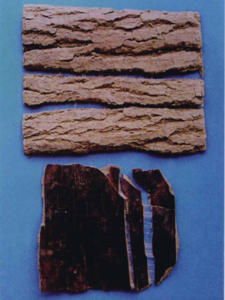
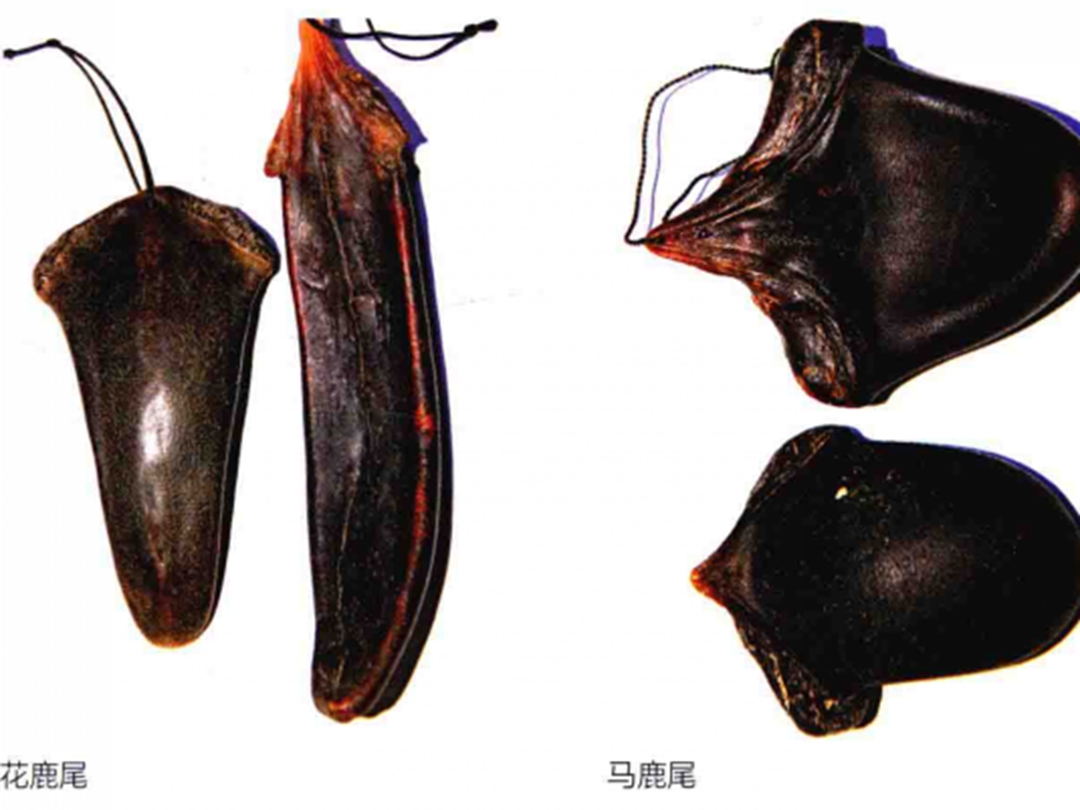
1. Elk Tail: It is bluntly rounded and resembles a pig’s tongue. Female elk tails are thick and short, with a relatively blunt, rounded tip; male elk tails are slender and elongated, with a relatively pointed tip. The hairy elk tail is 15–20 cm long, with a slightly flattened and wide base; the cut surface is uneven. The dorsal surface has long, brownish-yellow hair mixed with a small amount of white hair; the ventral surface has short, pale yellow hair and contains the caudal bone.The tail of the hairy sika deer is shorter, measuring 13–15 cm in length. The base is slightly flattened and wide; the cross-section is typically sutured, with thickened edges, a convex dorsal surface, and a concave ventral surface. The surface ranges from purplish-red to purplish-black, is smooth, oily, and lustrous, with visible pitted, microscopic pores and a few downy hairs, interspersed with longitudinal grooves. The texture is hard, and the cross-section is thick. It has a faint odor and a salty taste.
2. Sika Deer: The tail is narrower, longer, thinner, and smaller than that of the red deer. Most hairy tails feature a black line extending from the dorsal stripe, which gradually widens to 3.5–4.5 cm; the edges of the tail have long white hairs; the ventral surface has sparse white hairs, with bare skin visible. A few sika deer tails lack this black line. Hairless tails are slightly shorter.The base is slightly flattened and broad, with a sutured cross-section; the tip curves slightly downward and is purplish-red or purplish-black in color. The surface is smooth, oily, and lustrous, with visible pitted pores and a few downy hairs, as well as longitudinal furrows. It is hard in texture, has a fishy odor, and tastes salty.
Generally, the tail of the red deer is considered superior. The tail of the sika deer is lean and small and is rarely used. Tails that are dry, free of mold, rot, foul odors, and insect damage are considered acceptable; those that are plump, short, and sturdy are preferred.
Botanical Information
Morphological Characteristics
1. Sika Deer: Sika deer are approximately 1.5 meters long and weigh about 100 kg. They have prominent suborbital glands, large erect ears, and a slender, long neck. Their limbs are slender and long; on the outer side of the hind legs, below the ankle joint, there are brown plantar glands. The main hooves are narrow and small, and the lateral hooves are small. They have a distinct white patch on the rump and a short tail.Male sika deer have branched antlers; when fully grown, they have 4–5 tines. The brow tine extends diagonally forward; the second tine is set relatively far from the brow tine, and the main shaft splits into two small tines at its tip. The winter coat of the sika deer is chestnut brown, with inconspicuous white spots. The hair on the muzzle and cheeks is short, with sandy-yellow tips. A dark brown dorsal stripe runs from the top of the head along the spine to the tail.The white rump patch has a dark brown border. The undercoat is pale brown, and the groin area is white. The outer sides of the limbs match the body color, while the inner sides are slightly lighter. The summer coat is thin, without underfur, reddish-brown in color, with prominent white spots arranged in vertical rows along both sides of the spine and the lower edges of the flanks; there is a black dorsal stripe. The belly is white, the dorsal surface of the tail is black, and the limbs are lighter in color than the body.
2. Gueland Deer: This species is large, with a body length of 2 m and a weight exceeding 200 kg. Its shoulder height is approximately 1 m; the back is straight, and the heights at the shoulders and hindquarters are equal. The tip of the nose is bare, and the ears are large and conical. The neck is about one-third the length of the body, with relatively long undercoat on the underside of the neck. The limbs are long, and the hooves on both sides are long enough to touch the ground.The tail is short. Males have antlers; the brow tines extend forward, forming nearly a right angle with the main shaft, which curves slightly backward and inward. The surface of the antlers is rough except at the tips, and the base of the antlers has a small ring of tubercle-like protrusions. The winter coat is grayish-brown. The muzzle and lower jaw are dark brown, the cheeks are brown, and the forehead is brownish-black.The outer surface of the ears is yellowish-brown, while the inner surface is white. The neck and dorsal surface of the body are slightly yellowish-brown, with a blackish-brown dorsal stripe. The outer sides of the limbs are brown, while the inner sides are lighter in color. The rump has a yellowish-ochre patch. The summer coat is shorter, without undercoat, and reddish-brown in color.
Distribution Area
1. Sika Deer: Found in Northeast, North, East, and South China. 2. Elk: Found in Northeast, Northwest China, and Inner Mongolia, among other areas.