Dendrobium, a name in traditional Chinese medicine, refers to the following plants of the Orchidaceae family: Golden Hairpin Dendrobium (Dendrobium nobile Lindl.),Dendrobium huoshanense C.Z. Tang et S.J.Cheng, Dendrobium chrysotoxum Lindl., or Dendrobium fimbriatum Hook., as well as the fresh or dried stems of similar species within the same genus. It is primarily produced in Guangxi, Guizhou, Yunnan, and Hubei.This product has the effects of nourishing the stomach and promoting the production of body fluids, as well as nourishing yin and clearing heat. It is primarily used to treat heat-related illnesses with fluid depletion, dry mouth and intense thirst, deficiency of stomach yin, poor appetite and dry heaving, persistent deficiency heat following illness, yin deficiency with excessive fire, bone-consuming fever, blurred vision, and weakness of the tendons and bones.

Dendrobium
Dendrobium, a name in traditional Chinese medicine, refers to the following plants of the Orchidaceae family: Golden Hairpin Dendrobium (Dendrobium nobile Lindl.),Dendrobium huoshanense C.Z. Tang et S.J.Cheng, Dendrobium chrysotoxum Lindl., or Dendrobium fimbriatum Hook., as well as the fresh or dried stems of similar species within the same genus. It is primarily produced in Guangxi, Guizhou, Yunnan, and Hubei.This product has the effects of nourishing the stomach and promoting the production of body fluids, as well as nourishing yin and clearing heat. It is primarily used to treat heat-related illnesses with fluid depletion, dry mouth and intense thirst, deficiency of stomach yin, poor appetite and dry heaving, persistent deficiency heat following illness, yin deficiency with excessive fire, bone-consuming fever, blurred vision, and weakness of the tendons and bones.
Chinese Name : 石斛
Latin Name : Dendrobii Caulis
Aliases : Linlan, Jinsheng, Dulan, Shiti, Xuanzhu, Qiannian Zhu
Authentic Producing Area : Guangxi, Guizhou, Yunnan, Hubei
Nature, Flavor & Meridian Tropism : Slightly cold in nature, sweet in taste; enters the Stomach and Kidney meridians
Benefits & Efficacy
Benefits
Nourishes the stomach and promotes fluid production; nourishes yin and clears heat.
Indications
Mainly used to treat heat-related diseases with fluid depletion, dry mouth and intense thirst, deficiency of stomach yin, poor appetite and dry retching, persistent deficiency heat after illness, yin deficiency with excessive fire, bone-consuming fever, blurred vision, and weakness of tendons and bones.
Usage and Dosage
Internal use: Decocted, 6–12 g. Fresh material may be used at 15–30 g. When used in compound formulas, it should be decocted first; when used alone, it may be decocted for a longer period.
Precautions
1. This herb can consolidate pathogenic factors; therefore, it should not be used early in febrile diseases caused by heat. It can also promote dampness; thus, it is contraindicated in cases of damp-heat diseases that have not yet transformed into dryness and fluid depletion, or in cases of spleen-stomach deficiency-cold characterized by loose stools and a thick, greasy tongue coating. 2. Should not be used concurrently with atropine.
Chemical Constituents
This herb contains alkaloids such as dendrobine, dendrobamine, dendrobine-2, dendrobine-star, and dendrobine-in, as well as mucilage and starch.
Pharmacological Actions
This product has hypoglycemic, anti-cataract, and gastrointestinal regulatory effects.
Relevant Discussions
1. *Ben Cao Yan Yi*: “Treats deficiency-heat in the stomach.”
2. *Ben Cao Meng Quan*: “Nourishes essence and strengthens the yang. Strengthens tendons and bones, tonifies deficiency and emaciation, fortifies the spleen and knees, and dispels cold-induced arthralgia. It can expel external pathogenic heat from the skin and eliminate deficiency-fire in the stomach.”
Applications
Clinical Applications
1. To treat symptoms of heat-related diseases causing fluid depletion, restlessness and thirst, and a dry tongue with a black coating, it is often used in combination with Tianhuafen, fresh Shengdi, and Maidong, as described in the “Method for Clearing Heat and Preserving Body Fluids” in *Treatise on Epidemic Diseases*.
2. To treat epigastric pain, swollen and painful gums, and mouth and tongue sores caused by stomach heat and yin deficiency, it may be used in combination with Shengdi, Maidong, and Huangqin.
3. To treat kidney yin deficiency with blurred vision, it is often used in combination with Goji berries (枸杞子), Prepared Rehmannia (熟地黄), and Dodder Seed (菟丝子), as in the Dendrobium Nightlight Pill (石斛夜光丸) from *Revealing the Subtleties of the Original Mechanism* (*原机启微*).To treat kidney yin deficiency with weak and flaccid tendons and bones, it is often used in combination with Shu Dihuang, Shan Zhu Yu, Du Zhong, and Niu Xi—herbs that tonify the liver and kidneys and strengthen the tendons and bones. To treat kidney deficiency with excessive fire and bone-steaming fever, it is appropriate to use it in combination with Sheng Dihuang, Goji berries, Huang Bai, and Hu Huang Lian—herbs that nourish kidney yin and dispel deficient heat.
Related Compatibility
1. Dendrobium combined with Raw Rehmannia: Dendrobium excels at nourishing stomach yin, generating body fluids, and relieving restlessness and thirst; Raw Rehmannia excels at clearing heat, nourishing yin, generating body fluids, and quenching thirst. When combined, these two herbs enhance the effects of nourishing stomach yin, generating body fluids, quenching thirst, clearing heat, and relieving restlessness. This combination is suitable for conditions such as heat-related illnesses causing fluid depletion, dry mouth and throat, low-grade fever with restlessness and thirst, and a crimson tongue with a black coating.
2. Dendrobium combined with Saponaria: Dendrobium excels at nourishing yin, clearing heat, benefiting the stomach, and generating body fluids; Saponaria excels at nourishing yin, clearing the lungs, benefiting the stomach, and generating body fluids. When combined, these two herbs enhance the effects of benefiting the stomach and generating body fluids. This combination is suitable for various conditions characterized by deficiency of stomach yin, loss of appetite, rumbling in the stomach, dull or burning pain in the epigastrium, dry heaving or hiccups, and a bright red tongue with little coating.
3. Dendrobium combined with Tianhuafen: Dendrobium excels at tonifying the stomach and promoting fluid production, while Tianhuafen excels at promoting fluid production and quenching thirst. When combined, these two herbs enhance the effects of tonifying the stomach, promoting fluid production, and quenching thirst. This combination is suitable for conditions such as intense stomach fire and deficiency of stomach yin.
4. Dendrobium combined with Astragalus: Dendrobium excels at nourishing the stomach and generating body fluids, while Astragalus excels at tonifying qi and raising yang. When combined, these two herbs enhance the effects of tonifying qi and nourishing yin. This combination is suitable for conditions such as deficiency of qi and yin, persistent low-grade fever, restlessness and thirst, lethargy, and fatigue.
5. Dendrobium combined with Goji Berries: Dendrobium enters the Kidney meridian and has the function of tonifying the Kidneys, nourishing essence, and improving vision; Goji Berries enter the Kidney meridian and serve to tonify the Liver and Kidneys, nourish essence and blood, and improve vision. When combined, these two herbs enhance the effects of tonifying the Liver and Kidneys, nourishing essence and blood, and improving vision. This combination is suitable for conditions such as deficiency of the Liver and Kidneys, and blurred vision resulting from inadequate nourishment of the eyes.
Medicinal Identification
Iron-Bark Dendrobium, Golden-Hairpin Dendrobium, and Earring Dendrobium:Dendrobium officinale (Tiepi Shihu) is most effective at nourishing yin, generating body fluids, and clearing heat; Dendrobium nobile (Jinchai Shihu) has a milder effect; Dendrobium candidum (Erhuan Shihu) is prepared by removing some of the fibrous roots from Dendrobium officinale and then twisting it into a spiral or spring-like shape while stir-frying—hence its name, which means “earring.” It is effective at generating body fluids and reduces the herb’s cold nature, making it suitable for consumption as a tea substitute.
Related Medicines
Yin-Nourishing and Stomach-Clearing Granules, Dendrobium Nightlight Granules (Pills).
Related Prescriptions
Summer-Heat Clearing and Qi-Boosting Decoction (*Wen Re Jing Wei*), Rehmannia Decoction (*Sheng Ji Zong Lu*).
Medicinal Diet Therapy
Heat-Clearing Dendrobium Porridge:
1. Effects: Nourishes yin and clears heat.
2. Ingredients: 30g Dendrobium, 100g brown rice.
3. Preparation: Lightly rinse the Dendrobium and thoroughly wash the brown rice; set aside. Add an appropriate amount of water to the Dendrobium and simmer until reduced to a decoction; strain out the residue and set the liquid aside. Place the Dendrobium decoction and brown rice in a pot and cook together until the porridge is done.
4. Usage: Consume as desired.
Notes
Patients requiring treatment with traditional Chinese medicine should first consult a licensed TCM hospital, where a TCM practitioner will conduct a professional diagnosis and prescribe the appropriate herbal formula.
Processing & Preparation
Harvesting & Processing
It can be harvested year-round. For fresh use, remove the roots and any mud or sand; for dried use, after harvesting, remove impurities, briefly blanch in boiling water or soften by baking, then rub and sun-dry simultaneously until the leaf sheaths are completely removed and the material is thoroughly dried.Huo Shan Dendrobium is harvested from November to March of the following year. Remove leaves, rootlets, and impurities such as mud and sand, wash thoroughly, and use fresh; or heat to remove the leaf sheaths to produce dried strips; or twist into a spiral or spring shape while heating, then dry—this is known as Huo Shan Dendrobium Fengdou.
Processing Methods
1. Dried Dendrobium: Take the raw herb, remove any remaining roots, wash thoroughly, cut into sections, and dry. For Huoshan Dendrobium, remove impurities.
2. Fresh Dendrobium: Wash the fresh herb thoroughly and cut into sections.
Storage Methods
Store the dried product in a well-ventilated, dry place, protected from moisture; store the fresh product in a cool, humid place, protected from freezing.
Crude Drug Identification
Properties of Crude Drugs
1. Fresh Dendrobium: Cylindrical or flattened cylindrical in shape, approximately 30 cm long, with a diameter of 0.4–1.2 cm. The surface is yellowish-green, smooth or with longitudinal striations; the nodes are distinct and darker in color, with membranous leaf sheaths on them. The flesh is succulent and breaks easily. It has a faint odor, a slightly bitter yet sweet aftertaste, and a sticky texture when chewed.
2. Golden Hairpin Dendrobium: Flattened cylindrical in shape, 20–40 cm long, 0.4–0.6 cm in diameter, with internodes 2.5–3 cm long. The surface is golden yellow or yellow with a greenish tint, featuring deep longitudinal grooves. The texture is hard and brittle, with a relatively flat and loose cross-section. It has a faint odor and a bitter taste.
3.Huoshan Dendrobium: Dried stems are straight or irregularly curved, 2–8 cm long, and 1–4 mm in diameter. The surface ranges from pale yellow-green to yellow-green, occasionally with yellow-brown patches, and features fine longitudinal striations. Nodes are distinct, and some may show remnants of grayish-white membranous leaf sheaths; one end may reveal short fibrous roots or root scars from the stem base, while the other end is the stem apex, which is relatively slender.The texture is hard and brittle; it breaks easily. The fracture surface is flat, grayish-yellow to grayish-green, and slightly horny. It has a faint odor and a bland taste; when chewed, it feels sticky. The fresh form is slightly plump. It is fleshy and breaks easily; the fracture surface ranges from pale yellow-green to dark green. It has a faint odor and a bland taste; when chewed, it feels sticky and leaves little residue.Fengdou is spiral or spring-shaped, typically with 2–5 spirals; when the stem is straightened, its characteristics are the same as those of the dried stem.
4. Drumstick Dendrobium: Coarse spindle-shaped, with a diameter of 1–3 cm at the middle and 3–7 nodes. The surface is smooth, golden yellow, with distinctly raised ridges. It is light and brittle, with a spongy cross-section.It has a faint odor, a bland taste, and feels sticky when chewed.
5. Tasseled Dendrobium, etc.: Long cylindrical in shape, 20–150 cm long, 0.4–1.2 cm in diameter, with distinct nodes and internodes 2–6 cm long. The surface is yellow to dark yellow with deep longitudinal grooves. The texture is loose, and the cross-section is flat or fibrous. It has a bland or slightly bitter taste and feels sticky when chewed.
Properties of Processed Slices
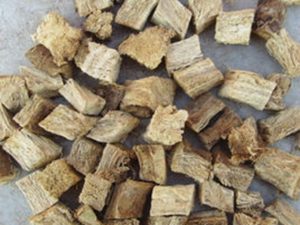
1. Dried Dendrobium: This product consists of segments that are flattened cylindrical or cylindrical in shape. The surface is golden yellow, greenish-yellow, or brownish-yellow, with a luster; it features deep longitudinal grooves or ridges, and some may have visible brownish-black nodes. The cross-section is yellowish-white to yellowish-brown, with numerous scattered vascular dots. It has a faint odor, a bland or slightly bitter taste, and is sticky when chewed.
2. Fresh Dendrobium: These are cylindrical or flattened cylindrical segments with a diameter of 0.4–1.2 cm. The surface is yellowish-green, smooth or with longitudinal striations, and the flesh is succulent. It has a faint odor, a slightly bitter yet sweet aftertaste, and is sticky when chewed.
Botanical Information
Botanical Classification
Species of the genus Dendrobium in the Orchidaceae family, including Dendrobium chrysanthum, Dendrobium huoshanense, Dendrobium malleum, or Dendrobium fringatum.
Distribution Area
Distributed in Sichuan, Yunnan, Guizhou, Guangdong, Guangxi, Hubei, and other regions; also found in Shaanxi, Henan, Jiangxi, and other areas.