Misuihua, a name in traditional Chinese medicine. It refers to the stems and leaves of Euryachinensis R.Br., a plant in the genus Euryachinensis of the family Theaceae. The plant is distributed in Jiangxi, Fujian, Taiwan, Hunan, Guangdong, Guangxi, Guizhou, and other regions. It has the effects of clearing heat, removing dampness, detoxifying, and promoting the healing of sores.It is primarily used to treat common cold with fever, damp-heat jaundice, sores, abscesses, and toxic swellings, burns and scalds, snake and insect bites, and bleeding from external injuries.

Mi Sui Hua
Misuihua, a name in traditional Chinese medicine. It refers to the stems and leaves of Euryachinensis R.Br., a plant in the genus Euryachinensis of the family Theaceae. The plant is distributed in Jiangxi, Fujian, Taiwan, Hunan, Guangdong, Guangxi, Guizhou, and other regions. It has the effects of clearing heat, removing dampness, detoxifying, and promoting the healing of sores.It is primarily used to treat common cold with fever, damp-heat jaundice, sores, abscesses, and toxic swellings, burns and scalds, snake and insect bites, and bleeding from external injuries.
Chinese Name : 米碎花
Latin Name : Eurya chinensis R. Br.
Aliases : Xialaye in *Compendium of Chinese Herbal Medicines*, Misuizai in *Fujian Materia Medica*, and Daitcha in *Catalog of Medicinal Plants of Guangxi*.
Authentic Producing Area : Southern China
Nature, Flavor & Meridian Tropism : Taste: sweet, bland; slightly astringent; nature: cool. Enters the Lung and Liver meridians
Benefits & Efficacy
Benefits
Clears heat and removes dampness; detoxifies and promotes wound healing.
Indications
Common cold with fever, damp-heat jaundice, sores, abscesses, and toxic swellings; burns and scalds; snake and insect bites; and bleeding from external injuries.
Usage and Dosage
Internal use: Decocted as a soup, 15–30 g. External use: As needed; decocted in water for washing; ground into a powder and applied as a poultice; or pounded fresh and applied as a poultice.
Precautions
Not yet established.
Relevant Discussions
1. *Compendium of Chinese Herbal Medicines*: “Clears heat and detoxifies; removes dampness and promotes wound healing; prevents influenza; used externally to treat burns, scalds, and pustular skin conditions.”
2. *Fujian Materia Medica*: “Dispels wind, removes dampness, and detoxifies. Prevents and treats colds, chest tightness, burns, pustular skin conditions, and trauma.”
Applications
Related Compatibility
1. To prevent influenza: 6 g each of Shrimp-Eye Herb and Honeysuckle, and 3 g of Roadside Chrysanthemum. Decoct in water and drink. (*Medicinal Herbs of Huiyang District, Guangdong Province*)
2. To treat nasopharyngeal cancer: 30 g of Shrimp-Eye Herb and 45 g of White Eyebrow Bean. Decoct in water and drink as a tea substitute as an adjunctive treatment. (*Medicinal Herbs of Huiyang District, Guangdong Province*)
3. To treat burns from water or fire: Dry the leaves of *Shrimp-Eye* in the sun, grind into a powder, mix with tea oil, and apply topically to the affected area. (*Traditional Chinese Medicinal Herbs of Huiyang Region, Guangdong Province*)
Processing & Preparation
Harvesting & Processing
Can be harvested year-round; use fresh or sun-dried.
Crude Drug Identification
Botanical Information
Botanical Classification
Mi Sui Hua, a plant of the genus *Lithocarpus* in the family Theaceae.
Morphological Characteristics
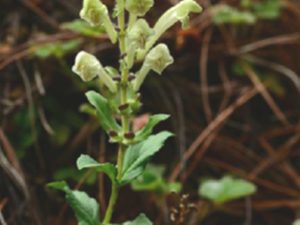
A small shrub, growing up to 1.5 m tall. Young branches are two-angled, and both the branches and terminal buds bear short soft hairs. Simple leaves are alternate; petioles are 2–3 mm long; leaf blades are thin and leathery, obovate or obovate-elliptic, 2–5.5 cm long and 1–2 cm wide, with a short acute apex, a gradually narrowing base, and margins densely covered with fine serrations.Flowers are unisexual, with separate male and female plants; 1–4 flowers are axillary; flowers are white to yellowish-green; sepals are 5, ovate, persistent, and glabrous; male flowers have minute bracts, petals that are obovate, 3–3.5 mm long, and approximately 15 stamens, with or without a rudimentary ovary;in female flowers, the petals are ovate, 2–2.5 mm long, with no stamens; the ovary is glabrous, the style is 1.5–2 mm long, and the apex is shallowly 3-lobed. The berry is globose, approximately 4 mm in diameter, and black when ripe. Flowering occurs in April, and fruiting occurs from July to August.
Distribution Area
Distributed in Jiangxi, Fujian, Taiwan, Hunan, Guangdong, Guangxi, Guizhou, and other areas.