Wuling Shen is the name of a traditional Chinese medicine. It is the sclerotium of *Anthracus nigricans*, a fungus belonging to the genus *Anthracus* in the family Anthracaceae. This herb has a sweet taste and neutral nature; it enters the Heart and Liver meridians. It has the effects of calming the mind, stopping bleeding, and lowering blood pressure. It is primarily used to treat insomnia, palpitations, hematemesis, epistaxis, hypertension, and burns.

Wuling Shen
Wuling Shen is the name of a traditional Chinese medicine. It is the sclerotium of *Anthracus nigricans*, a fungus belonging to the genus *Anthracus* in the family Anthracaceae. This herb has a sweet taste and neutral nature; it enters the Heart and Liver meridians. It has the effects of calming the mind, stopping bleeding, and lowering blood pressure. It is primarily used to treat insomnia, palpitations, hematemesis, epistaxis, hypertension, and burns.
Chinese Name : 乌灵参
Aliases : Black Poria, Lei Zhen Zi, Black Ginseng, Chicken (Earth-Bound) Egg, Ground Charcoal Stick, Chicken Poria
Nature, Flavor & Meridian Tropism : Sweet in taste, neutral in nature; enters the Heart and Liver meridians
Benefits & Efficacy
Benefits
Calms the mind, stops bleeding, and lowers blood pressure.
Indications
Insomnia, palpitations, hemoptysis, epistaxis, hypertension, burns.
Usage and Dosage
1. Internal use: Decoct 3–10 g. 2. External use: Take an appropriate amount, grind into a powder, and apply as a paste mixed with sesame oil.
Precautions
Contraindicated for pregnant women.
Relevant Discussions
1. *Guanxian County Annals*: “It can tonify qi.”
2. *Compendium of Sichuan Chinese Medicinal Herbs* (1960 edition): “Dispels dampness and calms the mind; tonifies the Heart and Kidney; promotes urination; alleviates palpitations; stimulates lactation; treats insomnia, epistaxis, and postpartum hemorrhage.”
Applications
Clinical Applications
1. For insomnia: 15 g of Wuling Shen, 12 g of Poria, combined with sour jujube seeds and other ingredients.
2. For low milk production: 25 g of Wuling Shen, 1 pair of pig’s front hooves; stew into a soup and consume.
3. For deficiency of the heart and kidneys: 1 Wuling Shen, 1 pig’s heart, and 1 pig’s kidney; stew into a soup and consume. (*Comprehensive Handbook of Medicinal Herbs for Medicinal Dishes*)
Notes
Patients requiring treatment with traditional Chinese medicine should first consult a licensed TCM hospital, where a TCM practitioner will conduct a professional diagnosis and prescribe the appropriate herbal formula.
Processing & Preparation
Harvesting & Processing
In spring and summer, dig up the underground sclerotia, wash off dirt and sand, air-dry, and set aside for later use.
Processing Methods
Remove impurities, soak until thoroughly softened, cut into thick slices, and dry.
Storage Methods
Place in a bamboo basket and store in a dry, cool, and well-ventilated area.
Crude Drug Identification
Properties of Crude Drugs
The sclerotia are spherical, elliptical, or ovoid, occasionally flat and block-shaped, 4–10 cm long and 1–7 cm in diameter. The surface is dark brown or black, slightly glossy, and densely covered with irregular fine wrinkles.One end has a circular depression resembling a “belly button,” while the other end has a protruding scar from the stalk, the tip of which often splits open to resemble a bird’s beak. The body is relatively firm and not easily broken; the fracture surface is uneven, white or yellowish-white, with a fine texture and slightly soft consistency. Occasionally, some specimens have coarse surface patterns, are light in weight, or are spongy or hollow inside. They have a distinctive odor and a sweet taste.
The best quality is characterized by fine surface patterns, a firm body, sinking when placed in water, and a white interior—commonly known as “fine-patterned goods”; the next best quality has coarser surface patterns, a lighter body, and sinks halfway when placed in water—commonly known as “second-grade goods”; the lowest quality has rough surface patterns, a light and spongy body, does not sink when placed in water, and has brownish-yellow flesh—commonly known as “coarse-patterned goods.”
Properties of Processed Slices
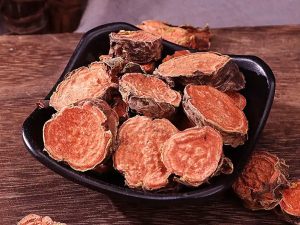
This product consists of irregular, thick slices. The outer skin is black, with fine or coarse wrinkles. The cut surface is white or yellowish-white. The texture is fine and slightly chewy. It has a distinctive fungal aroma and a mild flavor.
Botanical Information
Botanical Classification
Black-stemmed Charcoal Horn Fungus (a fungus of the genus Charcoal Horn Fungus in the family Charcoal Horn Fungus).
Morphological Characteristics
Black-stemmed Charcoal Horn Fungus, also known as Black-stemmed Deer-antler Fungus (*Names of Spore-bearing Plants: Supplement*). The mycelium is white, 8–14 μm in diameter, interwoven into a network, and densely distributed within the abandoned nests of black-winged soil termites.Upon maturity, portions of the mycelium aggregate to form a sclerotium. The sclerotium is spherical, ovoid, or egg-shaped, hence its common name “chicken (or earth) egg.” Its exterior is brown or black, with a diameter of 1.5–8 cm. A circular indentation marks the point of attachment to the mycelium; as the sclerotium matures, it gradually detaches from the mycelium, forming a “belly button”-like depression.The interior of the sclerotium is white, fleshy, and soft, with a fragrance similar to that of the chicken (soil) mushroom. It has a sweet taste. The upper end of the sclerotium has a stalk that hangs from the upper wall of the termite nest and is connected to the pseudorhiza. The pseudorhiza is cylindrical or flattened cylindrical, 2–3 mm in diameter, black on the outside and white on the inside, often branched, and grows in a winding, sprawling manner through the soil.They connect to the stem of the fruiting body at the top. The fruiting bodies grow scattered or in clusters on the ground; they are mostly unbranched, though occasionally branch from the stem. They are cylindrical, with a total height (including the stem) of 4–18 cm; the stem is 1–6 cm long and 2–5 mm in diameter, with a black exterior, grayish-white interior, and a black center. The fruiting body is club-shaped, 3–12 cm long and 2.5–7 mm in diameter,slightly thicker in the middle and rounded at the tip. Initially grayish-white, they later turn brown. The outer surface features wart-like ascomata; the ascomata are elliptical and embedded in the outer layer of the stroma, with the ascomata protruding outward and black wart-like ostia. The ascomata contain numerous, subglobose spores that turn blackish-brown when mature, and the paraphyses are either single or branched.
Distribution Area
It is distributed in Jiangsu, Zhejiang, Jiangxi, Taiwan, Guangdong, Sichuan, and Yunnan in China.