
Chuanxiong is a Chinese medicinal herb. It is the dried rhizome of Ligusticum chuanxiong Hort., a plant in the Apiaceae family. The geo-authentic herb specifically refers to Chuanxiong produced in the central hilly plains of the Sichuan Basin, including areas such as Dujiangyan, Pixian, Pengzhou, Shifang, Chongzhou, Qionglai, and Meishan. This herb supports healthy blood circulation and qi movement, and helps with occasional discomfort caused by wind. It is traditionally used to support normal chest and rib area comfort, help with occasional swelling and discomfort from minor bumps and bruises, support menstrual regularity and comfort, maintain abdominal comfort, and support head and joint comfort.
Benefits and Functions
Function
supports healthy blood circulation and promotes the smooth flow of Qi. helps maintain a balanced internal environment and assists with occasional discomfort.
Primary Functions
helps with occasional chest discomfort, supports relief from stabbing sensations in the chest and rib area, aids in soothing swelling and pain from minor bumps and bruises, promotes a normal menstrual cycle, helps maintain regular menstruation and comfort during periods, supports abdominal comfort, helps with occasional head discomfort, and supports joint and muscle comfort related to wind-dampness.
Usage and Dosage
1. Oral administration: decoct in water, 3–10g; grind into powder, 1–1.5g per dose; or made into pills or powders.
2. External use: Grind into powder and sprinkle; or decoct as a mouth rinse.
Adverse Reactions
There are individual case reports of allergic reactions caused by Ligusticum chuanxiong (Chuanxiong), with clinical manifestations including skin itching, small red papules, chest tightness, and shortness of breath; there are also individual case reports of severe headache caused by high-dose administration.
Precautions
For patients requiring Chinese herbal support, the first step is to consult at a licensed TCM hospital. After professional TCM pattern differentiation, a qualified practitioner will prescribe an appropriate herbal formula.
Chemical composition
Mainly contains lactone compounds: Levistolide A, Ligustilide, 3-Butylphthalide, Butylidenephthalide, Senkyunolide, Neocnidilide, Diligustilide; nitrogen-containing compounds: Tetramethylpyrazine (Ligustrazine), Perlolyrine (Chuanxiongindole); phenolic acid compounds: Ferulic acid, Caffeic acid, Chuanxiong phenol; also contains Sabinene, etc.
Pharmacological Actions
This product supports healthy blood flow properties, promotes normal vascular function, and contributes to cardiovascular and cerebrovascular health.
toxicological effects
A single oral administration of Ligusticum chuanxiong (Chuanxiong) water decoction at 53.2 g/kg was given to mice, and no deaths or abnormal findings were observed over 2 weeks. When the decoction was administered at doses of 4.5, 13.5, and 22.5 g/kg for 9 consecutive days, the 22.5 g/kg dose resulted in fetal death in early-pregnancy mice, suggesting that caution is advised for use during pregnancy.
Related Discussions
1.According to the *Divine Farmer’s Materia Medica*, this substance supports healthy brain function during wind-related discomfort, helps maintain normal head comfort, supports the body’s response to cold-induced stiffness, aids in relaxing occasional muscle tension, promotes the natural recovery of minor skin injuries, and supports women’s reproductive health and regular menstrual cycles.
2.From the Mingyi Bielu: supports a balanced internal environment, helps maintain comfortable head and face sensations, assists with occasional tearing and nasal discharge, promotes a clear and steady mental state, supports warmth in the middle burner, and aids in maintaining comfort in the chest, abdomen, and rib area.
3. *Bencao Gangmu (Compendium of Materia Medica)*: “Chuanxiong (*Ligusticum chuanxiong*, Szechuan Lovage Root) is a Qi-regulating herb within the blood domain. The Liver dislikes states of urgency, and the acrid nature of this herb helps support the Liver’s normal function, making it suitable for individuals with Blood Deficiency patterns. Its acrid quality also assists in dispersing constrained Qi, thus it is appropriate for those with Qi Stagnation patterns.”
Clinical Applications
Clinical Applications
1. For patterns of Heart Vessel Blood Stasis presenting with chest discomfort and occasional pain, it is often used together with Salvia miltiorrhiza (Danshen), Cinnamomum cassia (Guizhi), and Santalum album (Tanxiang); for Liver Qi Stagnation presenting with rib-side discomfort, it is often combined with Bupleurum chinense (Chaihu), Paeonia lactiflora (Baishao), and Cyperus rotundus (Xiangfu), as in the formula Chaihu Shugan San (Bupleurum Liver-Soothing Powder) from *Jing Yue Quan Shu* (Complete Works of Jing Yue); for Liver Blood Stasis presenting with abdominal masses and fullness and stabbing pain in the chest and ribs, it is frequently used together with Persicae semen (Taoren) and Carthamus tinctorius (Honghua), as in the formula Xuefu Zhuyu Tang (House of Blood Stasis-Expelling Decoction) from *Yi Lin Gai Cuo* (Corrections of Errors in Medical Forests). For trauma from falls and contusions with bruising, swelling, and pain, it may be combined with Boswellia carterii (Ruxiang), Commiphora myrrha (Moyao), and Panax notoginseng (Sanqi).
2. To support healthy blood circulation and help with occasional menstrual discomfort associated with blood stasis, it is often combined with Chi Shao (Paeonia lactiflora, Red Peony) and Tao Ren (Prunus persica, Peach Kernel), as in Xuefu Zhuyu Tang (Blood-Stasis Expelling Decoction, from *Yilin Gaicuo*). For patterns involving Cold Congealing with Blood Stasis, it may be combined with Gui Xin (Cinnamomum cassia, Cinnamon Bark) and Dang Gui (Angelica sinensis, Chinese Angelica), as in Wenjing Tang (Warm the Menses Decoction, from *Furen Liangfang*). To support postpartum recovery and normal uterine discharge, and to help with occasional abdominal discomfort due to blood stasis, it may be combined with Dang Gui, Tao Ren, Pao Jiang (Zingiber officinale, Processed Ginger), etc., as in Shenghua Tang (Generation and Transformation Decoction, from *Fu Qingzhu Nüke*). To help maintain regular menstrual cycles, whether early or delayed, it may be combined with Yi Mu Cao (Leonurus japonicus, Motherwort) and Dang Gui, as in Yimu Shengjin Dan (Motherwort Supreme Gold Pill, from *Yixue Xinwu*).
3. For head discomfort due to wind-cold pattern, combine with Notopterygium incisum (Qianghuo), Asarum heterotropoides (Xixin), and Angelica dahurica (Baizhi), as in Chuanxiong Chatiao San (Chuanxiong Mixture for Dispelling Wind from the Head) from *Prescriptions of the Bureau of Taiping People’s Welfare Pharmacy*; for head discomfort due to wind-heat pattern, combine with Chrysanthemum morifolium (Juhua), Gypsum fibrosum (Shigao), and Bombyx batryticatus (Jiangcan), as in Chuanxiong San (Chuanxiong Powder) from *Precious Mirror of Health*; for head discomfort due to wind-damp pattern, combine with Notopterygium incisum (Qianghuo), Angelica pubescens (Duhuo), and Saposhnikovia divaricata (Fangfeng), as in Qianghuo Shengshi Tang (Notopterygium Decoction for Overcoming Dampness) from *Clarifying Doubts about Internal and External Injuries*; for head discomfort due to blood deficiency pattern, utilize this herb’s action of dispelling wind and supporting comfort, combine with Angelica sinensis (Danggui) and Paeonia lactiflora (Baishao), as in Jiawei Siwu Tang (Augmented Four-Substance Decoction) from *Golden Cabinet Wings*; for head discomfort due to blood stasis pattern, combine with Paeonia lactiflora root (Chishao) and Moschus (Shexiang), as in Tongqiao Huoxue Tang (Unblock the Orifices and Invigorate Blood Decoction) from *Corrections on Medical Errors*.
Related Compatibility (Xiangguan Peiwu)
1. *Ligusticum chuanxiong* (Chuanxiong) paired with *Lindera aggregata* (Wuyao): Chuanxiong is acrid, warm, aromatic, and dispersing, capable of ascending and descending—rising to the crown of the head and descending to the blood sea (Xuehai). It is a Qi medicine within the blood, excelling at promoting blood circulation. Wuyao is acrid, dispersing, warm, and unblocking, ascending to the Spleen and Lung, descending to the Liver and Kidney, with the ability to move Qi, disperse cold, and support comfort—leaning toward moving Qi. When combined, these two herbs work together to support healthy blood circulation, remove blood stasis, promote Qi flow, and help with occasional discomfort. This combination is suitable for patterns of Qi Stagnation and blood stasis that may manifest as menstrual irregularities, occasional menstrual discomfort, and other related concerns that support normal menstrual health.
2. Chuanxiong (Ligusticum chuanxiong) paired with Danggui (Angelica sinensis): Chuanxiong is acrid, warm, and slightly drying, with a tendency to invigorate blood and move Qi; Danggui is sweet, tonifying, acrid, and dispersing, with a moist and enriching nature, leaning toward nourishing and harmonizing blood. When used together, these two herbs combine the actions of invigorating blood, nourishing blood, and moving Qi, while balancing moisture and dryness. This allows the formula to dispel stasis without consuming Qi and blood, and to nourish blood without causing blood stagnation or Qi obstruction. Together, they support healthy blood circulation and harmonize blood function. This combination is suitable for occasional discomforts associated with blood deficiency and blood stasis patterns, such as headaches, menstrual irregularities, painful menstruation, amenorrhea, postpartum abdominal discomfort due to blood stasis, and discomfort from wind-dampness affecting movement.
3. Ligusticum chuanxiong (Chuanxiong) paired with Paeonia lactiflora (Baishao): Chuanxiong, acrid, warm, aromatic, and dispersing, helps promote blood circulation and move Qi, with a tendency to ascend and disperse. Baishao, slightly bitter and mildly sour, nourishes blood and preserves Yin, with a tendency to astringe and gather. When used together, these two herbs support both blood circulation and blood nourishment, and simultaneously helps with occasional and soften the Liver. This combination helps promote blood circulation and helps with occasional stagnation without affecting healthy energy, and helps with occasional the Liver to helps with occasional stagnation without harming Liver Yin. It is suitable for supporting healthy menstrual function during occasional irregularity or absence related to insufficient Liver blood or Liver Yin, and for helping with chest and rib discomfort, occasional menstrual irregularity, and menstrual discomfort associated with Liver Qi Stagnation and blood stasis.
Differentiation of Medicinals
Raw Ligusticum chuanxiong (Chuanxiong): The raw form has a stronger acrid and aromatic dispersing nature. It is traditionally used to support healthy blood circulation and Qi movement, and to help maintain comfort from occasional wind-related influences. It is commonly used to support the body in situations of discomfort due to blood stasis and Qi Stagnation. Wine-processed Ligusticum chuanxiong (Chuanxiong): The wine processing guides the herb’s effects upward and enhances its ability to support blood circulation, Qi movement, and comfort. It is clinically used to support the body in addressing occasional head discomfort, chest and rib discomfort, menstrual irregularities and discomfort associated with Qi Stagnation and blood stasis, as well as supporting recovery from minor injuries and discomfort in muscles and bones.
related medicinal products
Qingxuan Tablet (supports Mental Clarity) (Pill), Suxiao Jiuxin Pill (supports Heart Health), Nao’an Granule (supports Brain Function) (Capsule), Xiaoshuan Tongluo Capsule (supports Healthy Circulation) (Granule, Tablet), Kanli Sand (supports Local Comfort)
Related Formulas
1. Chaihu Shugan San (Bupleurum Liver-Coursing Powder) (from *Zhengzhi Zhunsheng*, citing *Yixue Tongzhi*)
Herbal Ingredients: Bupleurum chinense (Chaihu), Paeonia lactiflora (Baishao), Cyperus rotundus (Xiangfu), Citrus aurantium (Zhiqiao), Citrus reticulata (Chenpi), Ligusticum chuanxiong (Chuanxiong), Glycyrrhiza uralensis (Zhigancao).
Functions: Helps helps with occasional the Liver and helps with occasional Qi Stagnation. supports the smooth flow of Qi and helps with occasional discomfort. Suitable for signs of imbalance associated with Liver Qi Stagnation, such as rib-side discomfort, alternating chills and fever, epigastric and abdominal distension and fullness, and a wiry pulse.
2. Tongqiao Huoxue Tang (Orifice-Opening Blood-Activating Decoction, from *Correction of Errors in Medical Classics*)
Ingredients: Paeonia lactiflora (Red Peony Root), Ligusticum chuanxiong (Szechwan Lovage Rhizome), Prunus persica (Peach Kernel), Carthamus tinctorius (Safflower), Allium fistulosum (Scallion), Zingiber officinale (Fresh Ginger), Ziziphus jujuba (Chinese Date), Moschus (Musk), Yellow Wine (Huangjiu).
Actions and Applications: supports healthy blood circulation and helps maintain openness of the orifices. Applicable for the pattern of Blood Stasis Obstructing the Head and Face. supports individuals with occasional headache, dizziness, hearing discomfort, hair thinning, facial bluish-purple discoloration, facial redness, and skin depigmentation. It also supports women with blood stasis patterns (dry blood taxation) presenting with emaciation, and children with nutritional accumulation (infantile malnutrition) presenting with muscle wasting, abdominal distension with visible veins, and intermittent sensations of warmth.
3. Chuanxiong San (Ligusticum Powder) from *Weisheng Baojian* (Precious Mirror of Health)
Ingredients: Ligusticum chuanxiong (Chuanxiong), Chrysanthemum morifolium (Juhua), Gypsum (Shigao), Bombyx batryticatus (Jiangcan).
Functions and Benefits: supports the body’s natural ability to disperse wind and clear heat. helps maintain a balanced internal environment. Beneficial for occasional head discomfort, eye irritation, and throat discomfort associated with external wind-heat patterns.
4. Chuanxiong Chatiao San (from the Prescriptions of the Bureau of Taiping People’s Welfare Pharmacy)
Formula Ingredients: Ligusticum chuanxiong (Chuanxiong), Angelica dahurica (Baizhi), Saposhnikovia divaricata (Fangfeng), Asarum sieboldii (Xixin), Notopterygium incisum (Qianghuo), Schizonepeta tenuifolia (Jingjie), Mentha haplocalyx (Bohe), Glycyrrhiza uralensis (Gancao), Camellia sinensis (tea).
Actions and Indications: supports the body’s ability to disperse wind and helps with occasional discomfort. Assists in maintaining normal comfort in the head and vertex area, particularly when associated with external wind exposure. Helps support the body’s natural response to chills and mild fever, helps maintain clear vision and open nasal passages, and may be used when the tongue coating is thin and white and the pulse is floating.
5. Shen Tong Zhu Yu Tang (Body Pain and Stasis-Expelling Decoction) (from *Correcting the Errors in the Medical Forest*)
Herbal ingredients: Gentiana macrophylla (Qinjiao), Ligusticum chuanxiong (Chuanxiong), Prunus persica (Taoren), Carthamus tinctorius (Honghua), Glycyrrhiza uralensis (Gancao), Notopterygium incisum (Qianghuo), Commiphora myrrha (Moyao), Angelica sinensis (Danggui), Trogopterus xanthipes (Wulingzhi), Cyperus rotundus (Xiangfu), Achyranthes bidentata (Niuxi), Pheretima aspergillum (Dilong).
Function and Indications: Promotes blood circulation and Qi movement, supports comfortable movement of the body and helps with occasional discomfort. Suitable for patterns of blood stasis and Bi (obstruction) in the meridians. supports shoulder, arm, lower back, leg, or general body discomfort that persists over time.
Modern Research
1. For conditions of compromised cerebral blood flow: Compound preparations primarily containing Ligusticum chuanxiong (Chuanxiong), such as Xiaoshuantongluo Capsules, are commonly used to support healthy cerebral circulation.
2. Cardiovascular support: Compound formulas containing *Ligusticum chuanxiong* (Chuanxiong) as the main ingredient (e.g., Suxiao Jiuxin Wan [Quick-Acting Formula for Heart Comfort], Tongmai Granules [Meridian-Supporting Granules], etc.) are commonly used to help maintain normal Heart function.
3. To support joint and soft tissue health: A compound preparation with Ligusticum chuanxiong (Chuanxiong) as the main ingredient (e.g., Shenyang Hong Yao [Shenyang Red Medicine]) is commonly used to help maintain comfortable movement of joints and soft tissues, and to support normal uric acid metabolism.
4. Occasional Discomforts and Head Tension: Formulas containing Ligusticum chuanxiong (Chuanxiong) as the main ingredient, such as Chuanxiong Chatiao San (Chuanxiong Mixture for Regulating and Dispersing), are commonly used to support the body’s natural balance during occasional head tension, nasal congestion, and mild dizziness, as well as promoting comfort in cases of periodic head discomfort.
Furthermore, Ligusticum chuanxiong (Chuanxiong) supports healthy functions in cases of occasional head discomfort, balance issues, speech recovery, hearing health, and eye health.
Note
Reference materials:
[1] Zhang Zhiguo, Yang Lei, Wu Ping, Gao Yuanfeng, eds. Common Terms and Atlas for Empirical Identification of Chinese Materia Medica [M]. 2022:98-99.
[2] Edited by Peng Cheng. National Ordinary Higher Chinese Medicine Colleges Pharmacy Major 14th Five-Year Plan Textbook: Pharmacology of Chinese Materia Medica, 3rd Edition [M]. 2024:201-203.
[3] Li Xue, Yu Liwei, Bai Fengyun, Song Yijun, and Ao Qiang, eds. *Traditional Shaanxi Processing Techniques of Chinese Materia Medica*. 2024:67–68.
[4] Guo Lanping, Huang Luqi (eds.). Research on Production Technical Specifications of Dao-di Herbs [M]. 2023:91-95.
[5] Chinese Pharmacopoeia Commission. Clinical Medication Instructions of the Pharmacopoeia of the People’s Republic of China: Chinese Herbal Pieces Volume (2020 Edition) [M]. Beijing: China Medical Science and Technology Press, 2022:824-827.
[6] China Association of Chinese Medicine. General Principles for Compiling Standards of Dao-di Herbs [S]. Beijing: China Association of Chinese Medicine, 2019:222-229.
Processing and Preparation (Paozhi)
Harvesting and Processing
In summer, when the nodes on the stem are prominently protruding and slightly purple, dig it up, remove soil and sand, sun-dry then oven-dry, and then remove fibrous roots.
Processing Methods
1. Chuanxiong (Ligusticum chuanxiong): Take the raw material, remove impurities, separate large and small pieces, soak until 40–50% saturated, wash clean, moisten thoroughly until fully soft, cut into thin slices, and air dry or dry at low temperature.
2. Wine-processed Chuanxiong: Take clean slices of Chuanxiong (Ligusticum chuanxiong), mix thoroughly with yellow rice wine, allow to moisten thoroughly, then place in a pan and stir-fry over gentle heat until dry. Remove and let cool. For every 100 kg of Chuanxiong, use 10 kg of yellow rice wine.
3. Stir-fried Ligusticum chuanxiong (Chuanxiong): Take clean slices of Ligusticum chuanxiong (Chuanxiong), place in a wok, and stir-fry over gentle heat until yellow or slightly scorched. Remove and allow to cool.
4. Bran-fried Ligusticum chuanxiong (Chuanxiong): Heat the wok, sprinkle wheat bran until smoke rises, then add Ligusticum chuanxiong slices and stir-fry until deep yellow. Remove, sift out the bran, and allow to cool. For every 100 kg of Ligusticum chuanxiong slices, use 18 kg of wheat bran.
Storage Method
Store in a dry container, sealed, in a cool and dry place. Protect from insects.
Herbal Identification
Differentiation
1. Transverse section: Cork layer consists of over 10 rows of cells. Cortex narrow, scattered with root trace vascular bundles, their cambium distinct. Phloem broad, cambium ring wavy or irregularly polygonal. Xylem vessels polygonal or subrounded, mostly in single rows or arranged in a “V” shape, occasionally with wood fiber bundles. Pith relatively large. Parenchyma scattered with numerous oil cavities, subrounded, elliptical, or irregular in shape, pale yellowish-brown; oil cavities smaller near cambium, gradually larger outward. Parenchyma cells rich in starch grains; some parenchyma cells contain calcium oxalate crystals, appearing as subrounded masses or subclustered crystal aggregates.
The powder is pale yellowish-brown or grayish-brown. Starch granules are abundant, individual granules are elliptical, oblong, subglobose, ovoid, or reniform, 5–16 μm in diameter, about 21 μm in length; hilum punctate, long slit-like, or V-shaped; occasionally compound granules are present, composed of 2–4 components. Calcium oxalate crystals are found in parenchyma cells, appearing as subrounded masses or cluster crystal-like forms, 10–25 μm in diameter. Cork cells are dark yellowish-brown, polygonal in surface view, with slightly wavy-curved walls. Oil cavities are mostly broken; occasionally fragments of oil cavities are observed, with thin-walled secretory cells containing numerous oil droplets. Vessels are mainly spiral vessels, also reticulate and scalariform vessels, 14–50 μm in diameter.
2. Take 1 g of the powder of this product, add 5 ml of petroleum ether (30–60°C), let it stand for 10 hours with occasional shaking, then allow it to settle. Take 1 ml of the supernatant, evaporate to dryness, dissolve the residue in 1 ml of methanol, then add 2–3 drops of a 2% solution of 3,5-dinitrobenzoic acid in methanol and 2 drops of a methanol-saturated potassium hydroxide solution. A red-purple color appears.
3. Take 1 g of the powder of this product, add 20 ml of diethyl ether, heat under reflux for 1 hour, filter, evaporate the filtrate to dryness, and dissolve the residue in 2 ml of ethyl acetate to prepare the test solution. Separately, take 1 g of the reference crude drug of Ligusticum chuanxiong (Chuanxiong) and prepare the reference crude drug solution by the same method. Then take the reference substance of Levistolide A, and dissolve it in ethyl acetate to produce a solution containing 0.1 mg per 1 ml (place in a brown volumetric flask) to prepare the reference substance solution. Perform the test according to the method for thin-layer chromatography (General Rule 0502). Draw 10 μl each of the three solutions described above and spot them separately onto the same silica gel GF254 TLC plate. Use n-hexane-ethyl acetate (3:1) as the developing solvent. After development, remove the plate, allow it to air dry, and examine under UV lamp (254 nm). In the chromatogram of the test solution, spots of the same color appear at positions corresponding to those in the chromatograms of the reference crude drug solution and the reference substance solution.
Medicinal Material Characteristics
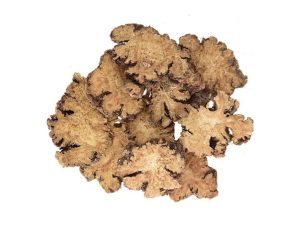
This product consists of irregular nodular fist‑shaped lumps, 2–7 cm in diameter. The surface is grayish‑brown or brown, rough and wrinkled, with numerous parallel raised nodes. At the apex there is a depressed, approximately circular stem scar, and on the lower side and on the nodes there are numerous small tubercular root scars. The texture is hard and firm, not easily broken. The fractured surface is yellowish‑white or grayish‑yellow, scattered with yellowish‑brown oil cavities, and the cambial ring is wavy. The odor is strong and aromatic; the taste is bitter and acrid, with a slight numbing sensation on the tongue and a mild aftertaste of sweetness.
Characteristics of Decoction Pieces
1. Ligusticum chuanxiong (Chuanxiong): This product appears as irregular thick slices. The outer surface is grayish-brown or brown with wrinkled striae. The cut surface is yellowish-white or grayish-yellow, showing distinct wavy annular striae or polygonal markings, with scattered yellowish-brown oil spots. The texture is firm. It has a strong aromatic odor and a taste that is bitter, acrid, and slightly sweet.
2. Wine-processed Ligusticum chuanxiong (Chuanxiong): Color deepens, with a slight wine aroma.
3. Stir-fried Chuanxiong (Ligusticum chuanxiong) and bran-fried Chuanxiong: They resemble Chuanxiong slices with a deepened color.
Botanical Information
Plant genus and species
Plant of the genus Ligusticum in the Apiaceae family.
Morphological Characteristics
Perennial herb, 40–70 cm tall, with a strong aromatic odor throughout the entire plant. The rhizome consists of irregular, nodular, fist-shaped masses, with numerous fibrous roots at the lower part. The stem is erect, cylindrical, hollow, with longitudinal grooves on the surface; the nodes at the lower part of the stem are enlarged and disc-shaped (commonly known as “lingzi”), while those above the middle are not enlarged. The lower stem leaves have petioles 3–10 cm long, with bases expanded into sheaths; the leaf blade is ovate-triangular in outline, 12–15 cm long, 10–15 cm wide, tripinnately to quadripinnately divided with 4–5 pairs of pinnae; pinnae are ovate-lanceolate, 6–7 cm long, 5–6 cm wide; ultimate segments are linear-lanceolate to long-ovate, 2–5 mm long, 1–2 mm wide, with a small mucronate tip, sparsely pubescent only on the veins. The upper stem leaves are gradually simplified. Compound umbels are terminal or lateral; involucral bracts are 3–6, linear, 0.5–2.5 cm long; rays are 7–20, unequal, 2–4 cm long; umbellets have 10–24 flowers; involucel bracts are 2–7, linear, slightly purple, pubescent, 3–5 mm long; calyx teeth are undeveloped; petals are white, obovate to elliptic, with a short mucronate apex and incurved; stamens are 5, anthers light green; styles are 2, 2–3 mm long, recurved downward. Young fruit is laterally compressed, 2–3 mm long, about 1 mm wide; dorsal vittae are 1–5, lateral vittae 2–3, commissural vittae 6–8. Flowering period is July–August, young fruit period is September–October.
Distribution Area
It is mainly cultivated in Jiangsu, Zhejiang, Jiangxi, Hubei, Hunan, Guangxi, Sichuan, Guizhou, Yunnan, Shaanxi, Gansu, and other regions.
authentic producing region
The central hilly plain area of the Sichuan Basin, including Dujiangyan, Pi County, Pengzhou, Shifang, Chongzhou, Qionglai, and Meishan in Chengdu.
Growing Environment
Concentrated in the basin’s central hilly plain region — including Dujiangyan, Pixian, Pengzhou, Chongzhou, Shifang, and Pengshan in Chengdu — the areas have an altitude of 500–700 m. The temperature ranges between 8–30°C, with no extreme heat in summer and no severe cold in winter. The ecological conditions in these regions, including climate, temperature, rainfall, and sunlight, are suitable for the growth of *Ligusticum chuanxiong* (Chuanxiong), making them appropriate zones for its production. The soil is mostly neutral or slightly acidic, with deep soil layers, good drainage and irrigation, and strong fertilizer retention capacity.
川芎って、四川盆地の限られた地域でしか育たないんですね。漢方薬に詳しい友達が「血の巡りを良くする」って勧めてくれたのを思い出しました。やっぱり産地が大事なんですね。勉強になります
I’ve always been fascinated by how the soil and climate of places like Dujiangyan give herbs like Chuanx
سبحان الله! هذه العشبة الصينية “تشوانشيونغ” رائعة، ولها تاريخ طويل في الطب التقليدي. من الجميل معرفة أنها تنمو في مناطق محددة في حوض سيتشوان، مما يعطيها جودة فريدة. هل جربها أحدكم من قبل؟
I’ve always been fascinated by how specific regions produce the best herbs—Chuanxiong from the Sichuan Basin sounds incredible. Does the local climate really change its medicinal properties that much? Would love to try some authentic stuff one day!
Interesting! I’ve used Chuanxiong in some herbal teas for circulation, but I never knew it was so specific to the Sichuan Basin region. The soil and climate must make a big difference in its potency. Have you tried any remedies with it?