
Introduction to Medicinal Diet
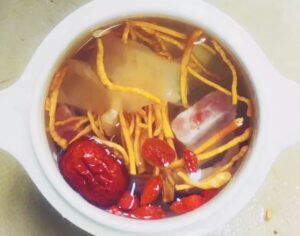
“Cordyceps, Dried Scallop, Corn, and Carrot Soup” is a classic nourishing medicinal cuisine that combines mountain delicacies with ocean flavors. Its core ingredients include cordyceps (typically Cordyceps militaris or Ophiocordyceps sinensis), dried scallops, sweet corn, and carrots. The soup has a golden, clear broth with a naturally sweet and savory taste, serving both as a daily soup and as a tonic dish that supports overall well-being. This soup is particularly popular in the Jiangnan and Lingnan regions, where it is typically slow-simmered to fully infuse the essence of the ingredients into the broth, making it a warming and comforting soup for all ages during autumn and winter.
Herbal Cuisine Benefits
The main benefits of this soup are to help nourish Yin, support Kidney health, strengthen the Spleen, and moisten the Lungs. Cordyceps sinensis (Dongchongxiacuo) enters the Lung and Kidney meridians, helping to support Lung Qi and nourish Kidney Essence (Jing). Dried scallop (Ganbei) is neutral in nature with a sweet and salty flavor; it helps nourish Yin and blood, supports Kidney health, and harmonizes the Middle Jiao (digestive system). Together, they support occasional lower back and knee comfort, as well as healthy breathing and energy levels, particularly when these are associated with lifestyle factors such as late nights, fatigue, or age-related changes. Corn and carrots help support Spleen function and harmonize the digestive system, promote healthy bowel regularity, aid the digestive process, and help helps maintain the accumulation of dampness that may arise from overly rich nourishment.
In addition, the soup is rich in high-quality protein, polysaccharides, beta-carotene, and various trace elements, which helps support the immune system, especially during seasonal transitions to promote occasional seasonal comfort. The corn silk (if retained in small amounts) also helps maintain normal fluid balance and supports occasional mild diuresis. Overall, the soup presents a “clear nourishing (Qing Bu)” characteristic, and even for individuals with a constitution prone to excess heat, moderate consumption helps maintain internal balance without causing discomfort.
Functions of Traditional Chinese Medicine
Harmonizes and tonifies the Lung and Kidney, supports the body’s ability to receive Qi and maintain comfortable breathing.
According to Traditional Chinese Medicine, “the Lungs govern Qi, while the Kidneys are the root of Qi.” *Cordyceps sinensis* (Dongchongxiacao) is sweet in taste, warm in nature, and enters the Lung (LU) and Kidney (KI) Meridians. It is a classic substance for gently tonifying the Lungs and Kidneys. For individuals experiencing occasional cough, shortness of breath, and wheezing aggravated by exertion during periods of temporary respiratory sensitivity, this soup supports healthy respiratory function by tonifying the Lungs and Kidneys. Dried scallop (Ganbei) also enters the Kidney Meridian, assisting *Cordyceps* in securing and astringing Kidney Qi, thereby supporting deep and powerful breathing.
supports healthy digestive function and appetite, and helps maintain normal moisture and fluid balance.
Corn (Zea mays) and carrots (Daucus carota), yellow in color, are considered to enter the Spleen meridian; they support healthy Spleen function and digestion. Their sweet flavor helps harmonize the middle burner and replenish vitality. Dried scallops possess a rich umami taste, which in TCM is described as “awakening the Spleen and stimulating the appetite.” The overall soup is neutral in nature, neither cold nor drying, making it suitable for consumption before meals by individuals seeking support for occasional digestive weakness and lack of appetite. The beta-carotene in the soup is more easily absorbed in the presence of fats (such as when simmered with a small amount of pork ribs or chicken), and is converted into vitamin A, which helps maintain healthy mucous membranes and normal vision.
Suitable for
1. Suboptimal health status, chronic sleep deprivation, and high work pressure among young and middle-aged individuals. This group often experiences lower back soreness, dry eyes, and lack of vitality. The Kidney-supporting and blood-nourishing properties of Ophiocordyceps sinensis (Cordyceps) and dried scallop (Ganbei) can help with occasional fatigue. 2. Elderly individuals with weak constitution, or those in recovery after wellness or postpartum. The soup is rich in nutrients and easy to digest, making it suitable for those needing gentle nourishment and having weaker digestive function. 3. Individuals with chronic respiratory concerns (such as occasional breathing difficulty) during non-acute phases. This may serve as supportive care to help maintain respiratory health. 4. Children and adolescents who need to support immune health (consume in moderation). However, note that corn kernels may pose a choking risk; it is recommended to cut corn into sections or use only the corn broth.
This soup is also recommended for women’s post-menstrual recuperation. The dried scallops nourish blood, carrots provide iron, and together with Cordyceps’ supportive effect on hormonal balance, they help maintain a healthy complexion and helps with occasional occasional dizziness after menstruation.
Contraindicated Populations
1. Individuals presenting with signs of imbalance associated with Excess Heat Patterns (such as fever, sore throat, yellow phlegm) should not consume this. Cordyceps and dried scallops are both tonifying in nature and may “close the door to trap the bandits” (retain pathogens), potentially exacerbating internal heat and inflammation. 2. Those with a Dampness-excess constitution, thick greasy tongue coating, sticky stools, or obvious edema should use caution. Although corn may help drain dampness, the cloying nature of dried scallops and cordyceps can easily contribute to Dampness and Phlegm. 3. Individuals with shellfish allergies should avoid dried scallops; they may be substituted with dried oysters or conpoy (dried scallop), but still be mindful of cross-allergic reactions. 4. Children’s digestive function is not yet fully mature; it is recommended that only those over three years old consume small amounts, and the soup should not be overly salted. For those in early pregnancy with an unstable constitution, it is best to consume under the guidance of a TCM practitioner to avoid discomfort caused by the blood-activating property of Cordyceps.
Proportions of food ingredients in the formula
(The following are precise amounts for 4 servings) Dried Cordyceps militaris (Yongchongcao, insect flower) 15 g; if using Cordyceps sinensis (Dongchongxiacao), use 2–3 g (approximately 6–8 pieces). Dried scallop (conpoy, Yaozhu) 30 g, soaked in warm water for 30 minutes in advance. One sweet corn (approximately 250 g), cut into sections or remove kernels. One carrot (approximately 150 g), peeled and cut into irregular chunks. Lean pork or chicken thigh 150–200 g (to enhance savory flavor, optional). Ginger 3 slices (approximately 10 g), salt to taste (season at the end). Water 1500–1800 ml.
Note: For a vegan version, meat may be omitted, and tofu or shiitake mushrooms may be used to enhance umami flavor, though the supportive properties may shift slightly. Wash the corn silk thoroughly and wrap it in cheesecloth before boiling together to better support healthy urinary function.
Preparation Method
Step 1: Prepare the Ingredients
Rinse the dried scallops, then soak in warm water until soft (about 30 minutes). Reserve the soaking liquid for later use. Rinse the cordyceps flowers twice under cold water and gently squeeze out excess moisture (do not soak for long to avoid nutrient loss). Wash the corn and cut into 3–4 cm sections. Cut the carrot into irregular chunks. Cut the lean meat or chicken into pieces, place in a pot with cold water, bring to a boil over high heat, skim off any foam, then remove and rinse clean.
Step 2: Combination and Simmering Place the blanched meat pieces, corn segments, carrot chunks, and ginger slices together in a stew pot (a clay pot or ceramic pot is preferred). Add the water used to soak the dried scallops along with enough clean water to cover. Bring to a boil over high heat, then reduce to low heat and simmer gently for 40 minutes.
Step 3: Add the Cordyceps militaris (Cordyceps flower) and dried scallop (干贝). Place the rehydrated dried scallop together with the Cordyceps militaris into the pot. Continue simmering over low heat for 20–25 minutes. Note that the Cordyceps militaris should not be added too early, as prolonged cooking at high heat may affect its active constituents.
Step 4: Season and finish. Five minutes before turning off the heat, add a small amount of salt according to personal taste (the saltiness should not be too strong, to preserve the sweetness of the soup). You may sprinkle in a small amount of Lycium barbarum (Goji Berry) (about 5g) for garnish, cover and let it simmer for 2 minutes. Finally, remove the Zingiber officinale (Ginger) slices and the Zea mays (Corn Silk) packet, then ladle into bowls and serve.
Drinking Tips
1. The best time to consume is on an empty stomach in the morning or before lunch, as the Spleen and Stomach’s transportation and transformation functions are stronger during these times, allowing full absorption of the herbal benefits. Consuming in the evening may increase nighttime urination; it is recommended to avoid fluids two hours before bedtime.
2. Leftover soup can be refrigerated for up to 2 days. When reheating, it must be brought to a full boil; repeated freezing and thawing is not recommended. If the beneficial properties diminish, you may add a small amount of fresh Cordyceps militaris (Chongcaohua) to enhance the flavor.
3. This soup falls under the category of ‘balanced supplementation’. It is advisable to consume it 2–3 times per week, and not for more than two consecutive weeks. If long-term health maintenance is needed, it is recommended to take a one-week break before resuming, to avoid excessive supplementation that may disrupt the body’s normal fluid metabolism.
Klingt nach einer interessanten Kombi! Ich hab noch nie mit Cordyceps gekocht, aber die Mischung aus Meeresfrüchten und süßem Gemüse macht mich neugierig. Ist der Geschmack sehr pilzig oder eher mild? Würde das gerne mal im Herbst ausprobieren –
This soup sounds amazing! I love how it blends mountain and ocean flavors. Cordyceps with dried scallops must give such a deep umami taste. Perfect for a nourishing winter meal—warming and good for the lungs and kidneys. Definitely adding this to my soup rotation!
This soup sounds like the perfect balance of earthy and sweet! I’ve always wanted to try cordyceps but wasn’t sure how to use it. Corn and carrots seem like a gentle way to introduce it. Can’t wait to make a batch for the family. Thanks for the recipe!
このスープ、めっちゃ気になる!冬の乾燥シーズンにぴったりそう。干し貝柱の旨味と冬虫夏草の組み合わせって贅沢すぎる。黄金色のスープ、想像しただけで体の芯から温まりそう。今度
This sounds delicious and nourishing! I love how it combines earthy cordyceps with sweet corn and carrot, plus the umami from dried scallops. Perfect for winter wellness. Has anyone tried this with cordyceps militaris instead of the wild variety? Curious about the taste difference!