Stir-Fried White Peony Root is a decoction piece produced by lightly stir-frying the traditional Chinese medicine White Peony Root. Compared to the raw form, the stir-frying process reduces its cold nature, making it more effective for nourishing the blood and the nutritive qi, consolidating yin, and stopping sweating, while also softening the liver and relieving pain. It is commonly used clinically to treat blood deficiency-induced pallor and weakness, spontaneous and night sweats, as well as abdominal pain and diarrhea caused by disharmony between the liver and spleen.

Roasted White Peony Root
Stir-Fried White Peony Root is a decoction piece produced by lightly stir-frying the traditional Chinese medicine White Peony Root. Compared to the raw form, the stir-frying process reduces its cold nature, making it more effective for nourishing the blood and the nutritive qi, consolidating yin, and stopping sweating, while also softening the liver and relieving pain. It is commonly used clinically to treat blood deficiency-induced pallor and weakness, spontaneous and night sweats, as well as abdominal pain and diarrhea caused by disharmony between the liver and spleen.
Chinese Name : 炒白芍
Authentic Producing Area : Mainly produced in Zhejiang and Anhui
Nature, Flavor & Meridian Tropism : It has a bitter and sour taste, a slightly cold nature, and enters the Liver and Spleen meridians
Benefits & Efficacy
Benefits
Fried White Peony Root has the effects of nourishing the blood and harmonizing the营, consolidating yin to stop sweating, and soothing the liver to relieve pain.
Indications
Fried White Peony Root is primarily used to treat blood deficiency with sallow complexion, abdominal pain with diarrhea, and spontaneous or night sweats.
Usage and Dosage
Clinically, Fried White Peony Root is typically decocted into a herbal decoction; the standard dosage is 6–15 g. Due to variations in each patient’s condition and constitution, the specific dosage of Fried White Peony Root may vary from person to person; patients should strictly adhere to the dosage prescribed by their physician.
Precautions
1. Before using Fried White Peony Root, a TCM physician must conduct a pattern differentiation to avoid blind use without proper diagnosis. During treatment, follow the principle of “discontinuing treatment once the condition is resolved.” If symptoms improve, promptly schedule a follow-up visit so that the physician can assess the situation and adjust the dosage or discontinue the medication to ensure treatment safety and efficacy. 2. If you need to take other medications concurrently while using Fried White Peony Root, consult your doctor or pharmacist first. Do not take other medications on your own, as this may cause drug interactions that could affect efficacy or increase the risk of adverse reactions. 3. Pregnant and breastfeeding women should proactively inform their doctor of their physiological status (such as stage of pregnancy or breastfeeding status) before using stir-fried white peony root. The doctor will then assess the safety and suitability of the medication based on individual circumstances. 4. Infants, young children, and the elderly should not take large doses over an extended period.
Applications
Medicinal Identification
Roasted White Peony Root must be distinguished from Raw White Peony Root and Wine-Processed White Peony Root. These three are different processed varieties of White Peony Root. Raw White Peony Root excels at nourishing the blood, consolidating yin, and subduing liver yang; it is used for blood deficiency-related menstrual irregularities, dysmenorrhea, headaches, and dizziness.Fried White Peony Root has a slightly milder nature; its primary functions are to nourish the blood, harmonize the营 (ying), consolidate yin, and stop sweating, while also softening the liver and relieving pain. It is used for blood deficiency with sallow complexion, spontaneous sweating, night sweats, abdominal pain, and diarrhea. Wine-processed White Peony Root has reduced sour and cold properties; it enters the blood division and excels at regulating menstruation, stopping bleeding, softening the liver, and relieving pain. It is used for liver qi stagnation with blood deficiency, costal and abdominal pain, irregular menstruation, and cramping pain in the limbs.
Related Medicines
An Tai Wan (Pregnancy-Preserving Pills), Gu Jing Wan (Menstrual Regulation Pills).
Related Prescriptions
Xiang Sha Ping Wei San (from *Yi Zong Jin Jian*), Dang Gui Huang Qin Shao Yao Tang (from *Wan Shi Nü Ke*).
Notes
Patients requiring treatment with traditional Chinese medicine should first consult a licensed TCM hospital, where a TCM practitioner will conduct a professional pattern differentiation and issue a prescription.
Processing & Preparation
Harvesting & Processing
Harvest in summer and fall; wash thoroughly; remove the root tips, tails, and fine roots; boil in boiling water, then remove the outer skin, or peel first and then boil; sun-dry.
Processing Methods
Take the raw herb, wash it thoroughly, moisten it completely, slice it into thin pieces, and dry. Then, place the prepared white peony root slices in a roasting pan, heat over low heat, and roast until the surface turns slightly yellow; remove and allow to cool.
Storage Methods
Store in a dry, airtight container in a cool, dry place. Protect from moisture and insect infestation.
Crude Drug Identification
Properties of Crude Drugs
Cylindrical in shape, straight or slightly curved, with flat ends; 5–18 cm long and 1–2.5 cm in diameter. The surface is off-white or pale brownish-red, smooth or with longitudinal wrinkles and fine root scars; occasionally, remnants of brownish-red outer bark may be present.The texture is firm and difficult to break; the fracture surface is relatively flat, off-white or slightly brownish-red, with a distinct cambium ring and radiating rays. It has a faint odor and a slightly bitter, sour taste.
Properties of Processed Slices
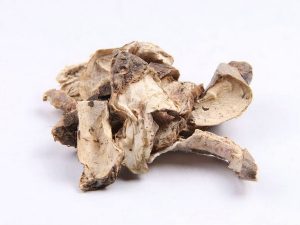
Thin, nearly circular slices; the surface is pale yellow or pale brownish-yellow, with some showing scorched spots. Slightly fragrant odor.
Botanical Information
Botanical Classification
Peony (Paeonia), a plant of the genus Paeonia in the family Ranunculaceae.
Morphological Characteristics
A perennial herb.
1. Characteristics of rhizome and leaves: The rhizome is swollen, spindle-shaped, or cylindrical; the stem is 40–70 cm tall and glabrous.Leaves are alternate; lower stem leaves are twice-ternate, while upper stem leaves are ternate; leaflets are narrowly ovate, elliptical, or lanceolate, with an acuminate apex, a cuneate or oblique base, and white, bony, fine teeth along the margins; both surfaces are glabrous, with sparse short soft hairs along the veins on the underside; the leaves are nearly leathery; petioles are up to 9 cm long.
2. Floral Characteristics: Flowers are bisexual, occurring in clusters of several at the apex or in the axils; sometimes only the terminal flower blooms, with a diameter of 8–12 cm; bracts 4–5, lanceolate, of varying sizes; sepals 4, broadly ovate or nearly round, 1–1.5 cm long, 1–1.7 cm wide, green, persistent;petals 9–13, obovate, 3.5–6 cm long, 1.5–4.5 cm wide, white, sometimes with deep purple patches at the base; filaments 0.7–1.2 cm long, yellow;The disk is shallowly cup-shaped, enclosing the base of the carpels, with bluntly rounded apical lobes; carpels 2–5, glabrous. The capsule is 2.5–3 cm long, 1.2–1.5 cm in diameter, with a beak at the apex. Flowering period: May–June; fruiting period: August.
Distribution Area
Native to Zhejiang, Anhui, Sichuan, Shandong, and other regions; also cultivated in Henan, Hunan, Shaanxi, and elsewhere.
Growth Habits
It prefers a warm, humid, and sunny environment; it is both cold- and heat-tolerant, capable of growing at temperatures ranging from -20°C to 42°C. It is drought-tolerant but sensitive to dampness and waterlogging; excessive rainfall can easily cause root rot. It thrives best in environments with a mild climate, moderate rainfall, and ample sunlight.Deep, fertile, and loose sandy loam, alluvial loam, and sandy yellow clay are the typical soils for peony growth.
Propagation Methods
Propagation is done by seed or by dividing the roots.
Cultivation Techniques
1. Propagation by seed: Sow in mid- to late September. Make furrows in prepared beds for row sowing; the furrows should be 3 cm deep. Scatter the seeds evenly into the furrows, cover with 6–10 cm of soil, and firm the soil. In April of the following year, remove part of the covering soil; seedlings will emerge in about half a month.
2.Propagation by Division: Cut the peony tubers from the roots. Select tubers that are large, solid (not hollow), and free of pests and diseases. Depending on their size and the number of buds, cut them into several pieces following their natural growth pattern, ensuring each piece has 2–4 buds and a 2-centimeter-long root stub at the base. Plant them in holes spaced 50 cm × 30 cm apart, with 1–2 plants per hole. Cover the plants thoroughly with soil, water them, and hill up the soil around the plants to protect them over winter.To increase yield, apply an appropriate amount of farmyard manure.
Pest and Disease Control
1. Diseases: Common diseases include brown spot, damping-off, root rot, gray mold, and rust. Before planting, soak the cuttings in carbendazim or thiophanate-methyl solution. At the first sign of disease, spray with carbendazim, Bordeaux mixture, or zinc dithion to control the infection, or dig up the entire plant and burn it.
2. Pests: Common pests include red spider mites, aphids, wireworms, flea beetles, and cutworms. These can be controlled by manual removal or using traps.