Toad Skin, a name for a traditional Chinese medicinal material. It is the dried body, with internal organs removed, of the Chinese giant toad (Bufo bufogargarizans Cantor) or the black-eyed toad (B. melanostictus Schneider) from the family Bufonidae. It has the effects of clearing heat, detoxifying, promoting diuresis, and relieving bloating.It is primarily used to treat boils, swollen abscesses, scrofula, eczema, abdominal distension due to malnutrition, and chronic bronchitis.

Toad Skin
Toad Skin, a name for a traditional Chinese medicinal material. It is the dried body, with internal organs removed, of the Chinese giant toad (Bufo bufogargarizans Cantor) or the black-eyed toad (B. melanostictus Schneider) from the family Bufonidae. It has the effects of clearing heat, detoxifying, promoting diuresis, and relieving bloating.It is primarily used to treat boils, swollen abscesses, scrofula, eczema, abdominal distension due to malnutrition, and chronic bronchitis.
Chinese Name : 蟾皮
Nature, Flavor & Meridian Tropism : Bitter in taste, cool in nature
Benefits & Efficacy
Benefits
Clears heat and detoxifies; promotes diuresis and relieves bloating.
Indications
Boils, abscesses, swollen and toxic sores, scrofula, eczema, abdominal distension due to malnutrition, and chronic bronchitis.
Usage and Dosage
Internal use: Decocted as a soup, 3–9 g; or ground into powder. External use: Apply an appropriate amount of fresh herb as a poultice; or mix dried powder with a carrier to form a paste for application.
Precautions
*New Reference on Herbal Slices*: “Contraindicated for cases of superficial heat or distension due to deficiency.”
Chemical Constituents
Mainly contains cinobufotalin, cholesterol, South American bufotoxin, distant bufotoxin, sand toad toxin, nonanoic acid, decanoic acid, etc.
Pharmacological Actions
1. Effects on Immune Function: Cinobufotalin is a water-soluble preparation extracted from the whole skin of the Chinese giant toad. Cinobufotalin can significantly increase serum IgG levels in normal, immunosuppressed, and sensitized mice, and it promotes both humoral and nonspecific cellular immune functions.Intraperitoneal injection of 0.1 mL/animal of cinobufotalin solution for 14 consecutive days significantly increased the total white blood cell count, elevated serum IgG levels in mice, and increased the anti-“H” agglutination titer in rabbits; however, it only increased the percentage of T lymphocytes by 19%.When administered intraperitoneally at a dose of 10 ml/(kg·day) for 7 days, Huachansu had no effect on serum IgG levels in normal mice but significantly increased the phagocytosis percentage and phagocytosis index of intraperitoneal macrophages in mice.It was also found that huachansu alleviates and counteracts cyclophosphamide-induced leukopenia, reduced lymphocyte percentage, and decreased IgG levels, and can also increase serum IgG antibody levels in the body following antigen stimulation. 2. Inhibitory Effect on Hepatitis B: Huachansu can significantly inhibit DHBV replication and exhibits strong antiviral activity. When administered intramuscularly at doses of 1 mL/kg and 3 mL/kg to mallard ducks infected with the hepatitis B virus (DHBV), the 3 mL/kg dose of Huachansu significantly improved the pathological condition of the ducks’ livers;however, serum DHBV DNA levels in three mallard ducks rose slightly after discontinuation of the drug, suggesting that the drug failed to completely inhibit DHBV to the point of disrupting the virus’s supercoiled structure. Meanwhile, both clinical observations and in vitro assays using 2215 cells revealed that the efficacy of huachansu against DHBV increased with higher doses. 3. Anticancer Effects: Oral administration of 20 g/kg huachansu significantly inhibited the growth of tumors such as mouse sarcoma (S180), solid mouse liver cancer (Heps), and mouse reticulosarcoma (L2), with an inhibition rate exceeding 30%;whereas doses of 8 g/kg and 3 g/kg of huachansu exerted some inhibitory effects on these three tumor lines, though not significantly. Additionally, the mice’s back fur became soft and lustrous, and their weight gain was significantly greater than that of the control group and the cyclophosphamide group, indicating a dose-response relationship between the strength of tumor growth inhibition and the dose, and suggesting that it inhibits tumors without harming normal cells.There are also reports that Compound Toad Skin Capsules exhibit radiation-sensitizing effects and provide a certain degree of protection against radiation-induced side effects. A 10 μg dose of Arina toad extract, isolated from fresh toad skin, achieved a 52% inhibition rate against the growth of P388 leukemia cells in mice. 4. Hypertensive Effect: 300 μg of Arina Bufo Extract can elevate blood pressure in rats by 5.33 kPa (40 mmHg), with the effect lasting for 40 minutes; when administered at a dose of 100 μg, blood pressure rises by 3.33 kPa (25 mmHg), lasting for 12 minutes.
Relevant Discussions
1. *Supplements to the Compendium of Materia Medica*: “Applied topically to treat severe poisoning; capable of drawing out toxins and neutralizing their effects.”
2. *In Search of the Origins of Materia Medica*: “Applied topically to treat sores and scrofula; used in moxibustion.”
3. *New Reference on Herbal Slices*: “Relieves malnutrition-induced fever, kills parasites and neutralizes poisonous insects, dispels dampness, and detoxifies.”
4. *Compendium of Chinese Animal Medicines*: “Clears heat and detoxifies; promotes diuresis and reduces swelling. Treats abscesses, boils, and toxic swellings; scrofula; tumors; abdominal distension caused by malnutrition; and chronic bronchitis, among others.”
Applications
Related Compatibility
1. To treat redness, swelling, and toxicity in the fingertips: Peel the skin off a live toad and wrap the outer side of the skin tightly around the affected area; by the next day, the toxin will be completely drawn out. For conditions such as boils on the back or around the mouth, the toxin will subside immediately; if it flares up again internally, apply the skin once more. It is crucial to ensure that the inner side of the skin does not come into contact with the flesh, as it will adhere firmly and be difficult to remove. This method may also be used to treat residual toxins following smallpox or measles. (*Secret Formulas from the Traveling Medicine Chest*)
2. For all types of herpes, eczema, and acne: 12 g of processed toad skin and 3 g of licorice. Decoct in water and take orally. (*Manual of Xinjiang Chinese Herbal Medicine*)
3. For prolapsed intestine: Burn a piece of toad skin in a bottle and use the smoke to fumigate the prolapsed area. (Formula by Sun Simiao, cited in *Compendium of Materia Medica*)
4. For early-stage cervical cancer: 15 g of dried toad skin, 30 g each of Phoenix Tail Grass and Curcuma zedoaria, and 9 g of Mountain Arrowhead. Decoct in water and take orally. One dose daily.
5. For early-stage nasopharyngeal cancer: 9 g each of dried toad skin, Xanthium seeds, and processed Pangolin scales; 15 g each of Prunella vulgaris, Polygonum aviculare, and Sargassum; 12 g each of bee hive and kelp; 30 g each of Snake’s Six Grains and Sargassum. Decoct in water and drink. One dose daily. (Formulas 6–7 are from *Applications of Insect-Derived Medicines*)
Notes
The skin naturally shed by a toad, also known as “toad skin,” is so thin that it is also called “toad robe.”
Processing & Preparation
Harvesting & Processing
Captured in summer and autumn; first remove the toad secretion, then remove the internal organs, spread open the body cavity, and sun-dry.
Crude Drug Identification
Properties of Crude Drugs
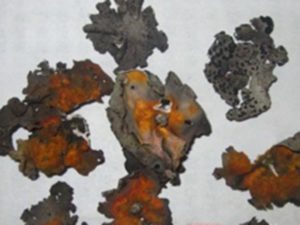
This product is flat and plate-like, approximately 0.5 mm thick, with a head that is slightly bluntly triangular. The limbs are flexed and extend outward. The outer surface is rough; the back is grayish-brown and covered with wart-like protrusions of varying sizes that are darker in color; the abdomen is yellowish-white, with finer wart-like spots. The head is relatively smooth, with prominent parotid glands that are long-ovoid and arranged in a figure-eight pattern.The inner surface is grayish-white, with shallow black depressions of the same size corresponding to the wart-like protrusions. In relatively intact specimens, when the limbs are flattened, the forelimbs lack webbing between the toes; the hindlimbs are long and robust, with webbing between the toes. The texture is tough and resilient, making it difficult to break. It has a faint fishy odor and a slightly numbing taste.
Specimens with large slices, a dry body, and good integrity are considered superior.
Botanical Information
Morphological Characteristics
1. Chinese Giant Toad: Body length generally exceeds 10 cm; robust build; head width greater than head length; rounded snout tip with a prominent snout ridge; nostrils near the tip of the snout; interorbital distance greater than the inter-nostril distance; eardrum clearly visible; no palatine teeth; upper and lower jaws are toothless.The forelimbs are long and stout; the fingers and toes are slightly flattened, with a faint marginal membrane on the sides of the fingers but no webbing; the finger lengths are, in order, 3, 1, 4, 2; the tubercles below the finger joints are mostly paired; there are two palmar protuberances, with the lateral one being larger.The hind limbs are stout and short; the tibio-tarsal joint extends forward to the shoulder level; the heels do not touch one another; the sides of the toes have marginal membranes, and the webbing is fairly well-developed; the medial metatarsal is elongated and large, while the lateral metatarsal is small and round.The skin is extremely rough; the top of the head is relatively smooth, with large, elongated parotid glands on both sides. The rest of the body is covered with round tubercles of varying sizes; those arranged in a relatively regular pattern are located behind the head, while those arranged diagonally run almost parallel to the parotid glands.In addition, the tubercles along the flanks are also arranged relatively regularly; those on the shins are larger; some specimens have indistinct tarsal folds; and the ventral skin is not smooth but covered with small tubercles.Color variation is considerable; during the breeding season, males are mostly blackish-green on the dorsal side, with pale markings on the flanks; females are paler on the dorsal side, with milky-yellow tubercles, and sometimes have oblique black longitudinal stripes extending from behind the eyes along the flanks; the ventral side is milky-yellow with fine brown or black patterns. Males are smaller and have black nuptial pads on the inner three toes, but lack vocal sacs.2. Black-eyed Toad: Body length 7–10 cm; males are slightly smaller. The head is high, and its width exceeds its length. The snout is rounded with a distinct snout ridge; the nostrils are near the tip of the snout. The interorbital distance is greater than the intranasal distance. The eardrum is large; there are no palatine teeth; both the upper and lower jaws are toothless; and the posterior end of the tongue lacks a notch.The head features very distinct black bony ridges or black lines along the snout ridge, the upper edge of the eye sockets, the anterior margin of the eardrum, and the margins of the upper and lower jaws. The top of the head is distinctly concave, and the skin is tightly attached to the skull. The forelimbs are slender and long; the fingers and toes are slightly flattened, with black tips; the digit order is 3, 1, 4, 2;subphalangeal tubercles are mostly paired; the lateral metacarpal tubercle is large, while the medial one is slightly smaller, both brown in color; the hind limbs are short, with the tarsometatarsal joint extending to the rear of the shoulder; the heels do not touch one another; the feet are shorter than the tibia; the sides of the toes are connected by a membrane forming a semi-web; subphalangeal tubercles are not prominent; the medial metatarsal tubercle is slightly larger than the lateral one.The skin is extremely rough; except for the top of the head, which is wart-free, the rest of the body is covered with round warts of varying sizes, some of which bear black spots or spines; the sides of the head feature oblong parotid glands; near the midline, from the back of the head to the hindquarters, there are two relatively regular rows of large warts arranged longitudinally.Large specimens of the Black-eyed Toad have their ventral surfaces covered with small spines. Body coloration varies considerably during their active period, generally appearing yellowish-brown with faint reddish-brown markings. Males possess black nuptial pads on the inner sides of the bases of the first and second digits, and a single subglottal vocal sac.
Distribution Area
1. Chinese Giant Toad: Found in Northeast China, North China, East China, Central China, as well as Shaanxi, Gansu, Qinghai, Sichuan, and Guizhou. 2. Black-eyed Toad: Found in Zhejiang, Jiangxi, Fujian, Taiwan, Hunan, Guangdong, Guangxi, Sichuan, Guizhou, and Yunnan.