Corn Silk, a traditional Chinese medicine, consists of the dried styles and stigmas of Zea mays L., a plant of the genus Zea in the Poaceae family. This product has the effects of promoting diuresis and reducing swelling, as well as eliminating dampness and alleviating jaundice. It is primarily used to treat edema with scant urination, damp-heat jaundice, and dizziness.
Corn Silk
Corn Silk, a traditional Chinese medicine, consists of the dried styles and stigmas of Zea mays L., a plant of the genus Zea in the Poaceae family. This product has the effects of promoting diuresis and reducing swelling, as well as eliminating dampness and alleviating jaundice. It is primarily used to treat edema with scant urination, damp-heat jaundice, and dizziness.
Chinese Name : 玉米须
Latin Name : Stigma Maydis
Aliases : Maize Silk, Maize Stamen, Maize Hairs
Authentic Producing Area : Found in most regions of China
Nature, Flavor & Meridian Tropism : Neutral in nature, sweet in taste; enters the Liver and Kidney meridians
Benefits & Efficacy
Benefits
Promotes diuresis and reduces swelling; dispels dampness and alleviates jaundice.
Indications
This herb is used for edema with scant urination, damp-heat jaundice, and dizziness.
Usage and Dosage
1. Internal use: Decoct 15–30 g; high dose: 60–90 g; or burn until charred and grind into powder. 2. External use: Apply an appropriate amount; burn to produce smoke and inhale.
Precautions
Not yet established.
Chemical Constituents
This herb contains heptacosane, nonacosane, hexacosane, ethyl linoleate, stigmast-5-ene-3-ol, saponins, alkaloids, amino acids, and other compounds.
Pharmacological Actions
This product has diuretic, hypoglycemic, immune-enhancing, antibacterial, antioxidant, antipyretic, hepatoprotective, hemostatic, and lipid-lowering effects.
Relevant Discussions
1. *Lingnan Caoyaolu*: “It also treats painful, intermittent urination with sand-like particles, accompanied by unbearable pain; prepare a decoction and take frequently.”
2. *Diannan Bencao*: “Relieves intestinal distension and dispels stagnant qi. Treats breast engorgement and redness in women, blocked milk flow, redness, swelling, and pain, as well as chills, fever, headache, and general fatigue.”
Applications
Related Compatibility
Corn Silk Combined with Moneywort: Corn silk has a sweet and bland taste with diuretic properties; it primarily enters the Kidney meridian and is effective at promoting urination, reducing swelling, and eliminating dampness to alleviate jaundice. Moneywort promotes urination and relieves dysuria; it is particularly effective at dissolving stones and can also clear damp-heat in the lower jiao, thereby clearing heat, draining dampness, and alleviating jaundice. When used together, these two herbs enhance each other’s effects and are commonly employed for damp-heat jaundice, stone-induced dysuria, and edema.
Medicinal Identification
Corn Silk and Winter Melon Rind: Both herbs have relatively mild effects and can promote diuresis and reduce edema; they are used for conditions such as difficulty urinating and edema. However, winter melon rind is slightly cold in nature and clears heat while promoting diuresis, making it more suitable for edema accompanied by heat. Corn silk also has the effects of draining dampness and alleviating jaundice, and can be used for damp-heat jaundice.
Medicinal Diet Therapy
Corn Silk and Clam Meat Soup:
1. Benefits: Promotes urination and clears heat; clears the liver and promotes bile flow. Suitable for treating jaundice caused by damp-heat stagnation in the liver and gallbladder. It can also be used as an adjunctive treatment for cholecystitis, gallstones, acute and chronic jaundice-type hepatitis, as well as nephritis with edema, hypertension, and beriberi.
2. Ingredients: 50g corn silk, 120g clam meat.
3. Preparation: First, simmer the clam meat in an earthenware pot over low heat until cooked through, then add the corn silk and continue simmering until both are tender.
4. Usage: Consume 30g of clam meat and 100mL of soup per serving.
Notes
Patients requiring treatment with traditional Chinese medicine should first consult a licensed TCM hospital, where a TCM practitioner will conduct a professional diagnosis and prescribe the appropriate herbal formula.
Processing & Preparation
Harvesting & Processing
Harvest when the corn is ripe, remove the stigmas, and sun-dry them.
Processing Methods
Remove impurities, husks (bracts), and ash residue from the raw material, then sun-dry or oven-dry to obtain the finished product.
Storage Methods
Store in a dry place to prevent mold and insect infestation.
Crude Drug Identification
Identification
1. The powder of this product is yellowish-brown. It contains numerous fibers with thin, colorless or yellowish-brown walls. Parenchymatous cells are oblong with slightly thick walls. Vessels consist primarily of spiral and annular vessels, often accompanied by fibers.
2. Take 1 g of the powdered sample, add 25 mL of ethanol, sonicate for 30 minutes, filter, and evaporate the filtrate to dryness. Dissolve the residue in 1 mL of methanol to prepare the test solution. Separately, take 1 g of maize silk reference material and prepare the reference solution using the same method.Test by thin-layer chromatography (General Rules 0502, Part IV of the 2020 Edition of the Chinese Pharmacopoeia). Pipette 5 µl of each of the two solutions and apply them separately onto the same silica gel G plate. Develop with a toluene-acetone (8:2) mobile phase, remove the plate, and allow it to air-dry.spray with a 5% ethanol solution of phosphomolybdic acid, and heat at 105°C until the spots become clearly visible. In the test sample chromatogram, spots of the same color appear at positions corresponding to those in the reference herbal material chromatogram.
Properties of Crude Drugs
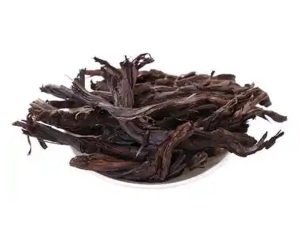
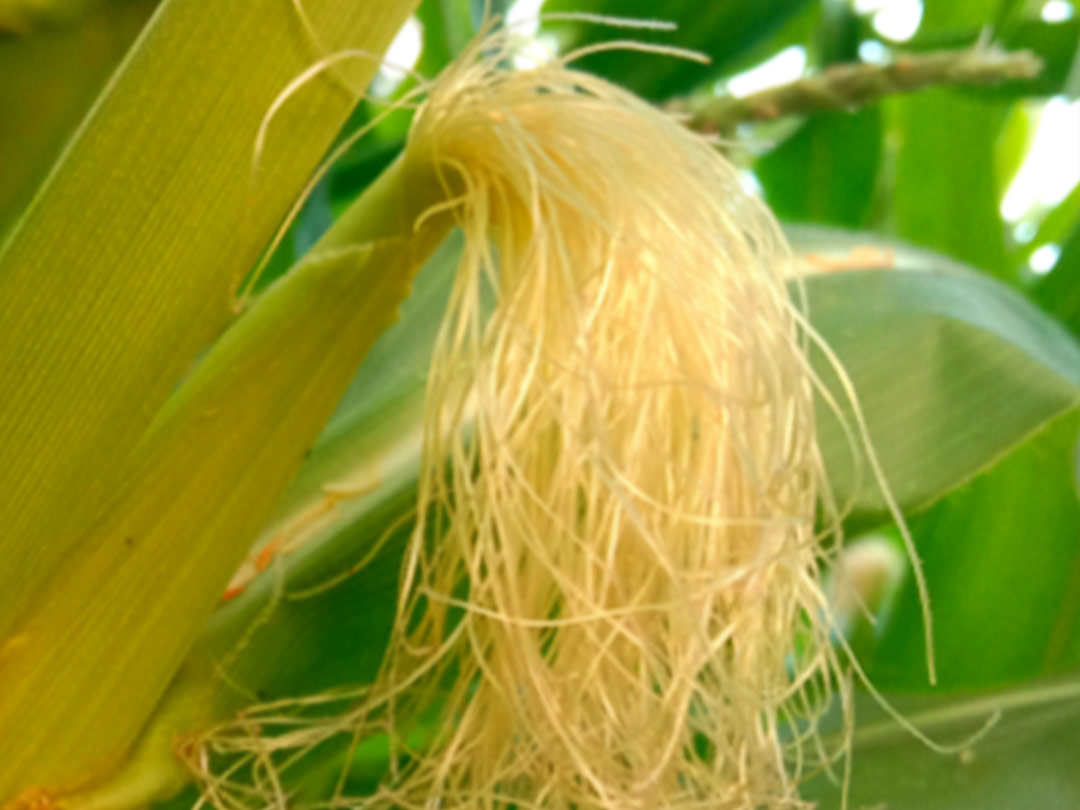
This product often clusters in loose bunches. The styles are filiform or filamentous; intact ones can reach up to 30 cm in length and approximately 0.5 mm in diameter. They range in color from pale green, yellowish-green to brownish-red, are lustrous and slightly translucent, with a stigma that is bifid and spread apart; the texture is soft. Those that are soft and lustrous are considered superior.
Properties of Processed Slices
This product is thread-like or filamentous and often forms loose clusters. It ranges in color from pale yellow to brownish-red, is glossy, and has a short, 2-lobed stigma. It is soft in texture. It has a faint odor and a slightly sweet taste.
Botanical Information
Botanical Classification
Maize (Zea mays), a plant of the genus Zea in the family Poaceae.
Morphological Characteristics
A tall, annual cultivated plant. The culms are stout and erect, 1–4 m tall, usually unbranched, and often bear aerial roots at the basal nodes.Leaves are broad, linear-lanceolate, with wavy, crinkled margins and a prominent midrib. A spreading, male panicle arises from the top of the stem; the branches of the male inflorescence are trigonal, with two male spikelets per node—one sessile and one with a short pedicel; each male spikelet contains two florets;The glumes are membranous with acute tips; both the lemma and palea are translucent and membranous; cylindrical female inflorescences emerge from the leaf axils, enveloped by numerous sheath-like bracts; female spikelets are densely arranged in longitudinal rows on a stout rachis, with broad glumes that are rounded or slightly concave at the apex, and a translucent, membranous lemma. Flowering and fruiting occur from July to September.
Distribution Area
Widely cultivated throughout China.