Polygonum cuspidatum, a traditional Chinese medicine, consists of the dried rhizomes and roots of Polygonum cuspidatum Sieb. et Zucc., a plant belonging to the genus Polygonum in the Polygonaceae family. This herb has the therapeutic effects of draining dampness and alleviating jaundice, clearing heat and detoxifying, dispersing blood stasis and relieving pain, and relieving coughs and resolving phlegm.It is primarily used to treat damp-heat jaundice, turbid urinary discharge, leukorrhea, rheumatic arthralgia, abscesses, boils, and toxic sores, burns and scalds, amenorrhea, masses and masses, traumatic injuries, and coughs caused by lung heat.

Japanese Knotweed
Polygonum cuspidatum, a traditional Chinese medicine, consists of the dried rhizomes and roots of Polygonum cuspidatum Sieb. et Zucc., a plant belonging to the genus Polygonum in the Polygonaceae family. This herb has the therapeutic effects of draining dampness and alleviating jaundice, clearing heat and detoxifying, dispersing blood stasis and relieving pain, and relieving coughs and resolving phlegm.It is primarily used to treat damp-heat jaundice, turbid urinary discharge, leukorrhea, rheumatic arthralgia, abscesses, boils, and toxic sores, burns and scalds, amenorrhea, masses and masses, traumatic injuries, and coughs caused by lung heat.
Chinese Name : 虎杖
Latin Name : Polygoni Cuspidati Rhizoma et Radix
Aliases : Spotted Bamboo, Sour Bamboo Stem, Sour Soup Stem, Sichuan Tendon Dragon, Spotted Village, Spotted Cane Root, Large-Leaved Snake Chief, Yellow Ground Willow
Authentic Producing Area : Jiangsu, Zhejiang, Jiangxi, Fujian, Shandong, Henan, Shaanxi, Hubei, Yunnan, Sichuan, Guizhou
Nature, Flavor & Meridian Tropism : Slightly cold in nature, slightly bitter in taste; enters the Liver, Gallbladder, and Lung meridians
Benefits & Efficacy
Benefits
Drains dampness and alleviates jaundice; clears heat and detoxifies; dispels blood stasis and relieves pain; suppresses cough and resolves phlegm.
Indications
Mainly used for damp-heat jaundice, turbid urinary discharge, leukorrhea, rheumatic arthralgia, abscesses, swellings, and toxic sores, burns and scalds, amenorrhea, masses and masses, trauma, and lung-heat cough.
Usage and Dosage
1. Internal use: Decocted as a soup, 10–15 g; or macerated in wine; or incorporated into pills or powders. 2. External use: Ground into a powder and applied as a poultice; or decocted into a concentrated liquid for wet compresses; or boiled into a paste for topical application.
Precautions
Due to its bitter and cold nature, which promotes blood circulation, it may interfere with fetal development; therefore, pregnant women should use with caution.
Chemical Constituents
This herb contains components such as paeoniflorin, flavonoids, emodin, emodin methyl ether, resveratrol, and polysaccharides.
Pharmacological Actions
This herb possesses a wide range of pharmacological effects, including stabilizing blood pressure, anti-shock, anti-myocardial ischemia, anti-thrombotic, improvement of cerebral ischemia, anti-lung injury and fibrosis, lipid-lowering, cholagogue, hepatoprotective, anti-inflammatory, antioxidant, antibacterial, and antiviral effects.
Relevant Discussions
1. *Mingyi Bielu*: “Primarily used to regulate menstruation and disperse blood stasis.”
2. *Compendium of Materia Medica*: “Treats various types of dysuria in both men and women.”
3. *Rihua Zi Bencao*: “Treats retained lochia after childbirth, distension and fullness in the chest and abdomen, and promotes the discharge of pus; is indicated for sores, boils, and abscesses; treats blood-induced fainting in women; addresses stasis blood from contusions; and dispels wind-toxin and stagnant qi.”
Applications
Clinical Applications
1. For treating damp-heat jaundice, this herb can be used alone in a decoction for immediate relief; it can also be combined with Yinchen, Huangbai, and Zhizi for enhanced efficacy.
2. For treating painful and difficult urination, cloudy urine, and leukorrhea caused by damp-heat stagnation in the bladder, it is effective when used alone. As described in *Yao Sengyuan’s Collection of Proven Formulas*, it can be ground into a powder and taken with rice water.
3.To treat the five types of dysuria, it may also be combined with diuretic and dysuria-relieving herbs.
4. For burning pain in the skin and subcutaneous tissue caused by scalds or burns, or for oozing of yellow fluid after ulceration, use it alone as a powder mixed with sesame oil and applied topically; alternatively, grind it into a powder with Di Yu and Bing Pian, mix with oil, and apply to the affected area.
5. To treat amenorrhea and dysmenorrhea, it is commonly combined with Tao Ren, Yan Huo Suo, and Hong Hua.
6. For the treatment of masses and masses (zhengjia), as described in *Qianjin Fang*, this herb is combined with Tugua root and Achyranthes root.
7. For pain resulting from trauma and contusions, it can be combined with Angelica sinensis, Frankincense, Myrrh, and Notoginseng.
8. For treating coughs caused by lung heat, it can be decocted and taken alone or combined with Fritillaria, Loquat leaves, and Apricot kernels.
Related Compatibility
Coptis combined with Rhubarb: Both herbs belong to the Polygonaceae family. They are bitter and cold in nature and function to clear heat, promote bowel movements, invigorate blood circulation, detoxify, and drain dampness. Together, they can be used to treat heat-induced constipation, damp-heat jaundice, amenorrhea due to blood stasis, trauma, and abscesses and swellings caused by toxins.However, rhubarb is a key herb for purgation and clearing food stagnation; it also cools the blood and stops bleeding. Therefore, it is highly effective for treating conditions such as real heat and food stagnation, abdominal distension with dry constipation, hemoptysis and epistaxis caused by uncontrolled blood flow due to blood heat, as well as red eyes, swollen gums, and mouth ulcers resulting from fire-toxin ascending to the upper burner.Polygonum cuspidatum not only promotes blood circulation and removes blood stasis to unblock the meridians, but is also effective at clearing heat and draining dampness to alleviate jaundice; it can be used for rheumatic arthralgia, trauma-induced blood stasis, damp-heat jaundice, and turbid urine and leukorrhea. Its detoxifying properties are effective for abscesses and swellings as well as venomous snake bites; it also clears the lungs, resolves phlegm, and relieves cough, making it suitable for treating coughs caused by lung heat.
Medicinal Identification
Polygonum cuspidatum and Desmodium styracifolium: Both are commonly used herbs for draining dampness and alleviating jaundice. They primarily target the Liver and Gallbladder meridians and are both capable of clearing heat, draining dampness, and alleviating jaundice, making them suitable for conditions such as damp-heat jaundice; they are often used in combination to enhance each other’s effects. Furthermore, both can clear heat, detoxify, reduce swelling, and relieve pain, and are used to treat conditions involving sores, abscesses, and toxic swellings.However, Polygonum cuspidatum excels at promoting blood circulation and regulating menstruation, clearing the lungs and resolving phlegm, and acting as a laxative to relieve constipation. It is used to treat blood stasis with amenorrhea, rheumatic arthralgia, swelling and pain from trauma, lung-heat coughs, and heat-induced constipation.On the other hand, Moneywort excels at clearing liver and gallbladder fire and eliminating damp-heat in the lower jiao; it has notable diuretic and urinary-tract-clearing effects, as well as the ability to clear heat and expel stones. It is a key herb for treating urinary disorders, particularly for promoting urination and expelling stones, and is suitable for conditions such as sand-and-stone dysuria, heat-induced dysuria, and painful, difficult urination. It is also highly effective for liver and gallbladder stones.
Related Medicines
Burn Relief Tincture, Hepatitis B Heat-Clearing and Detoxifying Granules (capsules, tablets), Shuanghu Liver-Clearing Granules, and Prostate-An Suppositories.
Related Prescriptions
Polygonum Cuspidatum Powder (*Shengji Zonglu*), Polygonum Cuspidatum Powder (*Taiping Shenghui Fang*).
Medicinal Diet Therapy
Polygonum Cuspidatum and Licorice Porridge:
1. Effects: Polygonum cuspidatum promotes blood circulation, unblocks meridians, clears damp-heat, and promotes bile secretion to alleviate jaundice; licorice unblocks meridians, regulates blood and qi, and clears heat and detoxifies; rice tonifies the middle burner, boosts qi, and strengthens the spleen and harmonizes the stomach. This porridge is suitable for alleviating jaundice associated with acute and chronic hepatitis. It may be continued even after jaundice has subsided.
2. Ingredients: 18 g of Polygonum cuspidatum, 9 g of licorice, and 50 g of rice.
3. Preparation: Add 600 mL of water to the Polygonum cuspidatum and licorice, then simmer in a clay pot for 2 hours. Strain out the residue, retain the liquid, and cook the rice into porridge. Allow to cool before serving.
4. Usage: Consume with meals.
Notes
Patients requiring treatment with Chinese herbal medicine should first consult a licensed Traditional Chinese Medicine (TCM) hospital, where a TCM practitioner will conduct a professional pattern differentiation and prescribe an herbal formula.
Processing & Preparation
Harvesting & Processing
Harvest in spring and fall; remove the fibrous roots, wash thoroughly, and while still fresh, cut into short segments or thick slices, then sun-dry.
Processing Methods
Take the raw herb, remove impurities, wash thoroughly, moisten thoroughly, cut into thick slices, and dry.
Storage Methods
Store in a dry container in a well-ventilated, dry place. Protect from mold.
Crude Drug Identification
Identification
1. The powder of this product is orange-yellow. It contains a large number of calcium oxalate cluster crystals, which are relatively large, with a diameter of 30–100 μm. Stone cells are pale yellow, square- or round-shaped, and some are branched; branched stone cells are often connected in groups of 2–3, with a diameter of 24–74 μm. They possess pit-like pores, and their cell cavities are filled with starch granules.Cork cells are polygonal or irregular in shape, with cell cavities filled with a reddish-brown substance. Vessels with bordered pores have diameters of 56–150 μm.
2. Take 0.1 g of the powdered sample, add 10 mL of methanol, sonicate for 15 minutes, filter, and evaporate the filtrate to dryness. Add 5 mL of 2.5 mol/L sulfuric acid solution to the residue,heat on a water bath for 30 minutes, allow to cool, and extract twice with 5 mL of chloroform each time by shaking; combine the chloroform solutions, evaporate to dryness, and dissolve the residue in 1 mL of chloroform to prepare the test solution.Separately, take 0.1 g of Polygonum cuspidatum reference herbal material and prepare a reference herbal material solution using the same method. Next, take emodin reference standard and emodin methyl ether reference standard, and dissolve them in methanol to prepare solutions containing 1 mg of each per 1 mL, which serve as the reference standard solutions.Perform the test according to the Thin-Layer Chromatography method (General Chapter 0502). Pipette 4 μL each of the test solution and the reference herbal material solution, and 1 μL each of the reference substance solutions, and apply them separately onto the same silica gel G thin-layer plate. Develop the plate using the upper layer of a mixture of petroleum ether (30–60 °C)-ethyl formate-formic acid (15:5:1) as the developing agent, develop the plate, remove it, allow it to air-dry, and examine it under ultraviolet light (365 nm).In the test sample chromatogram, fluorescent spots of the same color appear at positions corresponding to those in the reference herbal material and reference substance chromatograms; after exposure to ammonia vapor, the spots turn red.
Properties of Crude Drugs
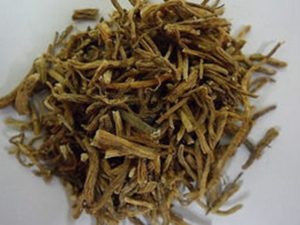
This product consists mainly of short cylindrical segments or irregular thick slices, 1–7 cm long and 0.5–2.5 cm in diameter.The outer bark is brownish-black, with longitudinal wrinkles and traces of fibrous roots; the cross-section shows a relatively thin phloem and a broad, brownish-yellow xylem with radiating rays; the phloem and xylem separate relatively easily. The pith of the rhizome contains septa or is hollow. The texture is hard. It has a faint odor and a slightly bitter, astringent taste.
Properties of Processed Slices
This product consists of irregular thick slices. The outer surface is brownish-black, sometimes showing longitudinal wrinkles and traces of fibrous roots; the cross-section reveals a relatively thin phloem and a broad, brownish-yellow xylem with radiating rays; the phloem and xylem separate relatively easily; the pith of the rhizome contains partitions or is hollow. It is hard in texture. It has a faint odor and a slightly bitter, astringent taste.
Botanical Information
Botanical Classification
Polygonum cuspidatum, a plant of the genus Polygonum in the Polygonaceae family.
Morphological Characteristics
A perennial herb. The stem is erect, 1–2 m tall, stout, hollow, and bears distinct longitudinal ridges. The leaves are broadly ovate or ovate-elliptic, 5–12 cm long, nearly leathery, with an acuminate apex, a broadly cuneate or nearly rounded base, entire margins, and small papillae along the veins; the petioles are 1–2 cm long and bear small papillae;Stipule sheaths are membranous, oblique, 3–5 mm long, brown, and truncate at the apex. Flowers are unisexual; the plant is dioecious. Inflorescences are panicles, 3–8 cm long, axillary; bracts are funnel-shaped, 1.5–2.0 mm long, with a gradually tapering apex; each bract contains 2–4 flowers;The flower pedicel is jointed in the middle to lower part; the perianth is deeply 5-lobed, pale green, with 8 stamens; in female flowers, the outer 3 perianth segments are winged on the back; at fruiting, they enlarge and the wings spread downward; the style is 3-lobed, with a tufted stigma. The achene is ovate, 3-angled, 4–5 mm long. Flowering occurs from August to September; fruiting from September to October.
Distribution Area
Distributed in central and southern China.
Growth Habits
It prefers a mild and humid climate and is tolerant of cold and waterlogging. It is not particular about soil type but grows best in loose, fertile soil.
Propagation Methods
Propagated by seeds and root division.
Cultivation Techniques
1. Seed Propagation: Direct seeding or seedling transplantation can be used. For direct seeding, sow in March–April with 33 cm between holes, planting 8–9 seeds per hole and covering with 3 cm of soil. For row seeding, make shallow furrows with 33–45 cm between rows, sow the seeds, then cover with soil and water. For seedling propagation, broadcast or row-sow in a seedbed, cover with 1.5 cm of fine soil, and keep the soil consistently moist.After seedlings emerge, thin them out and remove weeds; transplant when seedlings reach 7–10 cm in height.
2. Root Division Propagation: Dig up the mother plant before it begins to green up, separate the root crowns, ensuring each root has 1–2 buds, and then plant them.
Pest and Disease Control
Aphids may cause damage.