Teng Sanqi is the name of a traditional Chinese medicine. It consists of the dried, tuberous bulblets found on the vines of Anredera cordifolia (Tenore) van Steen., a plant in the Malvaceae family. It has the effects of tonifying the kidneys and strengthening the lower back, as well as dispersing blood stasis and reducing swelling. It is primarily used to treat pain and stiffness in the lower back and knees, post-illness weakness, trauma, and fractures.

Vine Notoginseng
Teng Sanqi is the name of a traditional Chinese medicine. It consists of the dried, tuberous bulblets found on the vines of Anredera cordifolia (Tenore) van Steen., a plant in the Malvaceae family. It has the effects of tonifying the kidneys and strengthening the lower back, as well as dispersing blood stasis and reducing swelling. It is primarily used to treat pain and stiffness in the lower back and knees, post-illness weakness, trauma, and fractures.
Chinese Name : 藤三七
Aliases : Vine Sanqi, Small Nianyao, Wild Sanqi
Authentic Producing Area : Cultivated throughout regions south of the Yangtze River basin
Nature, Flavor & Meridian Tropism : Slightly bitter in taste, warm in nature
Benefits & Efficacy
Benefits
Nourishes the kidneys and strengthens the lower back; dispels blood stasis and reduces swelling.
Indications
Teng Sanqi is primarily used to treat pain and stiffness in the lower back and knees, post-illness weakness, trauma, and fractures.
Usage and Dosage
1. Internal use: Decoct 30–60 g in water; or stew with chicken or lean meat. 2. External use: Pound an appropriate amount into a paste and apply as a poultice.
Precautions
Patients requiring treatment with traditional Chinese medicine should first consult a licensed TCM hospital, where a TCM practitioner will conduct a professional pattern differentiation and issue a prescription.
Chemical Constituents
The underground parts contain lariaglycoside aglycone, 3β-hydroxy-30-n-desmethyl-12,19-olibanol-28-acid, 3β-hydroxy-30-n-desmethyl-12,19-olibanol-28-acid ethyl ester,ursolic acid, 3β-hydroxy-12-olibanol-28,29-dicarboxylic acid 28-ethyl ester, and 3β-hydroxy-30-n-desmethyl-12,18-olibanol-29-acid ethyl ester.
Applications
Notes
Reference: *Chinese Materia Medica, Vol. 2*
Processing & Preparation
Harvesting & Processing
Harvested after the formation of bulbils; impurities are removed; used fresh or sun-dried.
Crude Drug Identification
Properties of Crude Drugs
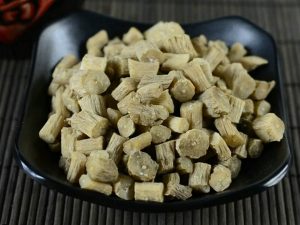
The bulbils are tuberous, with a few being cylindrical, 0.5–3 cm in diameter, with a grayish-brown surface and protrusions. They are firm yet brittle and break easily. The cross-section is grayish-yellow or grayish-white, with a slightly powdery texture. They have a faint odor and a slightly bitter taste.
Botanical Information
Botanical Classification
From the plant *Abelmoschus esculentus* of the Malvaceae family.
Morphological Characteristics
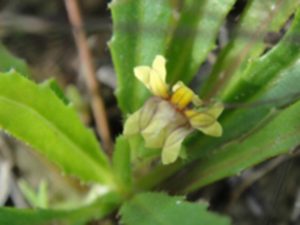
A perennial, slightly woody, twining vine with a smooth, glabrous surface. New shoots in a given year can grow to 4–5 m or longer. At the base of the plant, fleshy rhizomes grow in clusters, often protruding above the ground. The rhizomes and their branches bear terminal buds and laterally arranged buds in a spiral pattern; the buds are covered with fleshy scales.Old stems are grayish-brown with protruding lenticels; young stems are reddish-purple with longitudinal ridges. Axillary fleshy bulbils vary in size and shape, occurring singly or in clusters; they bear terminal and lateral buds, each with fleshy scales, and may develop into branches bearing leaves, forming inflorescences or solitary flowers.Leaves are alternate and petiolate; the leaf blades are fleshy, heart-shaped, broadly ovate to ovate-orbicular, 4–8(–12) cm long and 4–9(–15) cm wide, with a convex apex that is slightly rounded or slightly concave; the base is heart-shaped, cuneate, or rounded; the margin is entire; the surface is smooth and purplish-red, occasionally twisted and wavy; the midvein is slightly sunken on the underside and slightly raised on the upper surface.The raceme is axillary or terminal, either solitary or sparsely branched with 2–4 branches; the rachis is 10–30(–50) cm long, bearing tens to over 200 flowers;flower pedicels 2–4 mm long, with a lanceolate, acuminate bract at the base; two cup-shaped, fused basal bracts, above which are two small, broadly ovate or elliptic bracteoles arranged in an opposite pattern to the perianth segments, shorter than the perianth segments; perianth segments ovate or elliptic, ca. 3 mm long, ca. 2 mm wide, white;The stamens are longer than the perianth; the filaments are broad at the base and slightly fused, bending outward when the flower is still in bud; the ovary is nearly spherical and superior; the style is 3-lobed at the top, and the stigma is papillate. The flowers are fragrant; after blooming, they turn blackish-brown and persist for a long time. Although the flowers are hermaphroditic, they are usually sterile. The fruit has not been observed. Flowering begins in June and July and continues for half a year.
Distribution Area
It is currently cultivated in Jiangsu, Zhejiang, Fujian, Sichuan, Guizhou, Yunnan, and other regions. It is native to the tropical regions of the Americas.