The term “centenarian from Rugao” refers to people over the age of 100; it is a term of respect for those who have reached this milestone, highlighting both their longevity and their good health.
Rugao is a “World Longevity Village” certified by the International Society of Natural Medicine. It was officially awarded this title on October 25, 2011. The number of centenarians in Rugao ranks first among all counties and cities nationwide. As of 2026, there are more than 600 centenarians in Rugao, accounting for 31 per 100,000 of the population.
Can you imagine it? A 111-year-old woman who is not only able to take care of herself but also sweeps the floor, wipes down tables, sorts vegetables, and does household chores. She is Grandma Wang Gaiying, who lives in Rugao—a place known as the “World’s Village of Longevity.” You should know that there’s a local saying that goes: “At sixty, you’re still young; at seventy, you’re still sprightly; at eighty, you’re out and about; at ninety, you’re everywhere; and at a hundred, you’re still full of energy.”
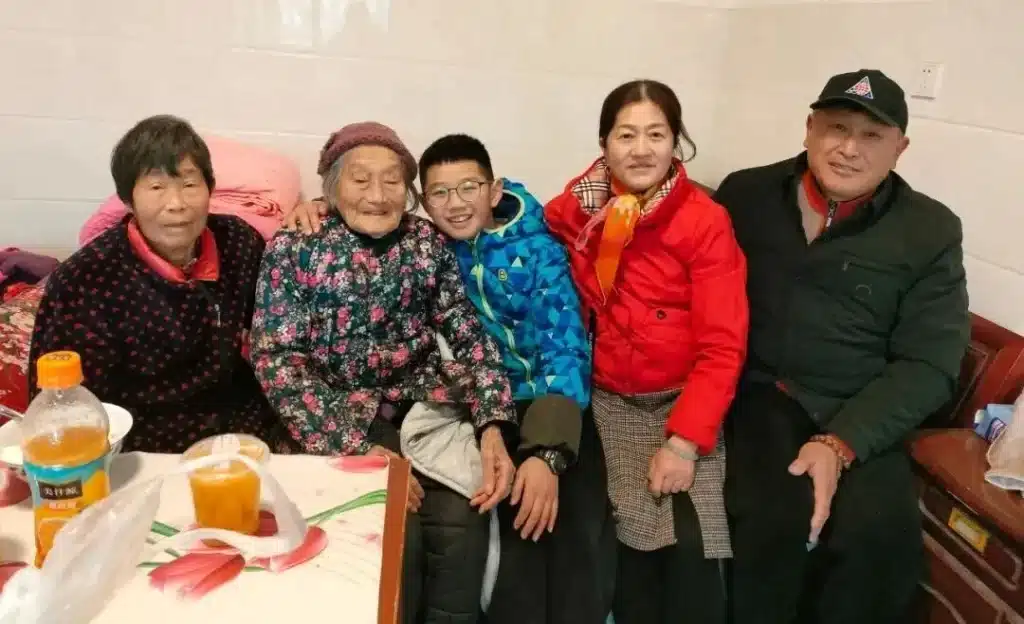
Elderly Ms. Wang Gaiying (second from the left) with her family; photo courtesy of the Jiangsu Civil Affairs WeChat official account
A Story About Basking in the Sun
My great-grandfather wasn’t in the best of health; he was prone to coughing. Every winter, he would always take me along to bask in the sun.
There was a certain art to sunbathing: we’d bring out a chair, find a warm, sheltered spot, and sit with our backs to the sun, letting its warmth soak into our spines. While my great-grandfather puffed on his pipe and told stories, I’d squat nearby, listening to the tales while doing my homework or reading a book. When the sun warmed my back until it felt toasty, my great-grandfather’s cough would ease, and I’d feel wonderfully comfortable too. As I grew up, I left my hometown, my family, and that little courtyard where we used to bask in the sun. I set out on my own, and with my busy work schedule and the pressures of life, basking in the sun became a luxury.
A Warm Back, a Cured Cough
Last winter, my wife caught a cold and developed a cough. She took three or four doses of traditional Chinese medicine, and her condition improved somewhat, but she never fully recovered—she’d still cough every now and then. I recalled basking in the sun as a child. If she could spend an afternoon in the sun, my wife’s cough would surely clear up. But finding a quiet, sheltered spot in the city where she could soak up the sun was no easy task. What could I do?
Before going to bed that night, I laid out the electric blanket, turned it on in advance, and let it warm up for an hour before going to sleep. I hoped the electric blanket would work like the sun and warm my wife’s back.
Things turned out exactly as I’d expected. After my wife fell asleep on the warm electric blanket, she didn’t cough all night, nor did she cough the next day. Her persistent cough was cured just like that.
Reflecting on the entire treatment process, I can’t help but admire the ingenious health tips of the elderly in rural areas. Sunbathing can actually cure illnesses!
I. Warming the Back to Nourish Yang Energy
To further understand the benefits of sunbathing and warming the back, I looked up relevant information online and was surprised to find that there are indeed many people who practice this.
Rugao City in Jiangsu Province is renowned as a “Hometown of Longevity” in China. A local proverb goes: “Until you visit Rugao, you won’t realize how young you are.” As of the end of 2007, Rugao—with a population of one million—had 705 residents aged 95 or older, including 102 centenarians, far exceeding the national average.
There are many secrets to their longevity, and among them, basking the back in the winter sun has been particularly beneficial for the elderly.
The people of Rugao enjoy basking in the sun to prevent illness. What sets them apart is that they focus on exposing their backs to the sun, allowing abundant yang energy to dispel the yin energy lingering on their backs, so that their bodies feel warm and comfortable all year round.
According to traditional Chinese medicine, the back is considered the “yang within yang.” If the back becomes chilled, pathogenic wind and cold can easily invade through the meridians of the back, damaging yang energy and leading to illness. The elderly, the frail, or those weakened by chronic illness are particularly susceptible to relapses and worsening conditions.
The normal functioning of the internal organs relies on yang energy; when yang energy is abundant, the body can ward off disease. The wise people of Rugao use the sun—this free “tonic”—to improve their yang-deficient constitution and strengthen their immune systems.
The back consists of the spine and the muscles that support it. Most back pain is caused by overwork, lack of muscle activity, exposure to cold, vasoconstriction, or strains to the soft tissues associated with the muscles. Therefore, in addition to sunbathing, it is important to keep your back warm. This applies not only to the elderly but especially to those who sit at a desk for long periods. For example, wearing a down vest or leather vest in winter and regularly warming up by a heater are highly beneficial for keeping the back warm.
II. Children Also Need to Keep Their Backs Warm
Clinically, we often encounter children who develop a cough after catching a chill, typically a dry cough. These children share a common trait: they love to be active and can’t sit still for a moment. After every bout of activity, they are inevitably drenched in sweat, and the clothes on their backs become soaked. When the little ones finally settle down, the cold, damp clothes cling to their backs, and they fall ill that very day.
In such cases, if treated with intravenous antibiotics, the cold solution entering the child’s body through the bloodstream immediately worsens the cough. Some children develop a runny nose right after the IV drip, leading doctors and family members to assume they have a cold. They then begin administering cold medicine, which constricts the nasal mucosa and suppresses the runny nose.
Physical activity leading to sweating → exposure to cold through a tank top → a cold affecting the lungs and causing a cough → treatment with intravenous antibiotics → onset of cold symptoms → symptomatic treatment with cold medicine → temporary relief of symptoms, but damage to yang energy and a decline in physical constitution.
This cycle repeats over and over, like a vortex; with each cycle, the child’s constitution weakens further. Some children become frail and vulnerable, catching a cold or developing a cough at the slightest provocation.
In fact, all of this stems from a deficiency of yang energy within the body. Rather than giving children IV drips every day, it would be better to let them soak up some sunlight and warm their backs. It is said that Wu Zhihui, one of the founding members of the Kuomintang, was frail as a child and unable to attend school, so he had to stay at home. Every day, he would run up the mountain, lie down or rest on a large rock, and read while completely naked, basking in the warm sunshine. The villagers repeatedly scolded him, but he never changed his habits. Who would have thought that when he grew up, he would be as strong as an ox and actually become a renowned long-lived figure?
There aren’t many places in the city where you can get proper sun exposure. When I encounter a sick child like this, I suggest that parents get a hot water bottle and place it against the child’s vest. Once the vest warms up, the cough will naturally improve.
Since children love to play, pin a dry towel to the back of their undershirt with a safety pin. Once the child has worked up a sweat, remove the damp towel to prevent sweat from soaking through the fabric—wet clothing pressed against the back can trigger a cough.
III. Warming the Back Warms the Heart
Why is one prone to coughing after catching a chill?
The *Huangdi Neijing* states: “Exposure to cold and consumption of cold beverages injure the lungs.” This contains two meanings: First, exposure to cold injures the lungs—that is, when the body is exposed to cold, it easily damages the lungs; second, consuming cold beverages injures the lungs—meaning that consuming cold foods and drinks also easily damages the lungs.
Therefore, for people with weaker constitutions who frequently suffer from colds and coughs, health maintenance should focus on two aspects: avoid getting chilled by staying warm, and avoid excessive consumption of cold foods and beverages while eating more warming foods.
Some might ask: Why are the lungs so susceptible to damage from cold pathogens? Is there a deficiency of vital energy? Where does the yang energy of the lungs come from?
The lungs are like the Earth’s atmosphere, while the heart is like the sun. The sun radiates vast amounts of heat, raising the temperature of the atmosphere and making it warm.
In the human body, when the heart’s fire is vigorous, the lungs are abundant in yang energy, and resistance is strong. If the heart’s fire is weak, the cold and yin energy in the lungs will increase. People with this constitution will start coughing immediately if they are even slightly exposed to the cold.
A while back, as the weather turned cold, several elderly women developed coughs. They received IV drips at the clinic, but after a week of treatment, there was no improvement. Their coughs were particularly severe at night, making it difficult to sleep through the night. Eventually, their conditions worsened; some patients even experienced urinary incontinence while coughing, wetting their pants and having to change their underwear multiple times a day—a truly agonizing ordeal.
So I advised the patients to lean their backs against the radiators at home and warm their vests. Once their vests were warm, their coughs would improve significantly. The patients followed my advice; after taking two doses of Chinese herbal medicine and warming their vests a few times, their coughs cleared up.
Last fall, an elderly woman also came to see me because of a persistent cough that wouldn’t go away; she mentioned feeling a chill in her back. While prescribing her herbal medicine, I advised her to apply a chili-based rheumatism plaster to her back. Once applied, the plaster generated heat, which alleviated the chill in her back and improved her cough.
By replenishing the yang energy in the back and dispelling the cold and dampness in the lungs, many coughs can be alleviated. With this understanding, consider the principle of “treating winter ailments in summer”—the logic is actually quite simple: it involves replenishing the body’s yang energy and dispelling cold phlegm.
The heart governs fire; those with deficient heart fire are prone to coughing. Observe the elderly and the frail: once their heart fire wanes, virtually all of them suffer from frequent coughing and shortness of breath.
In previous chapters, I discussed using cinnamon porridge to replenish fire, dispel cold, and warm and unblock the heart meridian. In this chapter, I’ll cover sunbathing, wrapping oneself in a hot water bottle, applying chili-based rheumatism plasters, and warming up by a radiator—all of which are practical techniques. Once the underlying principle is understood, there are many methods available, and treatment becomes straightforward.
For patients who cough due to exposure to cold, I often recommend crushing four or five cloves of garlic, mixing them with brown sugar, and brewing them as tea—this method is also very effective. I once treated a patient with a chronic cough caused by heart problems using a decoction of Trichosanthes kirilowii, Allium macrostemon, and rice wine. The treatment took effect after just one dose, and after three to five doses, the patient’s heart felt much better, and their cough and phlegm had improved significantly.
Start with the heart to treat the lungs without directly treating the lungs; start by dispelling cold to treat the cough without directly treating the cough!
IV. Dietary Precautions for People with Insufficient Internal Heat
Patients with insufficient internal heat should consume more warming foods and avoid cooling foods as much as possible. Some people mistakenly believe that eating fruit is always beneficial, unaware that many cold-natured fruits do far more harm than good.
In fact, there are many nuances to consider when it comes to eating.
Watermelon, cantaloupe, pears, tangerines, oranges, apples, sugarcane, bananas, persimmons, water chestnuts, and the like are all fruits with a cold nature and are not suitable for people with insufficient yang energy.
I once treated a child who suffered from recurring indigestion. The child had prominent blue veins at the bridge of the nose, bluish fingerprints, and a pale tongue root. I explained to the parents that the child had cold in the intestines; consuming raw or cold foods easily caused stagnation and led to indigestion. Therefore, I advised them to avoid buying the child fruits, cold drinks, and similar foods on a regular basis. Otherwise, they would be paying money for suffering—a loss that far outweighs any gain.
The child’s father, however, looked at me with disdain: “How can he get proper nutrition without eating fruit? The little guy is still growing—if he doesn’t eat it, his constitution will only get worse!”
As a result, a week later, after eating a small bowl of watermelon, the child’s cough worsened. After three days of ineffective treatment for the infection, they returned seeking Chinese herbal medicine. While describing the symptoms, the family member remarked: “ “I never expected it to be so effective—he ate just a small bowl of watermelon and coughed all night long!”
Feeding a child watermelon in the snowy winter is no different from feeding them poison; it doesn’t provide nutrition—it poisons the body.
Although children have a “pure yang” constitution with vigorous internal “fire,” this is relative. It’s like a matchstick: even when it burns with all its might, the flame is vigorous but ultimately feeble—it cannot withstand strong winds or bitter cold! A young sapling, though full of vitality, can sprout, bloom, and grow vigorously during the warm spring season, yet its vitality is fragile; just a few heavy snowfalls or bouts of extreme cold can easily freeze it to death.
I once ran the numbers for the parents of the children mentioned above. If you weigh 70 kilograms and your child weighs 10 kilograms, then your weight is seven times that of your child’s. This means that when you eat one popsicle, it’s equivalent to your child eating seven at once. Would you feel comfortable eating seven popsicles at once? Even if it’s fine once in a while, could you handle eating two or three times a day?
Never underestimate the impact of giving children “cooling” foods—such as two popsicles or two bananas a day—on their health; the effects are immense.
Does having excessive “heart fire” and abundant yang energy in the lungs necessarily mean strong immunity? Not necessarily; it also depends on whether lung qi is sufficient. If lung qi is deficient, immunity will be very weak.
To illustrate this point, let’s look at the following story: the story of repelling mosquitoes.