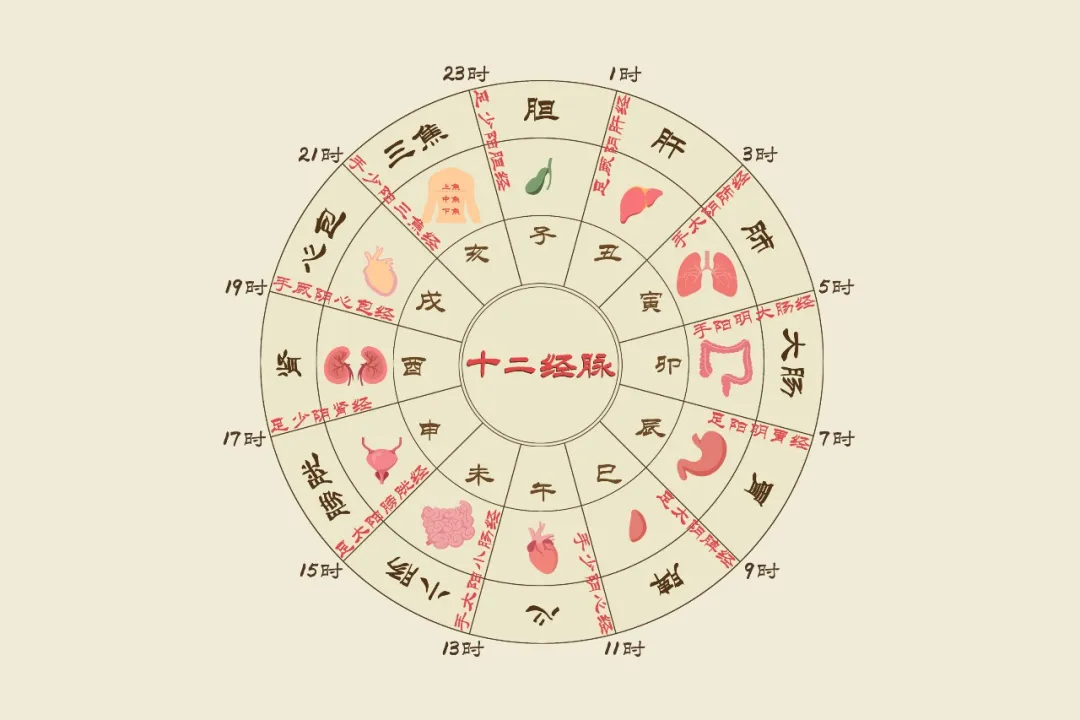
Chinese Body Clock is a traditional health practice originating from the Huangdi Neijing (The Yellow Emperor’s Inner Canon), a classic text of traditional Chinese medicine written more than 2,000 years ago. It is based on theories such as “the harmony between heaven and humanity” and “the flow of energy through the Zi and Wu hours.” This method advocates adopting appropriate daily routines, dietary habits, and qigong exercises during the twelve specific time periods of the day to nurture the corresponding internal organs and meridians, thereby aligning with the rhythms of nature.
During the Ming Dynasty, the hermit of Shishi referred to it as the “2-6 Practice,” while Qing Dynasty health experts called it the “Method for Remaining Disease-Free Throughout the Twelve Hours of the Day.” In modern applications, there are tools that assist in the practice by providing timed reminders, and some works, such as The Yellow Emperor’s Inner Canon: Health Preservation Methods for the Twelve Hours of the Day, systematically explain its theoretical framework.
It is a creation of nature and a unified whole. The concept of “harmony between heaven and humanity” in traditional Chinese medicine refers to the idea that people should adapt to the changes in nature’s rhythms and climate, living in accordance with the health-preserving principles of the twelve earthly branches each day. Only by doing what needs to be done at the appropriate time can one avoid illness or minimize the frequency of illness. Health preservation must not only align with the changes of the four seasons but also with the rhythms of the twelve hours of the day. Each hour corresponds to a meridian, and each meridian is connected to its corresponding internal organs; therefore, one’s daily routine should be adjusted according to the patterns of the rise and fall of meridian energy during each hour.
Its theoretical foundation stems from the Theory of Zi-Wu Flow. Traditional Chinese Medicine likens the body’s qi and blood to flowing water in nature, circulating through the twelve meridians from the Zi hour to the Wu hour, and then from the Wu hour back to the Zi hour. As time passes, the qi and blood in the meridians undergo periodic fluctuations in abundance and decline, giving rise to the concepts of “opening” and “closing”: when the qi and blood in a meridian are at their peak during its designated time, it is said to be “open”; when they wane outside that time, it is said to be “closed.”
Chinese Body Clock,Your Body Actually Comes with Its Own “Best User Manual”.
Have you ever had this experience: working late into the night, only to feel unproductive, anxious, and short of breath; or staying in bed in the morning, only to feel more and more tired the longer you sleep? This is most likely because your activity “schedule” doesn’t align with the “duty roster” of your internal organs.
This remarkable “schedule” was already laid out for us more than 2,000 years ago in the Huangdi Neijing (The Yellow Emperor’s Classic of Internal Medicine)—it is the Chinese Body Clock Preservation Method. Today, let’s become “time travelers” and follow this “one-day tour of the human body” map left by our ancestors to discover the healthiest way to live each day.

Chinese Body Clock First Stop: Zi Hour (11:00 PM–1:00 AM)
The “Golden Charging Station” Where the Gallbladder Meridian Reigns and Yang Qi Begins to Emerge
The Hour of Zi is the darkest time of the day, when yang energy begins to rise. The Huangdi Neijing states, “All eleven organs derive their energy from the gallbladder.” This depends on the gallbladder’s ability to generate energy; only when the gallbladder’s energy rises can the body’s qi and blood follow suit. Getting adequate sleep during the Hour of Zi is crucial for the entire day.
The hours of Hai and Zi correspond to the Water element. The hour of Zi marks the convergence of Yin and Yang, as well as the moment when all sounds fall silent. This is the best time to sleep, and one should strive to be as comfortable as possible. While sleeping, it is advisable to lie with bent knees and change positions periodically. The environment should be quiet; one’s full attention should be focused inward, free from sorrow or joy, free from rumination or delusion. In other words, one should devote oneself entirely to sleep and not dwell on other matters. Since Water is the source from which all things spring, the moment when Yin and Yang interact is when primordial energy first arises. As the Daoists say, “One Qi divides into Yin and Yang,” and when Yin and Yang unite, they transform once more into primordial energy. If, at this time, one’s mind remains restless or one continues to labor ceaselessly, it will disrupt the union of Yin and Yang, thereby hindering the generation of primordial energy. The Zi hour is also when the Gallbladder Meridian is active; here, “gallbladder” does not refer solely to the physical gallbladder within the body. The Inner Canon states: “All eleven viscera depend on the gallbladder.” ” The smooth flow of qi is essential for all five zang organs and six fu organs; when the qi of the liver and gallbladder flows smoothly, it provides strong and effective support for the qi of the five zang organs and six fu organs, allowing them to function normally. Therefore, aligning with the Gallbladder Meridian’s governing influence ensures the smooth flow of the body’s qi, benefiting all five zang organs and six fu organs. The gallbladder is also the organ of decision-making. To survive, we engage in many “plans and deliberations” every day—planning for work, for our future, for interpersonal relationships, for business, for our children, for our health, and for emotional entanglements. If the matters we deliberate on can be “decided” and smoothly carried out—that is, if our wishes come true—then our qi and blood will naturally flow smoothly, and the liver and gallbladder will function harmoniously. However, in real life, things rarely go as planned; often, our lofty aspirations go unfulfilled and events turn out contrary to our wishes. Consequently, many of our plans accumulate in the liver without being resolved and executed by the gallbladder, leading to a blockage in the liver-gallbladder pathway. Because emotions are suppressed, the liver and gallbladder’s digestive, blood-supplying, and detoxification functions are severely impaired, causing a multitude of illnesses to arise in the body.
Wisdom from the Huangdi Neijing: “All eleven organs depend on the gallbladder.” This is the moment when Yin Qi is at its peak and Yang Qi begins to emerge—much like the first seed planted in winter, its life force is extremely precious.
Health Preservation Core: Deep sleep to “recharge” Yang Qi.
Layman’s Explanation: The gallbladder governs decision-making; when its energy rises, the energy of the five zang organs and six fu organs flows smoothly. Sleeping soundly during the Zi Hour is like deeply recharging the body’s “generator” (yang energy), helping the gallbladder’s energy rise and ensuring the smooth flow of qi. Staying awake at this time is like forcing a cell phone to operate when its battery is low—it depletes your fundamental vitality the most.
Advice for Modern People: Put down your phone and make sure to fall asleep before 11:00 PM—this is the most cost-effective “beauty sleep” and “health-preserving sleep.”

Chinese Body Clock Second Stop: Chou Hour (1:00–3:00 AM)
The Liver Meridian Reigns, the Body’s Internal “Silent Deep Clean”
At this time, yang energy begins to rise; this period is known as the Chou hour. What is the Chou hour like? The character “Chou” resembles a hand being bound—just as yang energy begins to rise at this time, you must still exercise restraint and control; in other words, as energy rises, it must also descend. Therefore, to nourish the liver’s blood properly, you should get a good night’s sleep between 1:00 a.m. and 3:00 a.m.
Wisdom from the Huangdi Neijing: “When a person sleeps, blood returns to the liver.”
Health Essence: Deep sleep allows the liver to carry out its “major cleanup.”
Layman’s Explanation: The liver stores blood and governs the free flow of qi. At this time, yin blood returns to the liver to nourish it. The liver functions like a “blood bank” during Chou Hour, with blood returning to the “bank” for “maintenance.” If you’re still staying up late, binge-watching shows, or getting angry at this time, it’s like forcing the “blood bank” to work overtime to keep you entertained. Over time, toxins accumulate, leading to a dull complexion and irritability.
Advice for modern people: Ensure you’re in a state of deep sleep during the Chou hour. Avoid emotional agitation and eating before bed to give the liver a quiet working environment.

Chinese Body Clock Third Stop: Yin Hour (3:00–5:00 a.m.)
The Lung Meridian Takes the Lead: The “National Distribution Launch Ceremony” for Qi and Blood
The Yin hour refers to the period from 3:00 a.m. to 5:00 a.m., when the Lung Meridian is most active. This is the time when the body transitions from rest to activity—a process of transformation that requires deep sleep. People typically sleep most deeply between 3:00 a.m. and 5:00 a.m., which coincides with the body’s transition of qi and blood from a state of rest to movement—a process facilitated by deep sleep.
Early morning exercise is not recommended for elderly people with poor heart function. Those with heart disease should definitely get up later and rise slowly; morning exercise is also not advised for them. In the evening, when the atmosphere is dominated by Yin energy, you can engage in some physical activity. In the morning, however, when Yang energy is emerging, you should simply go with the flow of this natural process.
Wisdom from the Huangdi Neijing: “The lungs govern the hundred vessels.” The lungs redistribute qi and blood, circulating them throughout the body.
Health Preservation Core: Deep sleep ensures the “distribution” of qi and blood.
Layman’s Explanation: The lungs govern the dispersion and purification of qi and blood; they serve as the body’s “qi and blood dispatch center.” During the Yin Hour, they use Zong Qi to distribute the blood stored by the liver throughout the body. Deep sleep during this time ensures that all meridians are nourished. Many critically ill patients are prone to complications at this time precisely because the distribution of qi and blood is inadequate. Healthy individuals should be in deep sleep during this period to ensure the distribution process proceeds smoothly and unimpeded.
Advice for Modern People: Getting a good night’s sleep is key. Elderly people who are accustomed to morning exercise should avoid getting up too early during this time to prevent cold air from damaging the lungs.

Chinese Body Clock Fourth Stop: Mao Hour (5:00–7:00 a.m.)
The Large Intestine Meridian is Active; Time to Cleanse the Body’s “Sewer System”
The Mao hour refers to the period from 5:00 a.m. to 7:00 a.m., when the Large Intestine Meridian is at its peak. By this time, it is generally light out, the “Heavenly Gate” has opened, and waking up at 5:00 a.m. is normal. During this time, we should have a regular bowel movement to eliminate waste and toxins. This period signifies the opening of the “Earth Gate”—that is, the anus—so it is important to develop the habit of having a bowel movement in the morning. If you are having difficulty passing stool, you should hold your breath rather than clench your fists.
Traditional Chinese Medicine holds that the lungs and the large intestine are paired organs; only when lung qi is sufficient can a bowel movement occur.
Wisdom from the Huangdi Neijing: “The large intestine governs body fluids and transmits waste.”
Health Essentials: Get up, drink warm water, and eliminate accumulated waste.
Layman’s Explanation: As dawn breaks, the body’s “sanitation department” (the Large Intestine) begins its work. At this time, qi and blood flow to the Large Intestine, making it the optimal time to eliminate accumulated waste. Clearing out waste leaves you feeling light and refreshed, setting a positive tone for the new day.
Advice for Modern People: Drink a glass of warm water after waking up to moisten the intestines and promote bowel movements. Get into the habit of using the restroom at this time.

Chinese Body Clock Fifth Stop: Chen Hour (7:00–9:00 a.m.)
The Stomach Meridian is Active; Fill Your Body with “High-Quality Fuel”
The Chen hour refers to the period from 7:00 a.m. to 9:00 a.m., when the Stomach Meridian is most active. The Stomach Meridian is a long meridian running along the front of the body. Stomach pain is a problem related to the Stomach Meridian; in fact, knee pain is also a sign of stomach issues, and pain on the top of the foot is likewise associated with the Stomach Meridian—all of these areas lie along the Stomach Meridian’s path.
Eating breakfast at this time is essential for replenishing nutrients. This is when the yang energy of heaven and earth is at its peak, making breakfast the easiest meal to digest. Eating a large breakfast will not lead to weight gain. Because the Spleen and Stomach meridians are actively transforming and transporting nutrients, it is crucial to eat a substantial and nutritious breakfast. Eating breakfast is as precious as “spring rain, as valuable as oil.”
Wisdom from the Huangdi Neijing: “The stomach is the sea of water and grains and the great origin of the six fu-organs.”
Health Essentials: Eat a nutritious breakfast.
Layman’s Explanation: At this time, stomach qi is at its peak, and digestive capacity is strongest. The breakfast you eat will be efficiently converted into the essence of food and drink, serving as the energy source for the day. Skipping breakfast is like letting a “high-efficiency factory” run idle; over time, this can damage stomach qi and may lead to problems such as gallstones.
Advice for Modern People: Treat breakfast like an “emperor”—be sure to eat well and choose warm foods. Millet congee, steamed buns, and eggs are all excellent choices.

Chinese Body Clock Sixth Stop: Si Hour (9:00–11:00)
The Spleen Meridian is in Command; the “Nutritional Logistics Center” Runs Efficiently
The Si hour refers to 9:00 a.m. to 11:00 a.m., when the Spleen Meridian is at its peak. The spleen governs transformation and transportation; the breakfast we eat in the morning begins to be processed during this time. Our stomach is like a pot—how does it digest food? It relies on “fire” to gradually break down the contents of the spleen and stomach.
What is the spleen? The right-hand side of the Chinese character for “spleen” (脾) is “bi” (卑), which resembles an ancient maid tending the fire—adding a bit of firewood, fanning the flames, and so on. Among the five zang organs and six fu organs, the spleen is like a busy little maid. But if she falls ill, our entire “grand mansion” of internal organs will feel unwell, and we may develop so-called “diseases of the affluent,” such as diabetes. If a person experiences weight loss, excessive salivation, or edema, these are all symptoms of spleen disorders.
Wisdom from the Huangdi Neijing: “It governs transformation and transportation, raises the pure, and serves as the source of the generation of qi and blood.”
Health Preservation Core: Focus on work and study efficiently.
Layman’s Explanation: The spleen is the body’s “logistics director.” After breakfast, the spleen begins busily transporting nutrients throughout the body. At this time, the brain receives ample nourishment, making it the period of the day when thinking is most active and energy levels are at their peak—particularly suitable for tackling complex tasks.
Advice for Modern People: It’s best not to sit for long periods during this time; get up and walk around every hour to help the spleen lift the pure substances.

Chinese Body Clock Seventh Stop: Noon (11:00–13:00)
The Heart Meridian Reigns; a “Rest and Recharge Station” for the Transition of Yin and Yang
The Wu hour refers to the period from 11:00 a.m. to 1:00 p.m., when the Heart Meridian is most active. The Zi hour and the Wu hour mark the transition points of the cosmic energy of heaven and earth, and the human body should also pay attention to these transition points.
For the average person, taking a “Zi-Wu” nap is most important. Whether you go to sleep at 11:00 p.m., take a nap after lunch, or simply close your eyes for a while if you can’t fall asleep, all of these are beneficial. Because the energy of heaven and earth transitions during these periods, we should not disturb it during this shift. You don’t have enough energy to interfere with the energy of heaven and earth, so what should you do? Rest—remain still to adapt to all changes. It is essential to take a nap at this time; it is beneficial for your health.
Wisdom from the Huangdi Neijing: “The heart is the sovereign organ; spiritual clarity emanates from it.”
Core Health Principle: Lunch and a short nap (15–30 minutes).
Layman’s Explanation: The heart governs the blood vessels and houses the spirit; at noon, a hint of yin begins to emerge. Noon is when the Heart Meridian is active, so quiet rest is needed. Avoid overeating at lunch to prevent overburdening the body. A brief nap after lunch nourishes the heart’s yin, reduces cardiovascular and cerebral stress, and replenishes energy for the afternoon. This is like giving a high-speed CPU a brief “hibernation to cool down,” resulting in higher efficiency.
Advice for Modern People: “ A 15-minute nap at noon is as beneficial as an extra hour of sleep at night.” Even if you can’t fall asleep, simply closing your eyes and resting for 15 minutes is excellent nourishment for the heart.

Chinese Body Clock Eighth Stop: Wei Hour (1:00–3:00 p.m.)
The Small Intestine Meridian Takes the Lead: The Meticulous Work of the “Nutrition Sorter”
The Wei hour refers to the period from 1:00 p.m. to 3:00 p.m., when the Small Intestine Meridian is most active. The small intestine is responsible for absorption; its function is to absorb the essence of food that has been broken down by the spleen and stomach, and then distribute it to the various organs. It is important to eat a good, nutritious lunch.
The heart and small intestine are paired as exterior and interior organs. The exterior represents Yang, while the interior represents Yin. If there is a problem with Yang, there will also be a problem with Yin, and vice versa. In the early stages, heart disease may very well manifest along the Small Intestine Meridian. Some patients experience chest tightness and palpitations every afternoon around 2:00 PM, yet hospital examinations reveal no heart problems. Because the small intestine belongs to Yang and is the exterior, if there is a problem in this sensitive external area, the heart inside will certainly be affected as well.
Wisdom from the Huangdi Neijing: “The small intestine is the organ that receives and holds abundance; it transforms substances and expels them.”
Health Preservation Core: Allow the body to focus on digestion; avoid strenuous exercise or stressful work.
Layman’s Explanation: The small intestine is responsible for separating the pure from the impure; it is the body’s most precise “nutrient sorting center.” It absorbs the essence (the pure) from lunch, transports it throughout the body via the spleen, and passes the waste (the impure) down to the large intestine. At this time, the body’s blood supply is primarily directed toward the digestive system. If you immediately engage in high-intensity work or exercise, it is equivalent to forcibly diverting the “nutrient-sorting” workforce—which, over the long term, can lead to digestive dysfunction and poor nutrient absorption.
Advice for Modern People: Take a leisurely walk after lunch; avoid immediately entering “battle mode.” Instead, handle routine tasks that do not require intense concentration.

Chinese Body Clock Station 9: Shen Hour (3:00–5:00 p.m.)
The Bladder Meridian is dominant; the “golden period” for high-efficiency learning and work
The Shen hour refers to the period from 3:00 p.m. to 5:00 p.m., when the Bladder Meridian is most active. The Bladder Meridian is a major meridian that runs from the heel of the foot along the back of the lower leg, up the sides of the spine, and all the way to the brain.
For example, pain in the lower leg indicates a problem with the Bladder Meridian, specifically a condition of Yang deficiency, which is a manifestation of deficiency in the Taiyang Meridian. Pain in the back of the head is also related to the Bladder Meridian, and memory decline is linked to it as well. This is primarily due to Yang Qi failing to rise sufficiently, resulting in an insufficiency of Qi and blood in the upper body, which leads to memory decline. If you feel particularly sleepy during this time, it is a sign of Yang deficiency.
Wisdom from the Huangdi Neijing: “The Taiyang Meridian governs the exterior yang and is paired with the kidney yang.”
Health Preservation Essentials: Drink plenty of water, exercise regularly, and engage in high-efficiency learning and work.
Layman’s Explanation: At this time, the body’s qi and blood are abundantly supplied to the Bladder Meridian. As the Bladder Meridian is paired with the Kidney Meridian, yang energy is at its peak, and both the brain and body are functioning at their highest levels. The ancients referred to this hour as “evening meal” (夕食)—not to eat food, but as the time to “consume the nourishment of knowledge.” Memory and judgment are particularly sharp during this period, making it the “golden time” for students to review and for office workers to tackle complex tasks. At the same time, drinking plenty of water helps the Bladder Meridian flush metabolic waste from the body.
Advice for Modern People: Drink plenty of water at this time (especially plain water or light tea), get up and move around, stretch your body, and gently tap along the Bladder Meridian’s path on your back to help unblock the meridians and relieve fatigue. Seize this opportunity to double your efficiency in studying and working.

Chinese Body Clock Tenth Stop: You Hour (5:00–7:00 p.m.)
The Kidney Meridian is Active; the Time for the Body’s “Treasury” to Store and Preserve
The You hour refers to the period from 5:00 p.m. to 7:00 p.m., when the Kidney Meridian is at its peak. The kidneys govern the storage of essence. What is essence? Human essence is like “money” in a household—it can buy anything and be converted into anything. Whenever a problem arises in the body’s cells or tissues, “essence” will transform into that part or assist it. Essence is the most creative primal force within the human body. When you need something, you can draw upon your essence to obtain it. For example, if you are deficient in red blood cells, essence will manifest as red blood cells.
From another perspective, primordial energy is stored in the kidneys. This primordial energy is something we are born with—it is what is meant by the saying, “A person lives by a single breath.” Where is this primordial energy stored? It is stored in the kidneys. This is why, as people reach a certain age, they place great emphasis on nourishing the kidneys. However, the body has its own system; if the meridians are not unblocked, no amount of tonics will be effective—they simply cannot be absorbed. It all depends on one’s own digestive and absorptive capacity.
One manifestation of abundant kidney essence is ambition. For example, elderly people with insufficient essence tend to lack lofty aspirations, while children with abundant essence have lofty ambitions. Therefore, if one wishes to accomplish great things, the first priority is to preserve one’s kidney essence.
Wisdom from the Huangdi Neijing: “The kidneys store essence” and “the kidneys govern reproduction and growth and development”; they are the foundation of a person’s innate vitality.
Core Principles of Health Preservation: Rest, relax, and nourish the kidneys.
Layman’s Explanation: The kidneys are like the body’s “treasury,” storing the most precious life energy (Primordial Yin and Primordial Yang). During the You hour, the Kidney Meridian is on duty, responsible for gathering the remaining vital energy from the day and storing it in the “treasury” for future use. At this time, it is not advisable to engage in strenuous exercise or mentally taxing work; otherwise, you are forcibly “overdrafting the treasury’s reserves.”
Advice for Modern People: Dinner should be light and in small portions to reduce the body’s burden. You may take a walk, listen to soothing music, and drink a moderate amount of water—but avoid drinking too much to prevent nighttime bathroom trips that could disrupt the storage process. For those practicing wellness, this is an ideal time to massage the Yongquan acupoint on the soles of the feet (the starting point of the Kidney Meridian) or rub the kidney area on the lower back.

Chinese Body Clock Eleventh Stop: Xu Hour (7:00 PM–9:00 PM)
The Pericardium Meridian is active; this is the “period of physical and mental relaxation” to prepare for sleep
The Hour of Xu refers to the period from 7:00 p.m. to 9:00 p.m., when the Pericardium Meridian is at its peak. The pericardium is the outer membrane surrounding the heart, primarily responsible for protecting the heart muscle and ensuring its normal function. At this time, Yin energy is at its peak while Yang energy is waning; joy and happiness naturally arise, so people should relax and enjoy themselves. In ancient times, people would chat and unwind during this hour.
Since the heart itself is not susceptible to pathogenic factors, what part of the body is affected? It is the pericardium that absorbs these pathogenic factors. Many heart-related ailments can be attributed to disorders of the Pericardium Meridian. If your heart is beating particularly strongly, it means the pericardium has been affected by pathogenic factors. It begins with a pounding heartbeat, and then the problem travels along the Pericardium Meridian. The principle of Traditional Chinese Medicine is to treat from the Zang organs to the Fu organs; therefore, understanding the meridians allows one to treat such conditions.
The Pericardium Meridian also governs joy and happiness. Therefore, people should engage in some form of recreation during this time.
Wisdom from the Huangdi Neijing: The pericardium is the “minister and envoy,” taking the brunt of external pathogens on behalf of the heart to protect it.
Core Principle of Wellness: Maintain a cheerful mood and relax both body and mind.
Layman’s Interpretation: The pericardium is like the heart’s “guardian” and “spokesperson.” It begins its work during the Hour of Xu to clear external pathogens from around the heart, allowing the heart—the “sovereign”—to rest peacefully. Therefore, the essence of the Hour of Xu is “joy,” which allows both body and mind to feel at ease and relaxed. If you’re still working overtime, feeling angry, or watching stimulating TV shows or movies at this time, it’s like harassing your “heart’s guard,” preventing it from functioning normally and thereby disrupting the heart’s rest.
Advice for modern people: This is a good time to chat with family, listen to light music, do some simple stretching, or soak your feet in warm water. Let your heartbeat gradually slow down to make final preparations for sleep. When soaking your feet, the water should not be too hot; stop once you begin to sweat slightly. This effectively directs excess heat downward, aiding in falling asleep.

Chinese Body Clock Twelfth Stop: Hai Hour (9:00 PM–11:00 PM)
The Triple Burner Meridian is in command; this is the “shutdown” time when all meridians rest and recuperate
The Hour of Hai refers to the period from 9:00 p.m. to 11:00 p.m., when the Triple Burner Meridian is most active. The Triple Burner refers to the mesh-like region that connects the five zang organs and six fu organs. The Triple Burner must remain unobstructed; if it becomes blocked, illness ensues.
The zodiac sign for the Hour of Hai is the Pig, which, once well-fed, grunts softly and falls asleep. Therefore, during the Hour of Hai, we should rest, allowing both body and soul to immerse themselves in warm darkness, so that life and the body may undergo their natural cycle of renewal through rest.
Wisdom from the Huangdi Neijing: “The Triple Burner is the official in charge of drainage; waterways originate from it.” The Triple Burner governs the circulation of qi, blood, and body fluids throughout the entire body.
Core Health Principle: Fall asleep or prepare for sleep, allowing all meridians to rest and recuperate.
Layman’s Explanation: During the Hour of Hai, the human body should be like a precision instrument that has finished its day’s work, entering a state of “complete shutdown and self-check.” The Triple Energizer governs transformation and regulation of fluids; by sleeping during this hour, all meridians receive optimal rest and replenishment of vital energy. Failing to sleep at this time disrupts the body’s “self-check and repair” process. Over time, this leads to the depletion of all meridians, resulting in premature aging and a weakened immune system.
Advice for Modern People: Be sure to go to bed around 10:30 p.m. and aim to fall asleep before 11:00 p.m. Before bed, avoid eating, drinking large amounts of water, or thinking about complex issues. You can lie in bed and practice some simple meditation or abdominal breathing to help calm your mind.
Chinese Body Clock,The Twelve-Hour Health Preservation Method is not a rigid set of rules, but rather a philosophy of living in harmony with nature. We don’t need to live every minute like a precision instrument, but understanding the body’s rhythms allows us to find a way to live in harmony with ourselves amid the hustle and bustle of modern life.
Start by going to bed half an hour earlier tonight, begin by eating a proper breakfast tomorrow, and try to listen to the signals your body sends at each hour. When you begin to align with the rhythms of heaven and earth and reconcile with your body, good health will naturally follow. This ancient wisdom from the Huangdi Neijing is the most personal health “schedule” that each of us can embrace.
Chinese Body Clock,The Twelve-Hour Cycle Health Preservation Method is practiced and promoted in various ways even today. For example, some works present the “Traditional Chinese Medicine Twelve-Hour Cycle Health Preservation Method” through live performances, combining it with professional knowledge of Traditional Chinese Medicine to explain the content in an accessible and easy-to-understand manner, covering the full range of daily health practices from waking up at Mao hour to going to sleep at Hai hour.
References:
[1] The Yellow Emperor’s Inner Canon: Suwen and The Yellow Emperor’s Inner Canon: Lingshu, classic works of Traditional Chinese Medicine
[2] Ding Xiaoying, Department of Musculoskeletal Injuries, Shenzhen Traditional Chinese Medicine Hospital, Ziwu Liuzhu: Health Preservation Methods Based on the Twelve Earthly Branches, October 2024
[3] 2017 Nobel Prize in Physiology or Medicine—Jeffrey C. Hall, Michael Rosbash, and Michael W. Young, for research on the molecular mechanisms of circadian rhythms, Nobel Committee
[4] Chinese Nutrition Society, Dietary Guidelines for Chinese Residents (2022)
[5] European Society of Cardiology (ESC), “Association of napping with incident cardiovascular events in a prospective cohort study,” 2020