Red-haired Grass is the name of a traditional Chinese medicine. It is the whole plant of Murdannia nudiflora (L.) Brenan, a member of the Commelinaceae family. It is distributed in East China, Central and South China, and Southwest China. It has the effects of clearing lung heat, cooling the blood, and detoxifying. It is commonly used to treat coughs caused by lung heat, coughing up blood, vomiting blood, sore throat, red and swollen eyes, and abscesses and swellings caused by toxins.

Red-haired Grass
Red-haired Grass is the name of a traditional Chinese medicine. It is the whole plant of Murdannia nudiflora (L.) Brenan, a member of the Commelinaceae family. It is distributed in East China, Central and South China, and Southwest China. It has the effects of clearing lung heat, cooling the blood, and detoxifying. It is commonly used to treat coughs caused by lung heat, coughing up blood, vomiting blood, sore throat, red and swollen eyes, and abscesses and swellings caused by toxins.
Chinese Name : 红毛草
Aliases : Ground Garlic, Sky Needle, Ground Blue Flower, Duck’s Tongue, Ground Pond Flower, Mountain Kelp, Red Reed Grass, Bamboo Leaf Grass, Hundred-Day Sun, Meat Grass, July Single-Stem Flower, Small Chicken Tongue Weed, Slender Bamboo Shell Herb, Blood-Fearing Herb, Red Bamboo Shell Herb, Slender Bamboo Field, Chicken Tongue Grass
Authentic Producing Area : East China, Central and South China, Southwest China
Nature, Flavor & Meridian Tropism : Sweet and bland in taste; cool in nature; enters the Lung and Stomach meridians
Benefits & Efficacy
Benefits
Clears lung heat; cools the blood and detoxifies.
Indications
Cough due to lung heat, coughing up blood, vomiting blood, sore and swollen throat, red, swollen, and painful eyes, and swollen, toxic sores and abscesses.
Usage and Dosage
Internal use: Decocted as a soup, 15–30 g; higher doses up to 60 g may be used; or juiced. External use: Apply an appropriate amount of fresh, pounded herb as a poultice.
Precautions
Not yet determined.
Relevant Discussions
1. *Tianbao Bencao*: “Resolves phlegm, clears fire, stops bleeding, clears fire from the Three Jiao, and removes stasis to generate new blood.”
2. *Compilation of Commonly Used Folk Herbs*: “Clears heat, relieves cough, and treats hematemesis.”
3. *Chronicle of Sichuan Chinese Medicinal Herbs* (1960 edition): “Clears lung heat, promotes blood circulation, reduces swelling and toxicity, and treats cough with hemoptysis.”
4. *Compendium of Chinese Herbal Medicines*: “Cools the blood and stops bleeding. Primarily treats lung-heat cough, hemoptysis, tonsillitis, pharyngitis, and acute enteritis. For external use, it treats redness and swelling caused by boils and abscesses.”
5. *A Brief Compendium of Guangxi Ethnic Medicines*: “Treats postpartum physical weakness and penile edema in children.”
6. *Compendium of Medicinal Plants of Zhejiang*: “Primarily used to treat mastitis.”
7. *Compendium of Fujian Medicinal Herbs*: “Clears heat and drains dampness.”
Applications
Related Compatibility
1. For hemoptysis due to lung heat: 15 g of Red-haired Grass (or 60 g of fresh material), 60 g each of Guanyin Grass, Platycladus leaf, Xihe Willow, and brown sugar. Decoct in water and drink. (*Chongqing Herbal Medicine*)
2. For coughing and hemoptysis due to consumptive disease: 60 g each of Red-haired Grass, lotus root nodes, dried side-root, Tu Bajie root, and Yangquehua root. Decoct in water, add Bai Caoshuang, and take orally; or stew with meat and consume. (*Chongqing Herbal Medicine*)
Processing & Preparation
Harvesting & Processing
Harvest in summer and fall; wash thoroughly; use fresh or sun-dry.
Crude Drug Identification
Properties of Crude Drugs
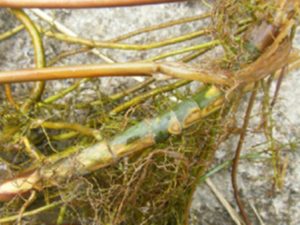
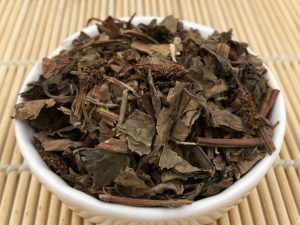
The whole plant often forms tangled clumps; it is yellowish-green and glabrous. The stem is cylindrical, approximately 1.5 mm in diameter, with branches and fibrous roots; the surface is smooth with longitudinal ridges, and the nodes are slightly swollen; the texture is soft, with a central pith in the cross-section. Leaves are alternate, often shriveled and fragmented; when a complete leaf is flattened, it is lanceolate, 2–10 cm long and 0.5–1.5 cm wide;entire, with slightly long cilia; the veins are parallel; the flowers are mostly shed; the bracts are linear and fall off early; the petals are shriveled and purple. It has a faint odor and a bland taste.
Botanical Information
Botanical Classification
Leaf of *Nudiflora* (family *Oryzaceae*).
Morphological Characteristics
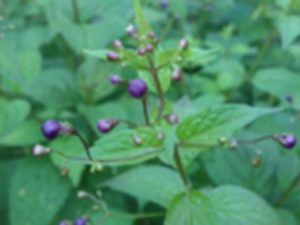
A delicate perennial herb, 5–30 cm tall. Fibrous roots are well-developed. Stems grow in clumps, are prostrate, fleshy, and produce adventitious roots at the nodes; internodes are distinct and purplish. Simple leaves are alternate; leaf blades are linear-lanceolate, 3–10 cm long and about 1 cm wide, with an acuminate apex and a sheathing base that embraces the stem; the upper surface is dark green, while the lower surface sometimes has purple spots.Cymes arranged in a terminal panicle-like inflorescence; bracts linear to lanceolate, shorter than the leaves; bracts early deciduous; pedicels slender, ca. 4 mm long; sepals 3, oblong, ca. 4 mm long; flowers purple, petals 3, obovate;6 stamens, of which 2 are fertile and 2–4 are sterile; filaments are entirely hairy or, in the case of fertile stamens only, bear long bluish-purple hairs; ovary nearly spherical, glabrous, about 1 mm long; style linear. Capsule ovoid, 3-angled, about 4 mm long, 3-chambered, each chamber containing 2 seeds.Seeds are brown, with large, sparsely distributed pits on the surface. Flowering period: August–September; fruiting period: August–November.
Distribution Area
Distributed in East China, Central and South China, and Southwest China.