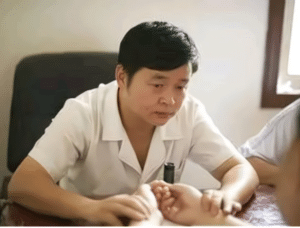
“Diseases Are Not Set in Stone” emphasizes that health and disease states can be actively changed—they are not predetermined.
The core point being made here is that many disease risks are influenced by factors such as lifestyle and the environment, and there is an opportunity to improve them through early awareness and adjustments.
Reflections on “Carving a Mark on the Boat to Find a Sword”
During the Warring States period, a man from the State of Chu was crossing the river by boat. When the boat reached the middle of the river, he accidentally dropped the precious sword he was carrying into the water. He hurried to retrieve it, but it was too late.
The people on board were deeply sorry to see this, but the man from Chu seemed confident. He immediately took out a small knife, carved a mark on the ship’s rail, and said to everyone, “This is where my sword fell into the water, so I’m marking it.” No one understood why he was doing this, nor did they ask him any further.
After the boat docked, the man from Chu immediately jumped into the water at the spot he had marked on the boat to retrieve his lost sword. He searched for quite a while but saw no sign of it. Finding this very strange, he muttered to himself, “My sword fell right here—I even carved a mark to show it—so how could I not find it?”
At that, the people on the boat burst out laughing: “The boat has been moving all along, while your sword sank to the bottom and hasn’t moved. How could you possibly find it?”
We’ve all read this fable when we were children. It teaches us that everything in the world is constantly evolving and changing, so when we think about issues or handle matters, we should take these changes into account and adapt to them. It’s no good to be rigid, inflexible, and unwilling to adapt.
When we read this fable, we all chuckle at the Chu man’s foolishness, yet in real life, we often unwittingly make the same mistake.
I. You Cannot Blindly Copy Someone Else’s Prescription
Many patients come to see me for treatment, only to pull out a worn-out prescription and say, “Doctor, just fill a few doses for me based on this prescription. I took this medicine when I was sick before, and it worked very well. Now that I’m sick again, just give me a few doses exactly as prescribed!”
Some of these prescriptions are from several years ago, or even longer.
There are also patients who come asking for a few doses of a formula that worked for a friend, because their condition resembles that friend’s. I’ve even heard of a patient who, after seeing a friend’s rheumatism improve significantly from drinking a certain medicinal wine, asked for the friend’s wine to take home and consume it themselves—only to end up with poisoning.
Faced with such situations, I often think of the story of “Carving a Mark on a Boat to Find a Sword,” because they are precisely making the same mistake as the characters in that tale!
The human body is incredibly intricate, and human diseases are incredibly complex—not to mention the vast differences that exist from person to person. Traditional Chinese Medicine (TCM) holds the principle that “the same disease may be treated differently, and different diseases may be treated similarly,” which precisely means that treatment should focus more on the changes in the pathogenesis rather than being rigidly bound by the disease name itself.
Therefore, when a previous illness recurs, while old prescriptions and treatment approaches can serve as a reference, applying them verbatim is a grave mistake that may cause irreparable harm to the body.
We now live in an age of highly developed information access. If we casually visit any medical forum and skim through the posts, we can find numerous threads sharing “ancestral secret recipes.” These posts cover a vast array of topics, ranging from treating hemorrhoids to curing tumors—nothing is off-limits. Many patients new to the field of medicine and enthusiasts of Traditional Chinese Medicine (TCM) are often highly intrigued by such posts. As soon as they see them, they rush to them like birds flocking to grain, eager to try them out immediately. This approach is both wrong and dangerous. There is no magic cure-all in the world. The *Treatise on Cold Damage* and the *Essentials of the Golden Cabinet* cover the treatment of nearly every disease; as long as we can apply them flexibly, they are far superior to countless secret recipes. Blindly chasing after secret formulas is undoubtedly putting the cart before the horse and a waste of energy. Furthermore, formulas are static, while diseases are dynamic. If one clings to a single secret formula to treat all similar illnesses without understanding the pathogenesis or the principles of pattern differentiation, isn’t that just as foolish as the man from Chu who tried to find his sword by marking the boat?
When faced with any valuable clinical experience, we should analyze the pathogenesis of the disease, the clinical approach, and the rationale behind the medication selection. Only then can we avoid making the mistake of “carving a mark on a boat to find a sword” and truly grasp the essence of Traditional Chinese Medicine.
II. Seeking Medical Advice Online Is Absolutely Unacceptable
Many of you might say, “I would never make such a mistake. I only take medication after consulting a doctor online.”
Yes, the internet is becoming increasingly advanced, and communication between people has become much easier. In this vast virtual world, we can access information, shop, chat, and do many other things without leaving home—and, of course, we can also seek medical advice online.
When some patients feel unwell, their first thought is not to go to the hospital, but to seek online advice. They post inquiries on various medical websites to solicit opinions from others. This approach can yield advice from professionals and provide psychological comfort to patients. At the same time, by trying the treatments and medications suggested by others—which sometimes actually work—it has gradually become a common method of seeking medical care. Many patients who have long been plagued by illness, having sought treatment in vain elsewhere, hope to find a miracle doctor online who can prescribe a remedy to cure their condition.
On the surface, this approach appears safe and convenient, but in reality, it is not.
Seeking medical advice online cannot replace an in-person medical consultation. Setting aside the fact that, online, patients have no way of verifying a doctor’s qualifications—it’s possible that the person offering advice on the other end of the screen is merely a medical enthusiast—the internet is also a place where everyone has their own opinion, and the advice given may be contradictory, leaving patients even more confused. More importantly, no one’s illness is static; it is dynamic and constantly evolving. The information provided online is merely the patient’s one-sided description of their condition. Such descriptions can vary to varying degrees depending on the patient’s subjective perceptions.
Some people might say, “Didn’t I download a medical questionnaire from the internet and fill it out in detail according to the instructions?”
However, even the most detailed questionnaire can only represent a portion of the “Four Diagnostic Methods.” Perceptions of the pulse vary from person to person; even for the same patient, different doctors may arrive at different pulse readings. The pulse description on the questionnaire is merely your interpretation, not the doctor’s actual pulse diagnosis.
In Traditional Chinese Medicine, diagnosis requires the integrated application of the Four Diagnostic Methods—inspection, auscultation, inquiry, and palpation—none of which can be omitted. Relying solely on the medical questionnaire cannot provide a complete medical record. When you stand before a doctor, a single glance is enough for them to form a mental framework of your physical condition, developmental status, complexion, and vitality—aspects that a medical questionnaire simply cannot capture.
Even the most experienced doctor would find it difficult to prescribe a perfectly tailored formula without complete data from the four diagnostic methods. Even if the prescription happens to be correct this time—and the patient’s symptoms improve after three to five days of taking it—the formula still needs to be adjusted; it’s not something you take indefinitely.
It’s just like the story of “Carving a Mark on a Boat to Find a Sword”: the boat is moving and dynamic, so carving a mark to fix its position is completely meaningless. Some serious and chronic illnesses have long disease courses and complex pathogenesis; they are not as simple as the patient’s description of a headache or body pain. Even a seemingly simple, long-standing headache may be related to all five zang organs and six fu organs.
It is highly inappropriate to attempt to formulate a reasonable treatment plan for a complex condition based on just a few simple statements.
Treating serious illnesses is like playing a game of chess with missing pieces.
To win, not a single move can be wrong; only by fitting every piece together seamlessly can one untangle a stubborn knot. Otherwise, one wrong move leads to a series of errors, compounding mistakes until the situation becomes an intractable deadlock.
Whether in Traditional Chinese Medicine or Western medicine, diagnosis must be evidence-based. A physician must visualize a chessboard in their mind—this chessboard represents the pathogenesis of the disease, its current state, its progression, and its prognosis. Since every patient’s constitution is different, the selection of herbs, dosage, and duration of treatment all become critical considerations. Regarding the treatment plan: should one “attack” first and then “tonify,” or “tonify” first and then “attack,” or combine both approaches? Should one apply heat to treat cold, cold to treat heat, or use both heat and cold simultaneously?
All of these factors must be thoroughly considered before a doctor can put pen to paper to write a prescription.
If one relies on guesswork or estimates—thinking “it might be this” or “it could be that”—to build clinical reasoning and formulate a treatment plan, the result will inevitably be riddled with flaws and utterly meaningless.
Even if one gets lucky and happens to get it right by chance, what should be done next? Will the next step still rely on guesswork?
I often receive text messages or comments from netizens saying: “Doctor! My father has lower back pain. I suspect it’s caused by kidney deficiency. Could you please write a prescription?”
“Doctor! Please help me. I’ve been suffering from chronic insomnia and irritability. It might be due to some recent family issues, and my condition has worsened. I’ve tried many medications prescribed by other doctors, but none have worked. Could you please write a prescription for me?”
…
When I see these messages, I feel deep sympathy from the bottom of my heart. It breaks my heart to see patients suffering. Patients can speculate about their condition, and family members can guess at the cause, but doctors must not do so. If they did, it would be irresponsible toward the patient.
There are simply too many uncertainties involved—how could one possibly guess?
It’s impossible to write a perfect prescription for a patient through online consultations. If you truly want to hear others’ opinions, a doctor can only analyze the pathogenesis based on experience—that is, point out where the key issues of the illness might lie. As for how to prescribe medication, it must be tailored to the individual, the circumstances, and the timing. Don’t believe in so-called “miracle cures”; that’s no different from “carving a mark on a boat to find a sword”!
The story of “carving a mark on a boat to find a sword” teaches us a great deal. Both doctors and patients must avoid making such foolish mistakes!