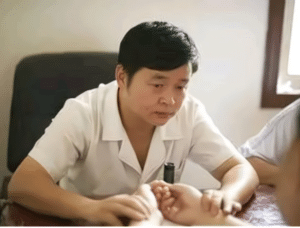
Trust Your Doctor — In traditional Chinese medicine, human life stages correspond with the four seasons, five elements and zang-fu organs. Childhood is like spring, associated with Wood and the Liver; youth resembles summer, linked to Fire and the Heart; middle age is autumn, matched with Metal and the Lung; old age is winter, governed by Water and the Kidney. Your body changes following these natural rhythms. When you feel unwell, trust your doctor, who reads the signals of your body and helps you restore balance between your inner self and nature.
A Story About Playing Pool
When I was in college, there was a period when I got really into playing pool. On weekend afternoons, I’d often invite a few close friends to the pool hall behind campus, where we’d play to our hearts’ content all afternoon—we weren’t satisfied until we’d decided a winner.
Playing billiards involves not only considering angles and power but also a lot of technique. One of my friends was particularly skilled; whenever I played him, I’d always lose the first two or three games. One time, we played until dark, and when we went out for a late-night snack together, we asked him to share his insights on the game. This expert said, “Treasure every shot you take!”
We were all captivated by his words, so we asked him to elaborate.
He said, “Often, when the angle is bad, it’s indeed hard to pocket the ball. At times like that, people tend to get impatient and take a careless shot—thinking, ‘If it doesn’t go in, so be it; I’ll just wait for the next chance.’ But that’s actually the wrong approach. Even with a difficult shot, there’s a way to handle it: you can control the cue ball to create difficulties for your opponent, or you can slowly work the ball to position it for an easier shot. If you see a shot that’s hard to make and just go for it without thinking, all you’ll do is create more opportunities for your opponent…”
“Treasure every shot you take!” Years later, my friend’s words still ring in my ears.
Life is like a game of billiards; you have many opportunities to take a shot. When the opportunity is good, a gentle push results in a beautiful pocket. When the opportunity isn’t good, it depends on how you handle it.
In clinical practice, we frequently encounter all kinds of patients and a wide variety of illnesses. This is especially true in Traditional Chinese Medicine (TCM), which isn’t a specialized field—we deal with an even broader spectrum of conditions. Some illnesses are simple; perhaps one or two doses of herbal decoction will do the trick, or maybe just one or two acupuncture sessions will suffice. But more often than not, we face complex conditions. It’s just like playing billiards: often, the ball’s angle isn’t ideal. To play a good game, in addition to honing your skills through regular practice, you need a strong mental attitude.
This is true for billiards, and it’s just as true for clinical practice!
Many chronic illnesses cannot be cured in just a day or two. Through careful observation, thorough differential diagnosis, and comprehensive consideration, we can formulate a reasonable treatment plan—and the disease will surely turn a corner.
Often, patients don’t understand this; they assume that if there’s no improvement after taking three to five doses of medicine, the doctor must be wrong. In fact, this is incorrect. Treating chronic diseases is like unraveling a tangled thread—just as in billiards, where difficult shots require careful, gradual execution and seizing the right moment. Doctors must cherish every opportunity for diagnosis and every prescription; patients, in turn, must value every visit, providing detailed feedback on how their condition changes after taking the medication. Only through this mutual cooperation—where both parties cherish every treatment opportunity—can we turn danger into safety and overcome the disease!
In fact, every time the human body falls ill, it is a test for the body. Getting sick isn’t a bad thing—it can actually promote better health and strengthen our immune system.
I remember three years ago, after staying up late for several days in a row, I woke up feeling noticeably drained. My vision was blurry, and I constantly felt like there was eye discharge, though when I wiped my eyes, there was nothing there. Since the liver manifests through the eyes, this discomfort immediately made me realize that staying up late had damaged my liver. So, I took a small handful of goji berries and seven or eight chrysanthemum blossoms, steeped them in boiling water, and drank the infusion like tea. As I drank it, I felt my eyes becoming more comfortable—it was truly an instant relief.
Later, whenever a patient described eye discomfort, I would habitually ask, “Do you constantly feel like there’s eye discharge, but when you wipe your eyes, there’s nothing there?” Many would nod in agreement. So when prescribing medication, I would use a combination of chrysanthemum flowers and goji berries, and the results were naturally excellent.
I remember one summer when the weather was humid. After eating starchy foods for several days, I felt discomfort during bowel movements—not that I couldn’t pass stool, nor that I couldn’t empty my bowels completely, but rather that the stool felt as if it were stuck to the intestinal walls. It took a lot of effort to pass stool, and I used a lot of toilet paper when wiping. This was a classic case of intestinal damp-heat. I prescribed Sophora flavescens and Poria cocos combined with a small amount of Artemisia argyi. After decocting the herbs and taking the decoction, the patient recovered quickly, but that sensation of stool sticking to the intestines remains unforgettable to this day.
Later, when I encountered patients with intestinal issues and detected intestinal damp-heat through pulse diagnosis, I would ask about their bowel movements. They would often reply that everything was fine. However, when I probed further—asking if their stool felt sticky or if they used a lot of toilet paper after a bowel movement—they would usually nod in agreement. In many people’s minds, as long as stools aren’t hard and dry or loose, they’re considered normal; they never associate sticky stools with intestinal abnormalities. If I hadn’t personally experienced the sensation of sticky stools caused by intestinal damp-heat, I might have accepted the patient’s self-report at face value, concluded their stools were normal, and ruled out intestinal damp-heat—which could easily lead to a misdiagnosis and a missed opportunity for timely treatment.
As a doctor, one must carefully observe the manifestations of illness within one’s own body each time one falls ill and fully understand the underlying pathogenesis. Only then, when encountering a patient with the same pathogenesis, will the doctor’s consultation be truly meaningful—rather than being rigid and simplistic, merely following textbook guidelines.
If you are studying Traditional Chinese Medicine (TCM), you should cherish your personal experiences even more. Use TCM pattern differentiation, acupuncture, and herbal decoctions to treat your own illnesses. Only by personally experiencing the wonders of TCM will you believe in its efficacy—and in your own prescriptions and every herb in your hands. Only with this belief can you truly master TCM and apply it effectively.
There are many opportunities in a person’s life. From the day we are born, we face choices, and every choice is an opportunity: pursuing higher education is an opportunity, and dropping out to enter the workforce is also an opportunity; securing a job after college is an opportunity, and having to temporarily change careers out of necessity is also an opportunity; encountering setbacks is an opportunity, and achieving even a small success is an opportunity; occasionally falling ill is an opportunity, and recovering from illness is also an opportunity…
Don’t wait until you want to be loved to learn how to give love; life is like a play, and in waiting, you miss the beauty;
Don’t wait until you’re lonely to remember your friends; in life, having one true friend is enough;
Don’t wait until you have a position to work hard; the world is truly wonderful, and as long as you’re willing to work hard, there are satisfying jobs everywhere;
Don’t wait until you fail to remember others’ advice; honest advice may be hard to hear but beneficial to follow, just as bitter medicine cures illness. People often prefer to believe slander because it always sounds so sweet;
Don’t wait until you fall ill to realize how fragile life is;
Don’t wait until you part ways to regret not cherishing your relationships;
Don’t wait until someone praises you to believe in yourself;
Don’t wait until someone points it out to realize you’re wrong. In fact, no one will mock you for having the courage to admit your mistakes; on the contrary, you’ll earn others’ respect;
Don’t wait until you’re rolling in money to help the poor. Helping others is always a virtue. By the time you’re rolling in money, you may not necessarily be happy, because others may not accept your charity;
Don’t wait until you’re on your deathbed to realize you should love life. Life is truly wonderful—why waste it on trivial pursuits? Life is like a long river—it has no end and no limits, and it doesn’t change because of your birth, aging, sickness, or death. To love life is to love yourself. After all, life must eventually come to a perfect conclusion.
Facing different circumstances with a positive mindset and cherishing every moment of life—that is what makes for a life without regrets.