Dehydration is the root cause of many chronic conditions. Issues such as headaches, lower back pain, high blood pressure, and gastrointestinal ulcers may all be linked to chronic insufficient water intake, and these problems can be alleviated through proper hydration.
The Story of Ironing Clothes
One day, when I was heading out to run some errands, my wife suggested I wear a suit. But when I went to look for it, I realized I hadn’t hung it up after the last dry cleaning, and now it was all wrinkled. It would be too embarrassing to go out looking like that—I might as well not wear it at all. But my wife said a suit makes me look sharp, so she told me to take it to the dry cleaner’s in our neighborhood and have them iron it. In the past, she was always the one who took care of the ironing. This time, though, she didn’t have enough time, so I had to go myself. Under the steam iron, the wrinkled suit became smooth and crisp in just a few minutes—it really looked the part. Looking at the crisp, well-pressed suit, I realized there was a lot to learn from this.
On the way home, as I reflected on the ironing process and observed the fresh green leaves and smooth bark along the roadside, my thoughts began to wander. I clearly remember that last winter, the branches along this road were withered, and the bark was all wrinkled. At the time, I thought the trees had frozen to death—could there be a similar principle at work here as with ironing clothes?
In summer, the weather is hot and the air is humid; nourished by the moist air, the trees’ bark appears smooth. Come winter, the weather turns cold and the air becomes dry; as the trees are buffeted by the cold wind, their bark dries out, shrinks, and becomes wrinkled. Could this be due to the effect of moisture?
Wrinkled clothes become smooth and flat under hot, humid steam; dry tree bark becomes moist and smooth in the humid summer. So what about the skin on our bodies?
Although the weather is hot in summer, our skin feels moist; in winter, even though there is often light rain or snow, our skin still feels dry.
The harmony between heaven and humanity—it is indeed true!
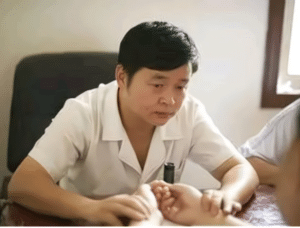
Not long after, I encountered a patient presenting with dry, hardened skin. The skin on her lower abdomen was taut like a drumhead, causing compression of the intestines within the abdominal cavity. As a result, the patient suffered from constant hiccups and difficulty swallowing; her lips had hardened and atrophied, making it difficult to speak; the skin on her fingers had atrophied and hardened, her hand joints were stiff, and her skin felt cold to the touch. She had been diagnosed with scleroderma at several hospitals and was managing her condition with steroid medication; over the three years since the onset of her illness, her condition had gradually worsened.
As I held the patient’s cold fingers and looked at her dry, atrophied skin—which resembled the withered bark of trees in winter—I fell deep in thought about how to restore this cold, parched skin to its normal state.
The Huangdi Neijing states: “Pure yang emerges through the pores, while turbid yin flows to the five internal organs.” The nourishment of the skin requires the distribution of wei qi (defensive qi) to the exterior; if wei qi is insufficient or cannot be distributed outward, the skin becomes dry and malnourished. The generation of wei qi relies on ying yin (nutritive yin); without sufficient yin, there is no source for its generation. For nourishing yin to transform into defensive qi, it also requires the warming and nurturing action of yang qi. If yang qi is excessively vigorous, it will evaporate and refine the nourishing yin, leading to its deficiency and insufficient generation of defensive qi; if yang qi is excessively deficient, the nourishing yin will lack the means to transform into qi, and defensive qi will also be insufficient.
The passage above can be understood as follows: the body’s Nourishing Yin is like a pot of water, and the body’s Yang Qi is like a fire of firewood. The firewood boils the water, transforming it into steam. The body’s Defensive Qi is like this moist vapor, which keeps the skin hydrated. If the fire burns too fiercely and the water boils dry, the steam will naturally disappear; at this point, more water must be added to continue producing steam. If the fire is too weak to bring the water to a boil, steam cannot be produced; in this case, the body’s yang qi must be replenished.
Scleroderma is very difficult to treat. The patient’s medical record is a thick volume documenting their medication history; most of the traditional Chinese medicine prescriptions focused on nourishing yin, but the results were unsatisfactory and failed to halt the progression of the disease.
Think of the scene of ironing clothes with an iron, or the process of firing a boiler. Then look at the patient before me and feel their cold, dry, and atrophied hands—the treatment approach gradually became clear.
So I prescribed the following formula for the patient: Aconite Root, White Atractylodes, Wild Atractylodes, Dried Ginger, Poria, Astragalus, Chinese Angelica, White Peony, Prepared Rehmannia, Processed Polygonum Multiflorum, Chinese Yam, Dodder Seed, Schisandra, and Raw Licorice.
Among these, Aconite, Dried Ginger, Cinnamon Twig, and Astragalus are all warming herbs that nourish the body’s yang energy. They are like the fire in a boiler or the electricity heating an iron—their purpose is to vaporize the body’s fluids, which is the only way to nourish the skin; Danggui, Baishao, Shudidi, Zhishouwu, and Huai Shan are herbs that nourish Yin. They are like the water in the boiler and the iron—the fire can only function when there is water; without water, even the fiercest fire is useless; Dodder Seed (Tu Si Zi) nourishes kidney essence; Poria (Fu Ling) drains dampness. This is because the patient has long suffered from a deficiency of yang qi, resulting in the failure of nourishing yin to transform and the retention of turbid yin within the body. Combined with Schisandra (Wu Wei Zi) to consolidate the body’s vital energy, the turbid yin can be eliminated without harming the vital energy.
Some may wonder: Why use Atractylodes macrocephala and Atractylodes lancea?
The spleen governs transformation and transportation. The body’s yang qi transforms the nourishing yin, which then rises gradually through the spleen to reach the lungs, where it is dispersed to the skin and muscles. The *Shennong Bencao Jing* states: “Atractylodes has a bitter and warm nature; it treats wind, cold, and dampness-induced arthralgia and atrophy of the muscles.” This refers to the ability of Atractylodes macrocephala and Atractylodes lancea to strengthen the spleen, nourish the earth element to generate the metal element, and moisturize the skin and muscles.
After the patient took the above prescription, their condition began to improve. Their skin gradually became warmer and softer. Previously, they had been particularly sensitive to the cold in winter, but after taking these Yang-nourishing herbs, their symptoms of aversion to cold improved significantly.
Just as we can use an iron to smooth out wrinkled clothes, why can’t we use medicine to smooth out our wrinkled skin?
In clinical practice, we frequently encounter patients with insomnia. When we look at the deep and shallow wrinkles on their faces and the chaotic lines on their palms, we realize that these very lines are the patient’s body revealing the nature of their condition—a deficiency of yin fluids within their body! Chronic insomnia and prolonged late nights damage the body’s yang energy, and behind this damage to yang lies damage to yin as well, because yin is the foundation of yang. By improving the patient’s sleep quality and correcting the body’s imbalance of yin and yang deficiency, it won’t be long before the wrinkles on their face and the chaotic lines on their palms begin to fade.
Traditional Chinese Medicine (TCM) draws upon the concept of “harmony between heaven and humanity.” Only by placing the patient within the context of nature and applying this framework can we resolve numerous complex medical issues.
In fact, we can experience this principle in our daily health practices as well.
In the north, where the weather is cold, every household uses central heating. On chilly nights, sleeping in a heated room naturally feels very comfortable, but often, because the heat is too intense, spending even a short time indoors can lead to a dry, sore throat and uncomfortable, dry skin. Experienced people will place a large basin filled with water in their home; this significantly humidifies the air, making people feel more comfortable. The principle is actually quite simple: it’s due to the low humidity in the air. By adding a basin of water, the moisture evaporates in a warmer environment, increasing humidity and making people feel more comfortable.
When we have a cold or fever and our body temperature rises, excessive water loss through evaporation can also lead to a dry throat and sore throat. Doctors often advise patients to drink more water—this works on the same principle as placing a basin of water in a heated room: it’s all about replenishing fluids.
When we are young, the body’s yin and yang energies remain robust, and metabolic functions operate normally, resulting in smooth, rosy skin. As time passes, when men reach 40 and women reach 35, the body’s yang energy begins to decline.
The *Huangdi Neijing* states: “At the age of five sevens, a woman’s Yangming meridian declines; her face begins to wither, and her hair begins to fall out. At the age of six sevens, the Three Yang meridians decline in the upper body; her face becomes completely withered, and her hair begins to turn white; for men, at the age of five eights, kidney qi declines, hair falls out, and teeth become brittle; at the age of six eights, yang qi exhausts in the upper body, the face becomes withered, and the temples begin to turn white.”
From this passage, we can see that when our bodily functions gradually decline, our skin becomes increasingly rough, and our movements grow slower, we should recognize this as the result of the decline of the body’s yin and yang energies. Appropriately replenishing the body’s deficient yang qi and yin essence can delay aging and restore vitality. Those who routinely experience symptoms such as dry skin, a sallow complexion, dizziness, palpitations, restlessness, and insomnia may consider taking blood- and yin-nourishing supplements, such as ejiao, to replenish blood and nourish yin. Conversely, those with symptoms of yang deficiency—such as aversion to cold, cold limbs, cold hands and feet, and loose stools or diarrhea—may consider increasing their intake of warming foods like beef and lamb, or taking yang-tonifying medications such as Fuzi Lizhong Pills or Gui Fu Di Huang Pills.
It is impossible for humans to remain eternally youthful, but as long as we understand the importance of the Yin and Yang energies, we can nurture Yin appropriately when needed—taking our physical condition into account—and tonify Yang when necessary, again based on our actual circumstances. In this way, the body can maintain a state of relative balance, leading to health and longevity.
As the *Inner Canon* states, “Follow the principles of yin and yang”—this is precisely what it means! Many aspects of daily life find corresponding manifestations in our bodies; to gain insight into life is to gain insight into the principles of medicine.