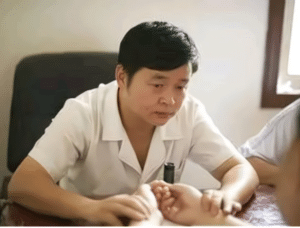
Stimulating acupoints can indeed help activate the body’s self-healing abilities, a claim supported by traditional Chinese medicine theory. The core principle involves stimulating key points along the meridians through methods such as massage and moxibustion to unblock the meridians, harmonize qi and blood, and strengthen the body’s vital energy, thereby aiding the body’s self-repair. Modern research has also found that acupoint stimulation can regulate the nervous system and improve blood circulation.
If you want to activate your body’s self-healing abilities through acupoints, you can start with the following approaches
Key Acupoints for Daily Wellness: Massaging Zusanli (four finger-widths below the outer side of the knee), Guanyuan (four finger-widths below the navel), Dazhui (the depression below the most prominent bone at the base of the neck when you tilt your head down), and Yongquan (the depression at the front of the sole of the foot) can help regulate the spleen and stomach, nourish original qi, invigorate yang energy, and improve sleep. These are simple at-home wellness practices. Massage each point for 3–5 minutes until you feel a mild sensation of soreness and fullness.
Targeted Relief for Discomforts: Different minor ailments can be addressed by stimulating specific acupoints. For example, for headaches and fever, press Hegu (at the web between the thumb and index finger on the back of the hand); for insomnia and vivid dreams, press Shenmen; for stomach pain and constipation, press Zusanli; for nasal congestion, press Yingxiang; and for chest pain and tightness, press Neiguan.
Relief for Eye Strain: Massage the Zanzhu acupoint (in the indentation at the inner end of the eyebrow), Yuyao acupoint (between the eyebrows), Sizhukong acupoint (in the indentation at the outer end of the eyebrow), and Qingming acupoint (in the indentation at the inner corner of the eye), among others. Massage each acupoint clockwise and counterclockwise for four sets of eight beats each to help relieve eye strain.
Acupoint massage emphasizes a “sore and full sensation” rather than the more pain, the better; the pressure should be moderate. It is not recommended to massage on an empty stomach or within one hour after a meal, and areas with broken skin or infections should be avoided. Pregnant women should take special care: acupoints such as Hegu and Sanyinjiao are contraindicated, as they may trigger uterine contractions.
The Story of the Quarry
When I was a child, there was a quarry near my hometown. Every day, workers would quarry stone from the mountain, which was then transported to town and sold to builders. The builders used some of it to lay the foundations of houses, while the rest was crushed into gravel for use in concrete. What had once been a mountain lush with trees had been left scarred and ravaged by the quarry workers’ day-after-day excavation. Piles of discarded rubble and household trash lay scattered everywhere, with yellow soil and rock laid bare. Whenever it rained, the rainwater would wash fine gravel and silt down to the riverbed at the foot of the mountain, causing severe soil erosion.
My great-grandfather would often mutter, “If they keep quarrying like this, this mountain will be ruined; this mountain range is on the verge of being destroyed…”
After graduating from high school, I went to college, then graduated and started working in another city; I hadn’t returned home in the summer for many years. A few years ago, during the May Day holiday, I returned home and witnessed nature’s power to heal. The quarry was right by the roadside. As I walked along the country road, I was enchanted by the birdsong and the fragrance of flowers all around me, while searching for the mountain village I remembered from my childhood. The old dirt roads had been replaced by concrete ones; the once-barren mountains were now covered with trees; and those vast, once-glaring quarry sites were now a vibrant green, transformed into lush forests.
I asked the village elders when they had started planting trees on the mountain. They told me that quarrying had stopped several years ago; with no human disturbance, the mountainside had gradually healed on its own. Vines and creepers had grown more and more abundant, and the trees on the mountain were now as thick as a person’s arm.
Nature’s self-healing power is truly amazing!
I. Just like nature, the human body possesses a powerful ability to heal itself
After returning to the city, I was chatting with a friend about nature’s restorative power. My friend, who had practiced qigong, remarked that the human body’s ability to heal itself is no less impressive than nature’s. “Look at workers who are busy all day long—by evening, they’re exhausted and their limbs ache. But as long as they take a hot shower and get a good night’s sleep, they’re back to being full of energy and vitality the next day. Isn’t that one night’s rest the human body’s own self-healing process?”
My friend’s words really opened my eyes. That’s right! Humans are in harmony with heaven and earth, the spirit of all things; naturally, we experience nature’s restorative power within our own bodies. Later, I met an elderly physician who told me that when treating young patients, one need only stimulate the latent potential of their internal organs—there’s no need to use excessive medication to target the disease, as that can actually harm the organs themselves. For elderly patients, however, whose organ functions have already declined, simply stimulating their potential isn’t enough; targeted medication is also necessary.
This insight has been immensely beneficial to me.
Drawing on the theory of the harmony between heaven and humanity, all medicinal substances found in nature exist within the human body as well—they are simply stored in different locations. When treating illness with external medications, we use “external remedies” to correct imbalances. In acupuncture treatment, we also use “external remedies” to correct imbalances, but we draw upon the body’s own internal reservoir of healing power—the principle is the same.
II. Stimulating Acupoints to Activate the Body’s Self-Healing Ability
One afternoon, a 6-year-old boy discovered a lump on his right jaw, about the size of a broad bean. His parents bought him amoxicillin granules, but after taking them for a day, there was no improvement. The next day, his condition worsened; the lump had grown to the size of a quail’s egg. It was soft and movable upon palpation. He showed no symptoms such as toothache, sore throat, cough, phlegm, nasal congestion, or runny nose, and his six pulses were normal. Because the child was young and disliked the bitter taste of Chinese herbal medicine, he refused to take it, so the doctor prescribed cefaclor. On the third day, the lump continued to grow and had already extended below the ear. The right side of the child’s face was noticeably swollen, and the lump had become very hard, making it difficult for him to even eat congee. The parents hurriedly took the child to the city children’s hospital for treatment. A complete blood count showed no abnormalities, and the hospital was unable to provide a definitive diagnosis, so they simply administered an IV drip. By the sixth day, the swelling had still not subsided, so the parents brought the child to me for treatment with Chinese herbal medicine. At this point, the swelling had extended to the area below the right ear; it was neither red nor hot, but felt hard to the touch and was markedly tender. The tongue was red with a thin white coating. Upon pulse examination, all six pulses were steady, though the right cun pulse was slightly weak and the right chi pulse was slightly floating.
I treated him by needling the right Hegu (LI4) acupoint. Upon insertion, there was a distinct sensation of resistance, and the child also felt significant pain. After leaving the needle in for 10 minutes, I manipulated it with a lifting-and-thrusting technique that felt as smooth as moving through water. The skin around the Hegu acupoint became numb, and I left the needle in for another 8 minutes before removing it. At the follow-up visit the next day, the mass had shrunk to the size of a quail’s egg. I continued treating him with acupuncture at the Hegu point; after three consecutive sessions, the mass resolved completely.
Hegu: “He” means “to converge” or “to gather”; “Gu” refers to the hollow between two mountains. Hegu signifies the point where the qi and blood of the Large Intestine Meridian converge to form a powerful field of water, dampness, and wind. The substance at this point consists of water-dampness and cloud-like qi transmitted horizontally from the “Tian” (Heaven) level of the Sanjian (Three Intervals) point. Upon reaching this point—located between the first and second metacarpal bones on the back of the hand, where the muscular gaps are relatively large—the qi and blood transmitted from the Sanjian point converge here. This convergence forms a powerful field of water-dampness and cloud-like qi, hence the name Hegu.
The Large Intestine Meridian runs from the hand to the head. For any facial ailments—such as toothaches, headaches, fever, dry mouth, nosebleeds, neck pain, sore throat, and other disorders of the five senses—treatment beginning at the Large Intestine Meridian is effective. Therefore, Traditional Chinese Medicine holds the saying, “Treat the face and mouth by addressing Hegu.” Acupuncture at the Hegu point essentially stimulates the latent potential of the body’s internal organs, promoting self-healing—an approach that surpasses direct treatment of the disease itself.
“For the face and mouth, treat Hegu” is a line from the “Four General Points” verse. The original four lines read: “For the abdomen, treat Zusanli; for the lower back, treat Weizhong; for the head and neck, treat Lieque; for the face and mouth, treat Hegu.” Originally published in *Qiankun Shengyi* by Zhu Quan of the Ming Dynasty, it was later included in *Juying of Acupuncture and Moxibustion*, *Compendium of Acupuncture and Moxibustion*, *Yang Jingzhai’s Complete Book of Acupuncture and Moxibustion*, and *The Great Compendium of Acupuncture and Moxibustion*.
The Four General Acupoints evolved from the passage in *The Yellow Emperor’s Inner Canon: Ling Shu: Beginning and End*: “For conditions above the waist, the Hand Taiyin and Yangming meridians are primarily responsible; for conditions below the waist, the Foot Taiyin and Yangming meridians are primarily responsible.” For ailments affecting the front of the body—such as dysfunction of the spleen, stomach, or intestines, manifesting as abdominal pain, vomiting, or diarrhea—Zusanli (ST36) should be the first choice for treatment; for ailments affecting the back, such as soreness in the lower back and spine, the Weizhong acupoint should be selected for treatment; for conditions affecting the head, neck, chest, and lungs, the Lieque acupoint should be used, as it has the effect of “dispelling wind and cold, clearing the lungs, and relieving cough”; and for ailments of the head and face—primarily those involving the mouth and facial region—the Hegu acupoint can be used for treatment.
Later generations expanded upon this foundation by adding the Neiguan and Shuigou acupoints, forming the “Six General Acupoints” verse: “For the head and neck, seek Lieque; for the face and mouth, use Hegu; for the abdomen, rely on Zusanli; for the lower back, seek Weizhong; for the chest and flanks, respond with Neiguan; for emergency care, turn to Shuigou.” When these six acupoints are applied correctly, most diseases of the human body can be cured.
One afternoon in 2010, a patient came in for treatment after suffering from breathing difficulties due to an asthma attack for two days. He reported that both inhaling and exhaling were difficult; he felt as though qi was stagnant in his chest, unable to move up or down. His symptoms worsened with even slight movement, and he was unable to lie flat while sleeping. Upon examination, the patient’s lungs were filled with wheezing sounds, accompanied by cyanosis of the lips. His tongue was pale with a thin white coating. Pulse diagnosis revealed a stagnant and slippery pulse between the Cun and Guan positions on the right wrist, while the Cun pulses on both wrists were fine and weak, almost imperceptible.
The patient’s chest was obstructed by phlegm and stagnant qi, impeding the proper rise and fall of qi. Therefore, treatment should first focus on unblocking the flow of qi in the chest. Consequently, I needled the Shao Shang points on both sides to disperse lung qi, extracting several drops of purplish-black stasis blood from each. Simultaneously, I needled the Neiguan points on both sides to regulate the flow of qi in the heart and chest—as the saying goes, “The heart and chest are governed by Neiguan”—using a dispersing technique. After 10 minutes, the patient’s breathing became smooth, the wheezing subsided, and upon pulse examination, the Cun pulses on both sides regained a firm and distinct quality. Subsequently, I used long needles to stimulate both Zusanli (ST36) points to strengthen the stomach and descend qi; I added moxa wool to the tip of the needle and lit it, combining acupuncture with moxibustion. At the same time, I needled both Fenglong (ST40) points to resolve phlegm and subdue counterflow. After about half an hour, I removed the needles. The patient was breathing smoothly, with no wheezing audible on auscultation of the lungs; he was able to get up and move about freely and felt much lighter. I then prescribed Xiao Qinglong Decoction with the addition of Zhike and Jiegeng, for three doses.
During this patient’s treatment, I fully applied the principles from the “Six General Acupoints Rhyme”—“For the abdomen, retain Zusanli; for the chest and flanks, respond with Neiguan”—using acupuncture to stimulate the latent potential of the internal organs and facilitate the body’s self-healing process.
There are many such acupoints in the human body. Some can tonify qi, such as Spleen Shu (SP21), Zusanli (ST36), Tanzhong (CV17), Yongquan (KI1), Guanyuan (CV4), Qihai (CV6), Taixi (KI3), Baihui (GV20), Lung Shu (BL13), and Xuanzhong (BL54). These are renowned as the “Ten Major Qi-Tonifying Acupoints” and function much like commonly used qi-tonifying herbs; Some acupoints tonify blood, such as Xuehai, Tianshu, Guanyuan, Zusanli, Sanyinjiao, Yinbai, Biguan, Xiaguan, Qimen, and Zhangmen. These are hailed as the “Ten Major Blood-Tonifying Acupoints,” much like commonly used blood-tonifying herbs; among them, Guanyuan and Zusanli can both tonify qi and blood.
By understanding these acupoints, one can use them to correct imbalances and treat illnesses, thereby fully harnessing the body’s self-healing capabilities.
III. Fully Utilizing the Body’s Self-Repair Capabilities
In daily life, when we accidentally cut our finger with a knife, what we need to do is clean and bandage the wound to prevent infection—not seek out the best doctor to stitch it up so that it looks exactly like normal skin. That is impossible and unnecessary. Although large wounds require stitches, the healing of wounds relies on our skin’s natural self-healing ability. As we watch the wound heal day by day, we should realize just how powerful the body’s restorative capacity truly is.
Often, when we suffer from chronic illnesses that are difficult to cure and recur frequently, we should ask ourselves: What is preventing the body from healing itself? Is it external or internal factors? Is it poor lifestyle or dietary habits, the influence of our work environment, or excessive emotional stress? By identifying the factors that are harmful to our bodies and making improvements—overcoming the obstacles that hinder the body’s self-healing—we allow this powerful self-healing ability to take full effect, thereby curing the disease at its root.
Never underestimate our bodies. As the spirit of all creation, the human body is a living, highly sophisticated organism—not merely a mass of flesh and blood. Please cherish it, treasure it, and try to understand it.
When we cannot fully comprehend the human body, we can often unravel many mysteries by drawing on the principle of harmony between heaven and humanity and through the use of analogies and symbolism. Let’s explore Traditional Chinese Medicine through another story: the story of fogged-up glasses.