Artemisia, a name in traditional Chinese medicine, refers to the dried aerial parts of Artemisia annua L., a plant of the genus Artemisia in the Asteraceae family. This herb has the effects of clearing deficient heat, eliminating bone-consuming fever, relieving summer heat, arresting malaria, and reducing jaundice. It is primarily used to treat yin deficiency caused by warm pathogens (manifesting as fever at night and coolness in the morning), yin deficiency fever, bone-consuming fever, summer-heat-induced fever, malaria with alternating chills and fever, and damp-heat jaundice.
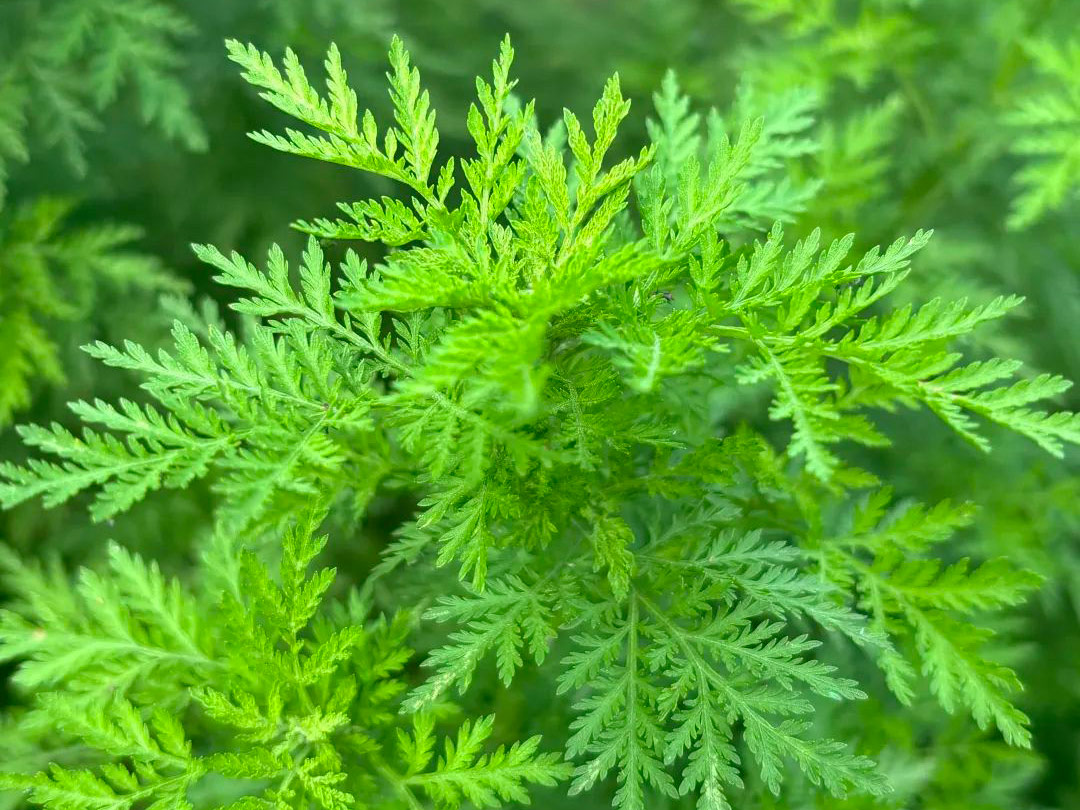
Artemisia
Artemisia, a name in traditional Chinese medicine, refers to the dried aerial parts of Artemisia annua L., a plant of the genus Artemisia in the Asteraceae family. This herb has the effects of clearing deficient heat, eliminating bone-consuming fever, relieving summer heat, arresting malaria, and reducing jaundice. It is primarily used to treat yin deficiency caused by warm pathogens (manifesting as fever at night and coolness in the morning), yin deficiency fever, bone-consuming fever, summer-heat-induced fever, malaria with alternating chills and fever, and damp-heat jaundice.
Chinese Name : 青蒿
Latin Name : Artemisiae Annuae Herba
Aliases : Artemisia seeds, Stinking Artemisia, Fragrant Artemisia, Bitter Artemisia, Stinking Blue Artemisia, Fragrant Blue Artemisia, Narrow-leaved Artemisia, Narrow Blue Artemisia, Grass Blue Artemisia, Grass Artemisia seeds
Authentic Producing Area : Produced in most regions of China
Nature, Flavor & Meridian Tropism : Cold in nature; bitter and pungent in taste; enters the Liver and Gallbladder meridians
Benefits & Efficacy
Benefits
Clears deficient heat, alleviates bone-consuming fever, relieves summer heat, stops malaria, and reduces jaundice.
Indications
1. Heat pathogens injuring yin, with fever at night and coolness in the morning: This herb is bitter and cold, clearing heat, and pungent and aromatic, promoting dispersion. 2. Fever due to yin deficiency, bone-steaming fever, and consumptive fever: This herb is bitter and cold; it enters the Liver meridian and moves through the blood, effectively clearing deficient heat and eliminating bone-steaming fever. 3. Fever caused by summer-heat pathogens: This herb is bitter and cold, clearing heat, and pungent and aromatic, promoting dispersion; externally, it relieves summer heat. 4.Malaria with alternating chills and fever: This herb is pungent, cold, and aromatic, primarily entering the Liver and Gallbladder meridians. It is highly effective at arresting malaria, particularly at relieving malaria attacks characterized by chills and high fever. It is a key herb for treating malaria with alternating chills and fever and is most suitable for cases of malaria complicated by summer-heat or damp-heat. 5. Damp-heat jaundice: This herb also has the function of promoting bile secretion and alleviating jaundice, and can be used for damp-heat jaundice.
Usage and Dosage
Oral Use: Decoct 6–12 g; do not boil for too long; or use fresh, squeezing out the juice to drink.
Precautions
Use with caution in patients with spleen-stomach deficiency or loose stools.
Chemical Constituents
This herb primarily contains sesquiterpenes, flavonoids, coumarins, volatile components, as well as β-galactosidase, β-glucosidase, β-sitosterol, and others. Sesquiterpenes include artemisinin, artemisinic acid, artemisinol, and methyl artemisinate.Flavonoids include 3,4-dihydroxy-6,7,3’,4’-tetramethoxyflavonol, cat’s-eye flavone, and cat’s-eye phenol.Coumarins include coumarin, 6-methoxy-7-hydroxycoumarin, and scopolin. The volatile components are primarily composed of caryophyllene, β-caryophyllene, isartemisinone, (S)-camphor, β-caryophyllene, and borneol, and also contain α-pinene, artemisinone, and camphor.
Pharmacological Actions
The neutral fraction of the diethyl ether extract of this product and its dilute alcohol extract exhibit significant antimalarial activity, while artemisinin and its derivatives possess anti-schistosomal activity in animals.Artemisinin, artemether, and artemisinate all stimulate the body’s cellular immune response. Artemisinin can slow the heart rate, inhibit myocardial contractility, reduce coronary blood flow, and lower blood pressure. Artemisia annua exhibits bactericidal and virucidal effects against a variety of bacteria and viruses. It has good antipyretic and analgesic effects and acts synergistically with honeysuckle, resulting in rapid and sustained fever reduction. Artemether provides radiation protection.Artemisinin has shown significant efficacy against experimental silicosis. Studies indicate that artemether exhibits marked cytotoxic effects on human hepatocellular carcinoma cells in vitro; in oral in vivo experiments, it demonstrates antitumor activity against liver cancer in mice and exhibits synergistic anticancer effects with 5-fluorouracil.Furthermore, results from specific toxicity tests on Artemisia annua suggest that artemisinin may have genotoxic effects, while artemether sodium exhibits significant embryotoxicity; administration during early pregnancy may cause delayed bone marrow development in the embryo.
Relevant Discussions
1. *Compendium of Materia Medica*: “Treats the chills and fever of malaria.”
2. *New Compilation of Materia Medica*: “Relieves summer heat.”
Applications
Clinical Applications
1. For the late stage of warm diseases, where residual heat has not been cleared, pathogenic factors are latent in the yin aspect, yin is injured, and body fluids are depleted—manifesting as fever at night and coolness in the morning, fever subsiding without sweating, or persistent low-grade fever following a febrile illness—it is often used in combination with softshell turtle shell, Anemarrhena rhizome, Moutan bark, and raw Rehmannia root, as in the Artemisia and Softshell Turtle Shell Decoction (*Treatise on the Differentiation of Warm Diseases*).
2. Treats fever due to yin deficiency, consumptive fever, tidal fevers, night sweats, and heat in the palms, soles, and chest, with a red tongue and little coating. It is often used in combination with Silver-processed Bupleurum, Coptis chinensis, and Anemarrhena asphodeloides, as in the Bone-Clearing Powder (from *Zhengzhi Zhunsheng*).
3. For treating external invasion by summer-heat, characterized by dizziness, headache, fever, and thirst, it is often combined with Forsythia, Talc, and watermelon rind, as in the Decoction for Clearing Heat and Dispelling Summer-Heat (Treatise on Seasonal Diseases).
4. As described in Emergency Formulas for Use at the Bedside, it may be used alone in a relatively large dose by pounding fresh material to extract its juice, or combined with Scutellaria, Talc, Indigo Powder, and Akebia according to the specific syndrome.This herb possesses an aromatic, dispersing nature and excels at clearing and resolving heat pathogens from the liver and gallbladder. It can be used in combination with herbs such as Scutellaria baicalensis, talc, and Pinellia ternata to treat conditions where damp-heat is stagnant in the Shaoyang and Sanjiao channels, leading to impaired Qi circulation, malaria-like alternating chills and fever, and chest fullness with vomiting, as seen in the Artemisia and Scutellaria Gallbladder-Clearing Decoction (from *Popular Treatise on Cold Damage*).
Related Compatibility
1. Artemisia annua combined with Anemarrhena asphodeloides: Artemisia annua excels at clearing deficient heat and eliminating bone-steaming fever; Anemarrhena asphodeloides is particularly effective at nourishing yin, moistening dryness, and purging deficient fire from the kidneys. When combined, these two herbs work together to nourish yin, clear heat, and eliminate bone-steaming fever, making this formula suitable for conditions of yin deficiency with internal heat, characterized by bone-steaming fever, tidal fever, and night sweats.
2. Artemisia annua combined with white mung beans: Artemisia annua, with its aromatic properties, transforms turbidity, clears heat, and relieves summer heat; white mung beans relieve summer heat, drain dampness, strengthen the spleen, and harmonize the middle jiao. When combined, these two herbs enhance the effects of clearing summer heat, strengthening the spleen, and draining dampness. This combination is suitable for conditions involving summer heat mixed with dampness, characterized by fever, dizziness, nausea, vomiting, and diarrhea.
3. Artemisia annua combined with Scutellaria baicalensis: Artemisia annua has an aromatic nature that disperses stagnation and is particularly effective at clearing heat and arresting malaria; Scutellaria baicalensis is bitter and cold, drying dampness, and is particularly effective at clearing and draining damp-heat. When combined, these two herbs enhance the ability to clear heat, dry dampness, and arrest malaria. This combination is suitable for conditions such as damp-heat stagnating in the Shaoyang channel, alternating chills and fever resembling malaria, and chest fullness with vomiting.
Medicinal Identification
Artemisia annua and Diguipi: Both can clear heat, cool the blood, and eliminate night sweats; they are effective against both deficient heat and excess heat, and can be used for both yin-deficiency fever and fire-heat excess patterns.However, Artemisia annua is pungent, cold, aromatic, and penetrating; it excels at clearing latent heat in the yin level and is therefore particularly effective for treating febrile diseases that injure yin, as well as conditions where pathogenic factors are latent in the yin level—manifesting as nighttime fever with morning coolness, absence of sweat, and bone-steaming fever. On the other hand, Lycium bark is sweet, bland, and slightly cold; it nourishes yin and cools the blood, excelling at clearing deficient fire in the liver and kidneys, and is thus especially suitable for liver and kidney yin deficiency with tidal fever and night sweats.Furthermore, Artemisia annua clears summer-heat and reduces fever, making it suitable for external summer-heat syndromes; Lycium bark clears lung heat and reduces fire, making it suitable for coughs caused by lung heat. Artemisia annua is a key herb for treating malaria and should be the first choice for malaria with alternating chills and fever; Lycium bark can also generate body fluids and quench thirst, making it commonly used for internal heat and diabetes.
Related Medicines
Cold and Cough Relief Granules (syrup, compound), Digestive and Fever-Reducing Syrup, Ganlu Tea, Pediatric Summer-Heat Relief Syrup.
Related Prescriptions
Artemisia and Soft-shelled Turtle Shell Decoction (*Treatise on Warm Diseases*), Bone-Clearing Powder (*Standards for Diagnosis and Treatment*), Artemisia and Scutellaria Gallbladder-Clearing Decoction (*Revised Popular Treatise on Cold Damage*), and Summer-Heat-Clearing Decoction (*Explanation of Warm and Febrile Diseases*).
Medicinal Diet Therapy
Artemisia Porridge:
1. Effects: It clears heat, relieves summer heat, and reduces deficiency heat. It can be used to help alleviate fever caused by external pathogens (such as summer heat) and yin deficiency fever.
2. Ingredients: 100 grams of fresh Artemisia annua, 50 grams of japonica rice, and an appropriate amount of white sugar.
3. Preparation: Wash the Artemisia annua thoroughly. Place it in a pot with the japonica rice, add an appropriate amount of water, bring to a boil over high heat, then reduce to low heat and simmer slowly until the mixture becomes thick and sticky.
4. Dosage: One bowl daily.
Notes
Patients requiring treatment with traditional Chinese medicine should first consult a licensed TCM hospital, where a TCM practitioner will conduct a professional pattern differentiation and issue a prescription.
Processing & Preparation
Harvesting & Processing
Harvest during the autumn flowering season; remove old stems and impurities, then air-dry in the shade.
Processing Methods
Take the raw herbal material, remove impurities, spray with clean water to slightly moisten, cut into sections, and dry.
Storage Methods
Store in a cool, dry place.
Crude Drug Identification
Identification
Take 3 g of the powdered product, add 50 mL of petroleum ether (60–90°C), and heat under reflux for 1 hour;filter; evaporate the filtrate to dryness; dissolve the residue in 30 mL of n-hexane; extract three times by shaking with 10 mL of a 20% acetonitrile solution each time; combine the acetonitrile extracts and evaporate to dryness; dissolve the residue in 0.5 mL of ethanol to prepare the test solution.Separately, take an artemisinin reference standard and dissolve it in ethanol to prepare a solution containing 1 mg per mL; use this as the reference solution. Perform the test according to the thin-layer chromatography method (General Chapter 0502). Pipette 5 μL of each of the two solutions and apply them separately onto the same silica gel G thin-layer plate. Develop with a mobile phase of petroleum ether (60–90 °C)-diethyl ether (4:5) as the developing agent, develop the plate, remove it, allow it to air-dry, spray with a 10% ethanol solution of sulfuric acid containing 2% vanillin, heat at 105°C until the spots become clearly visible, and examine under ultraviolet light (365 nm). In the test solution chromatogram, fluorescent spots of the same color appear at positions corresponding to those in the reference standard chromatogram.
Properties of Crude Drugs
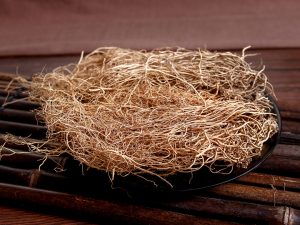
The stem of this product is cylindrical, highly branched toward the upper part, 30–80 cm long, and 0.2–0.6 cm in diameter; the surface is yellowish-green or brownish-yellow, with longitudinal ridges; it is slightly hard in texture, breaks easily, and has a pith in the center of the cross-section.The leaves are alternate, dark green or brownish-green, curled and brittle; when flattened, intact leaves are deeply three-pinnately lobed, with lobes and sublobes oblong or oblong-elliptic, and both surfaces covered with short hairs. It has a distinctive aromatic odor and a slightly bitter taste.
Properties of Processed Slices
This product consists of irregular segments, 0.5–1.5 cm long. The stems are cylindrical, with a yellowish-green or brownish-yellow surface bearing longitudinal ridges; they are slightly hard in texture, with a yellowish-white cross-section and white pith.The leaves are mostly shriveled or fragmented, dark green or brownish-green; when intact and flattened, they are deeply pinnately lobed three times, with lobes and sublobes that are oblong or oblong-elliptic, and both surfaces covered with short hairs. The flowers are yellow, with a distinctive aroma and a slightly bitter taste.
Botanical Information
Botanical Classification
Artemisia annua, a member of the genus Artemisia in the Asteraceae family.
Morphological Characteristics
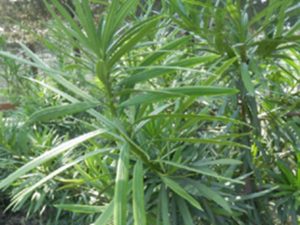
An annual or biennial herb, 30–150 cm tall, entirely smooth and glabrous. The stem is cylindrical, bluish-green when young, with fine longitudinal grooves on the surface; the lower part is slightly lignified, and the upper part branches from the leaf axils.Leaves are alternate; twice pinnately lobed, with first-order lobes elliptic and second-order lobes linear, entire or with 1–3 pinnately shallow lobes on each side, acuminate at the apex, soft in texture, smooth and glabrous on both surfaces, and bluish-green.Capitula are arranged in racemose panicles; each capitulum is lateral, slightly pendulous, and approximately 6 mm in diameter; the involucre is hemispherical, with 3–4 layers of bracts; the outer bracts are narrowly elongated, while the inner ones are ovate, with membranous margins; the receptacle is surrounded by tubular pistillate flowers on the outer rim, while the inner part contains only a single pistil with a 2-lobed stigma;The inner flowers are mostly hermaphroditic, greenish-yellow in color, with a tubular corolla, 5 stamens with slender, short filaments, and a single pistil with a filiform style and a 2-lobed, fork-shaped stigma. The achenes are oblong to elliptical, minute, and brown. Flowering occurs from June to July. Fruiting occurs from September to October.
Distribution Area
It is distributed throughout northern and southern China.
Pest and Disease Control
1. Stem rot: During the rainy season, if stem rot occurs, it can be controlled with Metil or Topsin-M.
2. Aphids: Spray pesticides before aphids migrate and spread; use 40% Dimethoate, 20% S-methamidophos, or Aphid-Louse Cleaner at the recommended rate per mu for control.