Mountain Cigu is the name of a traditional Chinese medicine. It consists of the dried pseudobulbs of the orchid species Cremastra appendiculata (D.Don) Makino, Pleione bulbocodioides (Franch.) Rolfe, or Pleione yunnanensis Rolfe. The former is commonly known as “Hairy Cigu,” while the latter two are commonly known as “Ice Ball Seeds.”It has the therapeutic effects of clearing heat and detoxifying, as well as resolving phlegm and dispersing nodules. It is primarily used to treat abscesses, boils, and carbuncles; scrofula and phlegm-nodules; snake and insect bites; and masses and lumps.
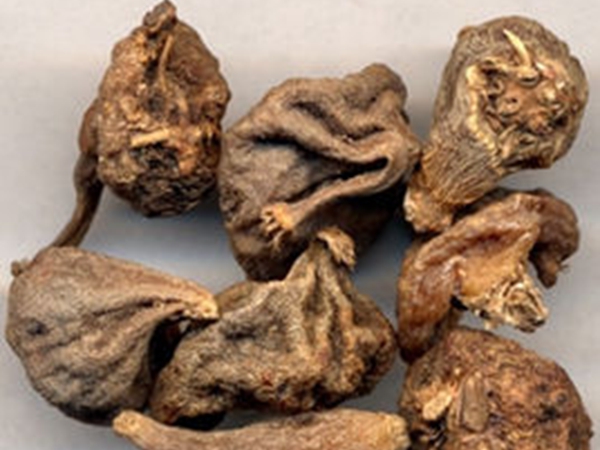
Mountain Arisaema
Mountain Cigu is the name of a traditional Chinese medicine. It consists of the dried pseudobulbs of the orchid species Cremastra appendiculata (D.Don) Makino, Pleione bulbocodioides (Franch.) Rolfe, or Pleione yunnanensis Rolfe. The former is commonly known as “Hairy Cigu,” while the latter two are commonly known as “Ice Ball Seeds.”It has the therapeutic effects of clearing heat and detoxifying, as well as resolving phlegm and dispersing nodules. It is primarily used to treat abscesses, boils, and carbuncles; scrofula and phlegm-nodules; snake and insect bites; and masses and lumps.
Chinese Name : 山慈菇
Latin Name : Cremastrae Pseudobulbus, Pleiones Pseudobulbus
Aliases : Golden Lamp Flower, Deer’s Hoof Grass, Mountain Arrowhead, Arrowhead, Mountain Arrowhead, Hairy Arrowhead, Mud Ice Seed, Abacus Seven, Human Head Seven, Tai Bai Ji, Water Ball Seed, Mud Bin Seed, Cai Pei Orchid
Authentic Producing Area : Sichuan, Guizhou
Nature, Flavor & Meridian Tropism : Sweet and slightly pungent in taste; cool in nature; enters the Liver and Spleen meridians
Benefits & Efficacy
Benefits
Clears heat and detoxifies; resolves phlegm and disperses nodules.
Indications
Boils, abscesses, carbuncles, scrofula, phlegm nodules, snake and insect bites, and masses or lumps.
Usage and Dosage
1. Internal use: Decoct 3–6 g; or grind into juice; or incorporate into pills or powders. 2. External use: Apply an appropriate amount of juice; or grind into a powder and apply as a poultice.
Precautions
Use with caution in individuals with deficiency syndromes or general weakness.
Chemical Constituents
It primarily contains polyphenolic compounds (such as Dendrobium alcohol) and bi-benzene derivatives (such as Dendrobiumin C, D, and Dendrobium alcohol), as well as Dendrobiumin I and II, and flavanone-3-ols.
Pharmacological Actions
This product exhibits antimicrobial and antitumor effects.
Relevant Discussions
1. *Supplement to the Materia Medica*: “Treats abscesses, swellings, sores, fistulas, scrofula, and tuberculosis; grind with vinegar and apply as a poultice.”
2. *Compendium of Materia Medica*: “Treats carbuncles and swellings; expels toxins and breaks through the skin; neutralizes various poisons; treats snake and insect bites, as well as rabies.”
Applications
Clinical Applications
1. For treating boils and abscesses on the back, carbuncles and toxic swellings, scrofula and phlegm nodules, as well as snake and insect bites, it is often combined with detoxifying and ulcer-healing agents such as realgar, cinnabar, and musk—for example, in the “Purple Gold Pills” (from *A Selection of 101 Prescriptions*)—and can be administered both internally and externally.
2. For the treatment of liver cirrhosis, when combined with earth beetle, pangolin scales, and mole crickets, it has a marked effect in softening the liver and spleen and restoring liver function; when formulated into a compound with fleabane, salvia root, gardenia, Zhejiang fritillary bulb, bupleurum, and summer枯草, it demonstrates good efficacy against scrofula and goiters.
3. For treating conditions such as epilepsy caused by wind-phlegm, *Remarkably Effective Formulas* recommends grinding *Shan Cigu* with tea and taking the mixture orally.
Related Compatibility
1. Mountain Arisaema combined with Sanling: Mountain Arisaema detoxifies and disperses nodules, while Sanling breaks up blood stasis and eliminates masses. When combined, these two herbs enhance their detoxifying, nodule-dispersing, blood-stasis-breaking, and mass-eliminating effects, making them suitable for treating masses and lumps caused by heat-toxin and blood stasis or qi and blood stagnation.
2. Mountain Tuber combined with Red Euphorbia: Mountain Tuber possesses strong heat-clearing and detoxifying properties, while Red Euphorbia excels at reducing swelling and dispersing nodules. When combined, these two herbs enhance their ability to clear heat, detoxify, reduce swelling, and disperse nodules. This combination is suitable for treating heat-toxin-induced sores, boils, carbuncles, and toxic abscesses, as well as scrofula and phlegm-nodules.
3. Mountain Arisaema combined with Corydalis: Mountain Arisaema clears heat, detoxifies, resolves phlegm, and disperses nodules; Corydalis promotes blood circulation, resolves stasis, and relieves pain. When combined, these two herbs work together to detoxify, resolve stasis, reduce swelling, and relieve pain. This combination is suitable for masses and accumulations caused by phlegm-dampness obstruction or qi stagnation and blood stasis.
Medicinal Identification
1. Mountain Arisaema vs. Smooth Arisaema: Both herbs clear heat, eliminate toxins, reduce swelling, and disperse nodules, and can be used to treat abscesses, malignant sores, sore throat, laryngeal obstruction, scrofula, and tumors. However, Mountain Arisaema is particularly effective at resolving phlegm and can be used to treat sore throat, scrofula, phlegm-nodules, and snake or insect bites.In contrast, Polygonatum odoratum is toxic and excels at resolving blood stasis, dispersing nodules, and reducing swelling; it is frequently used for masses, accumulations, and abdominal distension, as well as for redness, swelling, heat, and pain in the lower legs caused by descending damp-toxin.
2. Mountain Polygonatum and Paris polyphylla: Both herbs are cold in nature and possess the properties of clearing heat, detoxifying, reducing swelling, and relieving pain; they can both be used to treat abscesses, toxic sores, scrofula, and snake and insect bites.However, Mountain Cichorium is more potent in detoxifying, resolving phlegm, and dispersing nodules; it is particularly effective for treating carbuncles, scrofula, phlegm nodules, and masses and lumps. Chonglou, on the other hand, excels at clearing heat and reducing swelling; it is particularly effective for treating mumps and sore throat. It can also cool the liver, subdue wind, and relieve convulsions, and is commonly used for febrile convulsions in children.
Related Medicines
Dan Ci Capsules, Ruan Jian Oral Solution, and Long Bi Shu Capsules.
Related Prescriptions
Zijin Pills (also known as Yushu Dan) (*Authentic Treatise on Surgery*).
Notes
Patients requiring treatment with traditional Chinese medicine should first consult a licensed TCM hospital, where a TCM practitioner will conduct a professional pattern differentiation and issue a prescription.
Processing & Preparation
Harvesting & Processing
Harvest in summer and autumn; remove the aerial parts and any mud or sand; sort by size; place in a pot of boiling water and steam until thoroughly cooked through; then dry.
Processing Methods
Take the raw material, remove impurities, sort by size, wash thoroughly, moisten thoroughly, and slice thinly. Dry, then sift to remove dust and debris. Alternatively, crush as needed.
Storage Methods
Store in a dry container in a well-ventilated, dry place to prevent insect infestation.
Crude Drug Identification
Identification
Cross-section of this product: The outermost layer of *Mao Cigu* consists of a layer of flat epidermal cells; within this are 2–3 rows of cells with slightly thickened walls and a pale yellow color. Further inward are large, nearly circular parenchyma cells containing mucilage and starch grains. The parenchyma cells near the epidermis contain bundles of calcium oxalate needle crystals, 70–150 μm in length. Vascular bundles are scattered and of the exarch type.In the pericycle of the bulb, the epidermal cells are tangentially elongated; starch grains are present in smaller parenchyma cells; the sheath fibers of the vascular bundles are crescent-shaped, with occasional double crescent-shaped fibers.
Properties of Crude Drugs
1. Hairy Arrowhead: Irregularly flattened spherical or conical in shape, with a gradually protruding apex and root scar at the base. It is 1.8–3 cm long, with the swollen portion measuring 1–2 cm in diameter.The surface is yellowish-brown or brownish-black, with longitudinal wrinkles or grooves; the middle section has 2–3 slightly raised nodes, on which thread-like fibers remain from withered and decayed scale leaves. The texture is hard and difficult to break; the cross-section is grayish-white or yellowish-white, with a slightly horny appearance. It has a faint odor, a bland taste, and a sticky texture.
2. Iceball Spores: Conical, bottle-neck-shaped, or irregular lumps, 1–2 cm in diameter and 1.5–2.5 cm tall.The apex is gradually tapering, with a disc-shaped base at the tip; the base is swollen, rounded, and flat, with a central depression and 1–2 nodes, often偏向一侧. When the outer skin is removed, the surface is yellowish-white; when the skin remains, it is light brown, smooth, and has irregular wrinkles. The cross-section is light yellow and horn-like, semi-translucent.
Properties of Processed Slices
These are thin, circular or irregular slices. The outer epidermis is grayish-yellow or yellowish-brown, with fine wrinkles; the leaf base, root scars, and annular rings are visible. The cross-section is yellowish-white or pale brownish-yellow, horny and translucent, with numerous vein patterns and vein dots. The texture is firm. It has a faint odor, a bland taste, and is slightly sticky when chewed.
Botanical Information
Botanical Classification
Orchidaceae plants: Rhododendron orchid, Monocarpus orchid, and Yunnan Monocarpus orchid.
Morphological Characteristics
1. Rhododendron orchid: A terrestrial plant. Pseudobulbs are clustered, nearly spherical, and 1–3 cm in diameter. A single leaf is terminal, rarely with two leaves; the leaf blade is elliptical, up to 45 cm long and 4–8 cm wide, with an acute apex and a base tapering into a petiole. The flower spike arises laterally from the apex of the pseudobulb, is erect, and bears two sparse, tubular sheaths;the raceme bears numerous, sparsely arranged flowers; the flowers are asymmetrically arranged, purplish-red; the floral bracts are narrowly lanceolate, equal in length to or shorter than the flower stalk (including the ovary); the perianth segments are tubular, slightly spreading at the apex; the sepals and petals are nearly equal in size, oblanceolate, about 3.5 cm long, approximately 4 mm wide in the middle to upper part, and acuminate at the apex;The labellum is nearly spatulate, nearly as long as the sepals, with a shallow sac-like base; the margins on both sides are slightly reflexed upward; the anterior end is expanded and 3-lobed, with narrow lateral lobes and an oblong central lobe bearing a single appendage at the base that is either closely attached or somewhat separate; the gynostemium is slender, slightly shorter than the sepals. Flowering period: June–August.
2. Solitary Garlic Orchid: A terrestrial plant, 15–25 cm tall.The pseudobulb is narrowly ovate or long-necked bottle-shaped, 1–2 cm long, bearing a single terminal leaf; after the leaf falls, a cup-shaped ring of teeth remains. Leaves and flowers appear simultaneously; the leaves are elliptic-lanceolate, 10–25 cm long and 2–5 cm wide, with a slightly obtuse or acuminate apex, narrowing at the base into a petiole that clasp the flower spike. The flower spike bears a single terminal flower.The floral bracts are oblong, nearly acute, equal to or longer than the ovary; the flower is pale purple or pink; the sepals are erect, narrowly lanceolate, up to 4 cm long, 5–7 mm wide, and acutely pointed at the apex;the lip is wedge-shaped at the base, with three indistinct lobes; the lateral lobes are semi-ovate with blunt tips, while the median lobe is semicircular or nearly wedge-shaped, with a notched or almost unnotched apex and irregularly serrated margins; the inner surface bears 3–5 wavy or nearly erect folds. Flowering occurs from April to May, and fruiting in July.
3. Yunnan Monocarpus Orchid: This species resembles Monocarpus. The pseudobulb is bottle-shaped, topped with a cup-shaped ring of teeth, 2–3.5 cm long and 0.8–1 cm in diameter. Leaves are lanceolate, 20–30 cm long and 2.5–3.5 cm wide; young leaves are usually absent at flowering. Bracts are narrowly obovate and shorter than the ovary;The flowers are pale purple; the sepals are of equal size, short, rounded-obovate; the petals resemble the sepals; the labellum is expanded, 3-lobed, with serrated margins; the inner surface bears 2–5 nearly entire folds; the ovary, including the pedicel, is 3–4 cm long.
Distribution Area
1. Rhododendron Orchid: Found south of the Yangtze River basin, as well as in Shanxi, Shaanxi, Gansu, and other areas. 2. Single-bulb Orchid: Found in East China, Central and South China, Southwest China, as well as in Shaanxi, Gansu, and other areas. 3. Yunnan Single-bulb Orchid: Found in western Sichuan, Yunnan, and Guizhou.