Tamarind-leaved Dalbergia is a name used in traditional Chinese medicine. It refers to the roots, stems, and leaves of the leguminous plant Dalbergia pinnata (Lour.) Prain [D. tamarindifolia Roxd.; Derris pinnata Lour.]. It is distributed in Guangdong, Hainan, Guangxi, Yunnan, Tibet, and other regions. It has the effects of dispelling wind and relieving pain, promoting blood circulation, and promoting wound healing.It is primarily used to treat rheumatic pain, trauma, irregular menstruation, and lower limb ulcers.

Tamarind-leaved Dalbergia
Tamarind-leaved Dalbergia is a name used in traditional Chinese medicine. It refers to the roots, stems, and leaves of the leguminous plant Dalbergia pinnata (Lour.) Prain [D. tamarindifolia Roxd.; Derris pinnata Lour.]. It is distributed in Guangdong, Hainan, Guangxi, Yunnan, Tibet, and other regions. It has the effects of dispelling wind and relieving pain, promoting blood circulation, and promoting wound healing.It is primarily used to treat rheumatic pain, trauma, irregular menstruation, and lower limb ulcers.
Chinese Name : 罗望子叶黄檀
Aliases : Xie Hansheng, Oblique-leaved Sandalwood
Nature, Flavor & Meridian Tropism : Bitter and pungent in taste; warm in nature
Benefits & Efficacy
Benefits
Dispels wind and relieves pain, promotes blood circulation, and promotes wound healing.
Indications
Rheumatic arthralgia, trauma, irregular menstruation, and lower limb ulcers.
Usage and Dosage
Internal use: Decoct 15–30 g. External use: Apply an appropriate amount after pounding into a paste.
Applications
Processing & Preparation
Harvesting & Processing
Harvested in summer and fall; cut into small pieces, sun-dried, or used fresh.
Crude Drug Identification
Botanical Information
Botanical Classification
A plant of the Fabaceae family, Pterocarpus pinnatifolius.
Morphological Characteristics
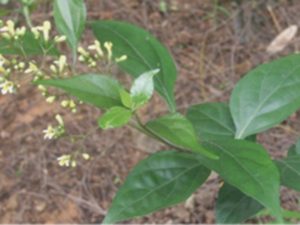
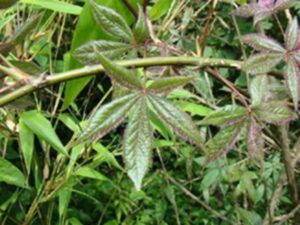
Pterocarpus pinnatifolius, also known as Oblique-leaved Rosewood in *Essentials of Chinese Medicinal Plant Resources* and Oblique-leaved Rosewood in *Flora of China*. A tree, 3–13 m tall. It has twisted, prostrate branches or may grow as a shrubby vine; young branches are densely covered with short soft hairs.The leaves are odd-pinnate, alternate, and 10–14 cm long; the petioles are covered with short brown soft hairs; the stipules are lanceolate, approximately 5 mm long, and densely covered with fine soft hairs; there are 21–41 leaflets, oblong-lanceolate, 1.5–1.9 cm long, approximately 7.5 mm wide, with rounded or slightly notched apices, oblique-cuneate bases, and short soft hairs on both surfaces;the leaf rachis is densely covered with short soft hairs. Flowers and leaves emerge simultaneously; panicles are axillary, with or without a short main inflorescence stalk, and the inflorescence bears corymbose branches; the main inflorescence stalk, inflorescence branches, and flower stalks are all densely covered with fine soft hairs; basal bracts and epicalyx-like bracts are ovate, covered with fine soft hairs, and persistent;The calyx is campanulate, pale yellowish, with or without external pubescence; the calyx teeth are ovate, with the upper two teeth nearly fused;Corolla white, petals with long claws; standard ovate, reflexed; stamens 9–10, monadelphous; ovary stalked, glabrous. Pod ligulate, 2.5–6.5 cm long, 1–1.3 cm wide, turning brown when dry. Seeds 1–3. Flowering period: January–March; fruiting period: June–July.
Distribution Area
Distributed in Guangdong, Hainan, Guangxi, Yunnan, Tibet, and other areas.