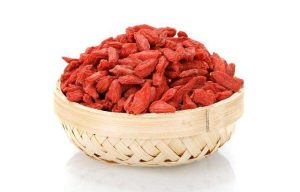
Goji berries, a traditional Chinese medicine, are the dried, ripe fruits of Ningxia goji (Lycium barbarum L.), a plant belonging to the genus Lycium in the Solanaceae family. They have the effects of tonifying the liver and kidneys, nourishing essence, and improving eyesight. They are primarily used to treat deficiency-syndrome with essence depletion, soreness and pain in the lower back and knees, dizziness and tinnitus, impotence and nocturnal emission, internal heat with excessive thirst, blood deficiency with pallor and weakness, and blurred vision.

Goji Berries
Goji berries, a traditional Chinese medicine, are the dried, ripe fruits of Ningxia goji (Lycium barbarum L.), a plant belonging to the genus Lycium in the Solanaceae family. They have the effects of tonifying the liver and kidneys, nourishing essence, and improving eyesight. They are primarily used to treat deficiency-syndrome with essence depletion, soreness and pain in the lower back and knees, dizziness and tinnitus, impotence and nocturnal emission, internal heat with excessive thirst, blood deficiency with pallor and weakness, and blurred vision.
Chinese Name : 枸杞子
Latin Name : Lycii Fructus
Aliases : Gouqizi, red goji berries, beet seeds, Western goji berries, dog’s milk berries, red and green chili peppers,Goji Hoof, Goji Berry, Diguzi, Goji Eggplant, Red Earrings, Blood Goji, Goji Sprout, Goji Bean, Blood Goji, Jin Goji
Authentic Producing Area : Gansu, Ningxia, Qinghai
Nature, Flavor & Meridian Tropism : Neutral in nature, sweet in taste; enters the Liver and Kidney meridians
Benefits & Efficacy
Benefits
Nourishes the liver and kidneys; enriches essence and improves vision.
Indications
Used for deficiency-syndrome with essence depletion, soreness and pain in the lower back and knees, dizziness and tinnitus, impotence and nocturnal emission, internal heat with excessive thirst, blood deficiency with sallow complexion, and blurred vision.
Usage and Dosage
Oral use: Decocted as a soup, 5–15 g; or incorporated into pills, powders, ointments, or wine preparations.
Precautions
1. Use with caution in patients with spleen deficiency and loose stools.2. Atropine can inhibit the cholinergic effects of Lycium barbarum; therefore, they should not be used together.
Chemical Constituents
This product contains betaine, polysaccharides, crude fat, crude protein, thiamine, riboflavin, niacin, carotene, ascorbic acid, β-sitosterol, linoleic acid, trace elements, and amino acids.
Pharmacological Actions
This product has pharmacological effects including boosting immunity, delaying aging, protecting against liver damage, lowering blood sugar, improving retinal disorders, regulating blood lipids, and combating fatigue.
Relevant Discussions
1. *Collected Annotations on the Classic of Materia Medica*: “Nourishes essence and vital energy; strengthens the vaginal canal.”
2. *Treatise on the Nature of Medicinal Substances*: “Nourishes deficiencies in essence; improves complexion; whitens the skin; sharpens vision; calms the mind; and promotes longevity.”
3. *Dietary Therapy Materia Medica*: “Strengthens tendons, delays aging, dispels wind, nourishes tendons and bones, benefits the body, and alleviates consumptive diseases.”
4. *Compendium of Materia Medica*: “Nourishes the kidneys, moistens the lungs, and improves vision.”
5. *Comprehensive Discourse on Materia Medica*: “Moistens the lungs and generates body fluids; nourishes the kidneys and replenishes essence.”
Applications
Clinical Applications
1. For treating liver and kidney deficiency, blurred vision, or dry, sore eyes: Prepared Rehmannia Root, Cornus Fruit, Poria, Chinese Yam, Moutan Bark, Alisma, Goji Berries, and Chrysanthemum. Mix with refined honey to form pills. (*Medical Class*: Goji-Chrysanthemum-Rehmannia Pills)
2. For treating liver and kidney deficiency manifested as dim vision, blurred vision, a hazy and vague visual field, frequent seeing of dark spots, and often accompanied by cold tears: 3 liang of Goji berries, 1 liang of Morinda root (with core removed), 4 liang of selected Chrysanthemum flowers, and 2 liang of Cistanche (soaked in wine, peeled, stir-fried, sliced, and baked).Grind the above ingredients into a fine powder, mix with refined honey, and form into pills the size of a Paulownia seed. Take thirty to fifty pills at a time, washed down with warm wine or salted water, on an empty stomach before meals. (*Formulae of the Imperial Bureau*: Chrysanthemum Eye Pills)
3. For treating deficiency of the Kidney meridian, blurred vision, or a hazy veil over the eyes: one jin of Ganzhou goji berries.Soak thoroughly in good wine, then divide into four portions. Stir-fry four liang with one liang of Sichuan pepper; four liang with one liang of fennel; four liang with one liang of perilla seeds; and four liang with the flesh of Sichuan melia. Remove the goji berries, then add one liang each of prepared rehmannia root, white atractylodes, and white poria. Grind into a fine powder, mix with refined honey to form pills the size of a tung seed. Take fifty to seventy pills daily.
4. For treating bi syndrome caused by wind-dampness: One jin of goji berries, four liang of genuine Han Fangji (both mixed with wine and stir-fried), one liang each of Qianghuo and Duhuo, and five qian each of Sichuan Achyranthes and wood apple. Lightly stir-fry all ingredients, grind into a powder, and form into pills the size of a Chinese gooseberry using refined honey. Take three qian every morning with plain hot water. (*Shenghui Fang*)
5. For treating chronic debility with unrelenting thirst and restlessness: 8 liang of goji berries (mixed with wine and lightly stir-fried), 10 liang of Diguopi (lightly stir-fried); grind both into a powder. Take 4 liang each of Ophiopogon tuber (core removed) and prepared Rehmannia root, boil in wine until reduced to a paste, then mix with the previous ingredients to form pills the size of a goji berry. Take 4 qian each morning and evening, washed down with white wine. (From *Qianjin Yaofang*)
Related Compatibility
1. Goji Berries Combined with Achyranthes Root: Goji berries excel at nourishing kidney yin and replenishing kidney essence; Achyranthes root excels at tonifying the liver and kidneys and strengthening tendons and bones. When combined, these two herbs enhance the effects of nourishing the liver and kidneys and strengthening tendons and bones. This combination is suitable for conditions such as kidney deficiency with bone atrophy, soreness and pain in the lower back and knees, and weakness in the legs.
2.Goji Berries Combined with Prepared Rehmannia Root: Goji berries excel at nourishing kidney yin and replenishing kidney essence; Prepared Rehmannia Root excels at tonifying blood, nourishing yin, and replenishing essence and marrow. When combined, these two herbs enhance the effects of nourishing kidney yin and replenishing essence and marrow. This combination is suitable for conditions such as kidney yin deficiency, depletion of essence and blood, soreness and weakness in the lower back and knees, a haggard appearance, and impotence or nocturnal emissions.
3. Goji Berries Combined with Dodder Seed: Goji berries excel at nourishing kidney yin, tonifying the kidneys, and replenishing essence; dodder seed excels at tonifying the kidneys, nourishing yin, consolidating essence, and reducing urinary leakage.When combined, these two herbs enhance the effects of replenishing essence and marrow, as well as tonifying the kidneys and securing essence. This combination is suitable for conditions such as kidney deficiency with deficient essence, erectile dysfunction, premature ejaculation, cold semen, post-ejaculatory dribbling, and prolonged infertility.
4. Goji Berries Combined with Aconite Root: Goji Berries excel at nourishing the liver and kidneys; Aconite Root excels at warming the kidneys and assisting yang.When combined, these two herbs work to tonify the kidneys, replenish essence, warm the kidneys, and strengthen yang. This combination is suitable for conditions such as yang deficiency, decline of Mingmen fire, soreness and pain in the lower back and knees, mental fatigue and weakness, and aversion to cold with cold limbs.
5. Goji Berries Combined with Deer Antler: Goji berries excel at nourishing the liver and kidneys, replenishing essence, and nourishing blood; deer antler excels at warming the kidneys, assisting yang, replenishing essence, and strengthening the tendons and muscles.When combined, these two herbs enhance the effects of tonifying the kidneys, replenishing essence, nourishing yin, and strengthening yang. This combination is suitable for conditions involving deficiency of both yin and yang, essence and blood, generalized emaciation, as well as symptoms such as seminal emission, erectile dysfunction, and loose stools.
6. Goji Berries Combined with Polygonum Multiflorum: Goji berries are effective at tonifying the kidneys, replenishing essence, nourishing the liver, and improving vision; Polygonum Multiflorum excels at replenishing essence and blood, consolidating the kidneys, and darkening hair.When combined, these two herbs enhance the effects of tonifying the liver and kidneys, nourishing essence and blood, strengthening tendons and bones, and darkening the beard and hair. This combination is suitable for various symptoms of premature aging caused by deficiency of the liver and kidneys and depletion of essence and blood, such as blurred vision, dim vision, dizziness, premature graying of the beard and hair, and frequent nighttime urination.
7. Goji Berries Combined with Angelica Root: Goji berries both nourish the yin of the liver and kidneys and nourish the blood; Angelica root nourishes and harmonizes the blood. When combined, these two herbs work to nourish and replenish the blood. This combination is suitable for postpartum wind-deficiency and exhaustion, pain in the limbs, restlessness due to mental deficiency, and loss of appetite.
8. Goji Berries Combined with Ejiao: Goji berries are sweet and neutral, excelling at replenishing yin and nourishing essence; ejiao is sweet and neutral, excelling at replenishing blood and nourishing yin. When combined, these two herbs provide both tonifying and moistening effects. This combination is suitable for treating yin-deficiency-induced consumptive cough and dry cough with scant phlegm.
9. Goji Berries Combined with Ophiopogon: Goji berries are neutral and non-heating, with the ability to replenish fluids and subdue fire; Ophiopogon is sweet, cold, and moist, serving to benefit the stomach and generate body fluids. When combined, these two herbs nourish the liver and kidneys while benefiting the stomach and promoting the production of body fluids. This combination is suitable for conditions such as frequent, scanty urination; dry mouth and restlessness; dry skin; and weakness in the lower back and knees that gradually leads to general weakness.
10. Goji Berries Combined with Bi Zi Ren: Goji berries are sweet and neutral in nature; they nourish liver blood and replenish kidney essence. Bi Zi Ren is sweet and moisturizing; it nourishes heart blood and calms the mind. When combined, these two herbs nourish the liver and kidneys, and nourish the heart and calm the mind. This combination is suitable for treating restlessness and insomnia, as well as a tendency to be easily startled or fearful.
Medicinal Identification
1. Polygonatum and Goji Berries: Both are sweet and neutral in nature and enter the Lung and Kidney meridians. They can nourish yin, tonify the kidneys, and moisten the lungs, and are used together to treat night sweats and spontaneous ejaculation caused by kidney yin deficiency, as well as dry cough due to lung dryness, consumptive cough due to yin deficiency, and diabetes.However, Polygonatum also enters the Spleen meridian and excels at strengthening the spleen and tonifying qi; as a herb that simultaneously tonifies both qi and yin, it is particularly suitable for treating the aforementioned symptoms of lung and kidney yin deficiency complicated by qi deficiency, as well as conditions of spleen and stomach weakness. Goji berries also enter the Liver meridian and excel at nourishing the liver and kidneys while improving vision; as a key herb for tonifying the liver and kidneys, they are primarily used to treat dizziness, blurred vision, and soreness and weakness in the lower back and knees caused by liver and kidney yin deficiency.
2. Chrysanthemum and Goji Berries: Both have a sweet taste, enter the Liver Meridian, and possess the ability to nourish yin and improve vision; they can both treat blurred vision and dim eyesight caused by deficiency of the Liver and Kidney.However, chrysanthemum flowers have a bitter and pungent taste and a slightly cold nature; they primarily enter the Lung Meridian. Their ability to nourish yin is relatively weak, and their primary functions are to disperse wind-heat, clear heat, and eliminate toxins, while also calming the liver and subduing its yang. They are primarily used to treat wind-heat common colds, fever and headache, boils and swellings caused by toxins, dizziness, and convulsions.Goji berries are sweet, neutral, and moist in nature; they enter the Kidney meridian and serve as a mild tonic for both yin and yang. They possess a stronger ability to nourish yin and excel at tonifying the kidneys and essence, nourishing the liver and improving vision. Additionally, they can moisten the lungs and relieve coughs, and are particularly effective for treating lower back pain due to kidney deficiency, seminal emission and premature ejaculation, pallor and weakness due to blood deficiency, consumptive cough due to yin deficiency, as well as hot flashes and night sweats.
3. Prepared Rehmannia and Goji Berries:Both have a sweet taste and enter the Liver and Kidney meridians. They share the ability to nourish the Liver and Kidney and replenish essence and marrow. Together, they treat all conditions of deficiency in essence and blood, including dizziness and vertigo, blurred vision, deafness and tinnitus, soreness and weakness in the lower back and knees, and premature graying of hair caused by Liver-Kidney deficiency, as well as sallow complexion due to blood deficiency, palpitations, insomnia, and irregular menstruation.However, Prepared Rehmannia Root is slightly warm in nature and moist in quality; it has a stronger tonifying effect and excels at replenishing blood, making it a key herb for this purpose. It also has a relatively heavy, greasy nature, so it is often combined with Amomum and Tangerine Peel—which aid digestion—to prevent it from causing a greasy sensation that obstructs the stomach. It is suitable for treating more severe cases of the aforementioned conditions or for individuals with strong spleen and stomach function.Goji berries (枸杞子) are neutral in nature, have a milder tonifying effect, and are particularly effective for improving eyesight, with a slight ability to assist yang. They are less cloying and are therefore more commonly used to treat milder manifestations of the aforementioned conditions or in patients with weak spleen and stomach function.
4. Sha Yuanzi and Goji Berries: Both have a sweet taste and enter the Liver and Kidney meridians; they are both effective at tonifying the Liver and Kidneys to improve vision, and are used to treat kidney deficiency-induced low back pain, seminal emission, and frequent urination, as well as blurred vision and dizziness caused by deficiency of the Liver and Kidneys.However, Sha Yuanzi is warm in nature and excels at tonifying the kidneys and securing essence; it is particularly effective for treating kidney yang deficiency, deficiency-cold in the lower jiao, instability of the essence gate, and seminal emission and enuresis. Goji berries are neutral in nature and moist in quality; they also enter the Lung meridian. They are a mild tonic for both yin and yang, capable of nourishing the lungs and kidneys, moistening the lungs, and relieving cough. They are particularly effective for treating lung and kidney yin deficiency, chronic cough with hemoptysis, and night sweats.
Related Medicines
Wuzi Yanzong Pills, Goji-Chrysanthemum-Rehmannia Pills, Brain-Nourishing Pills, Silkworm Moth and Moth Larva Tonifying Tablets, and Liver-Kidney Nourishing Formula.
Related Prescriptions
Goji-Chrysanthemum-Rehmannia Pills (*Compendium of Measles*), Yiguan Decoction (*Continuation of Famous Physicians’ Case Records*), Yougui Decoction (*Complete Works of Jingyue*), and Warm Liver Decoction (*Complete Works of Jingyue*).
Medicinal Diet Therapy
Goji Berry Porridge:
1. Benefits: Nourishes the liver, tonifies the kidneys, and moistens the lungs. Suitable for symptoms caused by liver and kidney deficiency, such as soreness and weakness in the lower back and knees, impotence and nocturnal emissions, male and female infertility, dizziness, blurred vision, and memory decline.
2. Ingredients: 15g goji berries, 100g rice, and white sugar to taste.
3. Preparation: Place the goji berries and rice together in a pot, add water, and simmer over low heat until it becomes porridge. Stir in white sugar just before it is fully cooked.
4. Usage: Consume while warm, 1–2 times daily. Not suitable for those with spleen deficiency and loose stools.
Notes
Patients requiring treatment with Chinese herbal medicine should first consult a licensed Traditional Chinese Medicine (TCM) hospital to receive a prescription following a professional TCM differential diagnosis.
Processing & Preparation
Harvesting & Processing
Harvest the fruits in summer or fall when they turn red; dry them with hot air, remove the fruit stalks, or air-dry until the skin wrinkles, then sun-dry and remove the fruit stalks.
Processing Methods
1. Goji Berries: Take the raw herbal material, remove impurities, and pick off any remaining fruit stalks and calyxes.
2. Roasted Goji Berries: Take the cleaned goji berries and roast them over low heat until scorch marks appear on the surface; remove and let cool.
3. Salted Goji Berries: Place table salt in a pan and heat over low heat until hot; then add the goji berries and stir-fry until they turn yellow and swell. Sift out the salt.
Storage Methods
Store in a dry container. Keep the stir-fried goji berries and salted goji berries tightly sealed in a cool, dry place, protected from heat, moisture, and insect infestation.
Crude Drug Identification
Identification
1. The powder of this product is yellow-orange or reddish-brown. On surface view, the epidermal cells of the exocarp appear polygonal or elongated polygonal; the vertical walls are straight or slightly wavy, and the outer annular walls bear parallel cuticular striations.The parenchyma cells of the mesocarp are polygonal in shape, with thin walls; the cell cavities contain orange-red or reddish-brown spherical granules. The stone cells of the seed coat appear irregularly polygonal when viewed from the surface; they have thick, undulating walls with distinct lamellar patterns.
2. Take 0.5 g of the sample, add 35 mL of water, heat to a boil for 15 minutes, allow to cool, and filter. Extract the filtrate with 15 mL of ethyl acetate by shaking, separate the ethyl acetate layer, and concentrate it to 1 mL to obtain the test solution. Separately, take 0.5 g of Lycium barbarum fruit reference material and prepare the reference solution using the same method.Perform the test according to the thin-layer chromatography method (General Chapter 0502). Pipette 5 μl of each of the two solutions and apply them separately onto the same silica gel G thin-layer plate. Develop with a mobile phase of ethyl acetate–chloroform–formic acid (3:2:1), remove the plate, allow it to air-dry, and examine it under ultraviolet light (365 nm).In the chromatogram of the test sample, fluorescent spots of the same color appear at positions corresponding to those in the reference herbal material chromatogram.
Properties of Crude Drugs
This product is spindle-shaped or oval, 6–20 mm long and 3–10 mm in diameter. The surface is red or dark red, with a small, protruding stigma scar at the apex and a white pedicel scar at the base. The pericarp is supple and wrinkled; the pulp is fleshy and soft.There are 20–50 seeds, which are reniform, flattened and curved upward, 1.5–1.9 mm long and 1–1.7 mm wide, with a pale yellow or brownish-yellow surface. It has a faint odor and a sweet taste.
Properties of Processed Slices
1. Goji Berries: See the “Medicinal Materials” section.
2. Roasted Goji Berries: Similar in appearance to Goji Berries, with scorched spots.
3. Salted Goji Berries: Similar in appearance to Goji Berries, with a dark red or soiled yellow surface, slightly swollen, and a slightly salty taste.
Botanical Information
Botanical Classification
Ningxia Goji (Lycium chinense), a plant of the genus Lycium in the Solanaceae family.
Morphological Characteristics
A shrub or, when cultivated, a large shrub, 1–3 m tall. Several main stems, stout; twigs with longitudinal ridges, bearing short, leafless spines and long spines bearing leaves and flowers; fruit branches slender and elongated, usually drooping at the tips, with pale grayish-yellow, glabrous outer skin. Leaves alternate or clustered in groups of several on short branches;petioles are short; leaf blades are lanceolate or oblong-lanceolate, 2–8 cm long and 0.5–3 cm wide, with an acute apex, a cuneate or narrowly cuneate base extending down into the petiole, entire margins, dark green above, pale green below, and glabrous. Flowers are axillary, often solitary or clustered in groups of 2–6 on short branches;Pedicels slender; calyx campanulate, 4–5 mm long, deeply 2–3-lobed at the apex, lobes broadly ovate or ovate-triangular; corolla funnel-shaped, tube ca. 8 mm long, 5-lobed at the apex, lobes ovate, ca. 5 mm long, pink or pale purplish-red, with dark purple veins, the tube bearing a ring of soft hairs above the point where the stamens are attached;There are 5 stamens; the pistil is single, with an oblong, 2-chambered ovary; the style is linear, and the stigma is capitate. The berries are ovoid, elliptic, or broadly ovoid, 8–20 mm long and 5–10 mm in diameter, red or orange-red, with a fleshy pericarp. The seeds are numerous, nearly reniform but flattened, and brownish-yellow. Flowering occurs from May to October, and fruiting from June to November.
Distribution Area
It is distributed in Gansu, Ningxia, Qinghai, Xinjiang, Inner Mongolia, Hebei, and other regions.
Growth Habits
Ningxia goji berries are highly adaptable. The main production area is Zhongning County, Ningxia, where the annual average temperature is 9.2°C, the average January temperature is -7.1°C, and the average July temperature is 23.2°C. The plant is cold-tolerant and can overwinter without frost damage at temperatures as low as -25.6°C.It thrives in full sun. It is not particular about soil type but is tolerant of saline-alkali conditions, fertile soil, and drought, though it is sensitive to waterlogging. It is best cultivated in fertile, well-drained, neutral or slightly acidic light loam soils; the salt content in saline-alkali soils must not exceed 0.2%. It is not suitable for cultivation in strongly alkaline soils, clay loam, rice paddies, or marshy areas.
Propagation Methods
Propagation is by seed or cuttings.
Cultivation Techniques
1. Seed Propagation: Through years of artificial cultivation and natural selection, Ningxia goji berries can be classified into three types based on branch characteristics: hard-stemmed, soft-stemmed, and semi-soft-stemmed; based on fruit shape, size, and color, they can be divided into long-fruit and round-fruit types;Based on morphology and characteristics, they can be classified into 12 varieties, namely White-stemmed Goji, Curled-leaf Goji, Club-shaped-fruit Goji, Pointed-tip Yellow-leaf Goji, Round-tip Yellow-leaf Goji, Pointed-tip Round-fruit Goji, Hemp-leaf Goji,Yellow-fruited Goji, Small Yellow-fruited Goji, Large Hemp-leaved Goji, Round-fruited Goji, and Needle-headed Goji. Among these, the Large Hemp-leaved Goji and Hemp-leaved Goji varieties are the most superior.Select high-quality varieties with large, brightly colored, mature fruits free of disease or insect damage. After harvesting in summer, soak the fruits in warm water (30–60°C), rub the seeds to loosen them, rinse thoroughly, and air-dry for later use.Before sowing, mix the seeds thoroughly with moist sand (1:3) and place them at a room temperature of 20°C to promote germination. Sow the seeds once 30% of them have sprouted, or after soaking them in clean water for one day and one night. Sowing can be done in spring, summer, or fall, with spring sowing being the primary method.For spring sowing, from late March to early April, sow in rows with a row spacing of 40 cm, at a depth of 1.5–3 cm, and cover with 1–3 cm of soil. After seedlings emerge, water as needed based on soil moisture conditions. When seedlings reach 1.5–3 cm in height, loosen the soil and remove weeds once; thereafter, repeat this process every 20–30 days.Thin the seedlings when they reach 6–9 cm in height, spacing them 12–15 cm apart, leaving 150,000–180,000 seedlings per hectare.Apply top dressing three times in May, June, and July in conjunction with irrigation. To ensure healthy seedling growth, promptly remove lateral buds growing 40 cm above ground level on young plants. When seedlings reach 60 cm in height, pinch the tips to accelerate the growth of the main stem and upper lateral branches. Seedlings may be transplanted from the nursery when the root diameter reaches 0.7 cm.
2. Propagation by Cuttings:From high-quality mother plants, collect one-year-old, lignified branches with a diameter of 0.3 cm or greater. Cut them into 18–20 cm long cuttings, bundle them into small bundles, and stand them upright in a basin. Soak them in a 100 × 10⁻⁶ α-naphthaleneacetic acid solution for 2–3 hours, then plant the cuttings at a spacing of 6–10 cm, inserting them diagonally into furrows and firming the soil around them.
Pest and Disease Control
1. Diseases include goji berry black fruit disease, which damages flower buds, flowers, and young fruit. During the fruiting period, spray with a 1:1:100 Bordeaux mixture; immediately after rain, spray a 600-fold dilution of 50% Thiram wettable powder for better results.For root rot, water the roots with a 1,000–1,500-fold dilution of 50% Topsin-M or a 1,000–1,500-fold dilution of 50% Carbendazim.
2. Insect Pests: Goji berry fruit fly. For control, when overwintering adults emerge, broadcast 45 kg/hm² of 50% carbaryl powder on the ground in the goji orchard; remove and deeply bury infested fruits; and irrigate or till the soil in the fall and winter to kill overwintering pupae in the soil.For the goji berry cutworm, irrigate and loosen the soil in the spring to disrupt overwintering sites and eliminate the pest source. In mid-April, broadcast 5% carbaryl powder (1 kg mixed with 5–7 kg of fine soil) over the ground in the goji berry orchard to kill overwintering adults.For the goji berry fruit borer, spray a 90% diazinon solution diluted 800–1,000 times during early to mid-April when the first-generation larvae are causing damage. Other pests include goji aphids and goji gall mites.