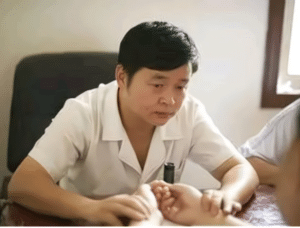
“Cold-Dampness Syndrome” is a syndrome in Traditional Chinese Medicine caused by external invasion of cold and dampness or the internal retention of cold and dampness. Typical symptoms include sensitivity to cold, heaviness and fatigue in the limbs, cold and painful joints, abdominal distension, and loose stools.
Cold-dampness syndrome is often caused by prolonged exposure to damp and cold environments, excessive consumption of raw and cold foods, or spleen-kidney yang deficiency, leading to the retention of fluid and dampness within the body. The combination of cold and dampness obstructs the flow of qi and blood. The condition commonly affects the joints, tendons and bones, and the spleen and stomach.
Symptoms of cold-dampness syndrome are quite widespread, but at their core lie the combined manifestations of “cold” and “dampness”:
Whole Body: Sensitivity to cold, cold extremities, a heavy and weak body, and mental fatigue.
Joints and Bones: Cold pain, aching and heaviness, symptoms worsened by cold, and difficulty bending or stretching.
Spleen and Stomach: Abdominal distension, poor appetite, loose, watery stools, and a white, greasy tongue coating.
Other: Clear, copious urine; increased vaginal discharge in women; dizziness and a sensation of heaviness in the head, etc.
The Story of the Wet Towel
Leg pain at night and lower back pain in the morning are mostly manifestations of cold-dampness syndrome.
It’s getting colder. In the morning, I use hot water to wash my face, and after I’m done, I hang the towel on the balcony. When I washed my face that evening, I noticed that the top half of the towel was already dry, while the bottom half was still wet—and to my surprise, a small amount of ice had even formed at the very bottom! I held the towel and pondered for a long time!
My wife said, “Hurry up and wash your face—what are you thinking about?”
That’s right! Looking at that half-dry, half-wet towel, I really did think a lot—I figured out the pathogenesis behind some recent difficult-to-treat conditions, and at the same time, I came up with treatment plans…
“Dampness tends to flow downward.” When a towel is thoroughly soaked and hung up, the water naturally flows downward; the top half dries first, while the bottom half becomes even wetter. Combined with the cold weather, after some time, the bottom half will gradually freeze.
As practitioners of Traditional Chinese Medicine, we know the phrase “dampness tends to flow downward” by heart, yet we rarely apply it—and often forget it when treating patients!
Patients often say, “Doctor! Every day when I climb the stairs, my legs feel like they’re filled with lead—they’re incredibly heavy. What’s going on?”
Western medicine doctors would immediately suspect a cerebrovascular issue and recommend a head CT scan, only to find the results normal; newly licensed TCM doctors might be at a loss, classifying it as a difficult-to-treat condition. Indeed, why do the legs feel as if they’re filled with lead, yet show no signs of swelling?
Actually, it’s just like this towel: when people stand for long periods during the day, dampness tends to sink downward, so dampness in the lower limbs becomes more pronounced. “Dampness is heavy and turbid”—when there is even a slight excess of dampness in the body, it can cause a feeling of fatigue in the legs; for patients with more severe dampness, the sensation is that “my legs feel as if they’re filled with lead—they’re incredibly heavy.”
If the temperature is high, the bottom of the towel will dry quickly and won’t freeze by nightfall!
In the human body, if kidney yang is sufficient—with no deficiency or only mild deficiency—dampness in the lower body will be vaporized by kidney yang, transformed into qi, and rise to circulate throughout the body. However, if kidney yang is deficient, it’s just like hanging a wet towel in winter: dampness settles in the lower jiao, naturally making “the legs feel as if they’re filled with lead, incredibly heavy”!
When resting in bed at night, the lowest point of the body is not the legs, but the area in contact with the mattress. According to the principle that “dampness tends to sink downward,” it should be the area in contact with the bed that feels uncomfortable!
This is exactly the case. Many patients report that during the day they feel fine, with only some fatigue in their legs. At night, they may feel okay for the first half of the night, but in the latter half, lower back and back pain gradually set in. Any area in contact with the bed feels extremely tired and painful, and they wake up in pain around 5 or 6 a.m., only to find relief after getting up and moving around.
Without delving deeper into the underlying pathogenesis, some people attribute this to disharmony between qi and blood, others blame the mattress, and still others think it’s caused by drinking too much water at night… In reality, this is simply dampness that has accumulated in the legs during the day shifting to the areas in contact with the bed at night—which is precisely the manifestation of “dampness tends to sink downward”!
At first, I thought it was some kind of intractable condition. I repeatedly asked about the exact time the pain occurred in the morning and analyzed it according to the Zi-Wu Liu Zhu theory… Now, whenever I see a damp towel, I think of “dampness tends to sink downward,” then of “insufficient vital energy,” and finally of “spleen and kidney yang deficiency”—and everything suddenly becomes crystal clear.
I. Warming and Tonifying Kidney Yang Is the Key to Treating Cold-Dampness Syndromes
I once treated a patient—a woman in her 40s who worked as a food preparer at a hotel. For the past week, she had been experiencing a heavy, uncomfortable sensation in both calves. The symptoms were relatively mild in the morning but worsened in the afternoon. Every evening after work, when climbing the stairs, her legs felt as if they were filled with lead—extremely heavy—though she showed no signs of lower-limb edema. After a night’s rest, her symptoms would subside. She visited a local top-tier hospital, where the doctor recommended a head CT scan. However, finding the cost too high, she declined the test and sought treatment from a TCM practitioner instead. At the consultation, her medical history and symptoms matched the description above. The root of her tongue was coated with a thick white layer, and her pulse was deep, slow, and weak at the right cun position, while at the left cun position it was deep and slippery.
Using the analogy of a wet towel, I explained to her: “When you wash your face in the morning and hang up a wet towel to dry, the water on the towel will slowly flow downward. As a result, the upper part of the towel will gradually dry out, while the lower part becomes increasingly wet.” Right now, you have a significant amount of cold and dampness in your body, just like that damp towel. When you stand for long periods during the day, the cold and dampness inside your body flows downward, causing the dampness in your legs to worsen. By the afternoon, you naturally feel very tired in your legs. At night when you sleep, your legs are level with your body, so the dampness automatically flows to other parts of your body. After a night of this drainage, your legs won’t feel heavy when you wake up in the morning.”
The patient smiled happily: “Now that you mention it, I immediately understand what’s going on. So how do we treat this? Is it easy to treat?”
“It’s quite easy to treat—we just need to redirect the cold dampness that’s sinking downward in your body so it rises upward! From now on, make sure to stay warm and avoid contact with cold water.”
“Can water actually flow upward?”
“Look at the water on the ground—when the sun shines on it, doesn’t it turn into water vapor and rise upward to form clouds? The human body works the same way. As long as the kidney’s fire is sufficient, your legs won’t be sensitive to the cold, and the cold and dampness below will transform into vapor and rise.”
After discussing this, I wrote a prescription for the patient.
Prepared Aconite Root, Roasted White Atractylodes, Poria, Dried Ginger, Black Beans, Licorice.
The kidneys are located in the lower part of the body. When kidney fire is sufficient, it can transform the cold and dampness in the lower limbs into vapor, which then rises gradually. The Wu Fu Pian in this formula is prepared from Aconite root. Aconite is pungent and sweet in nature, with intense heat; it can restore Yang to reverse collapse, tonify fire to assist Yang, dispel cold, and relieve pain. The *Shennong Bencao Jing* records: “Aconite treats wind-cold coughs, counterflow, and pathogenic factors; it warms the middle burner; treats traumatic injuries; breaks up hard masses, accumulations, and blood masses; alleviates cold-dampness; and relieves stiffness, knee pain, and inability to walk.” It is an excellent herb for tonifying kidney fire. When used, it invigorates the body’s kidney yang, causing dampness in the lower limbs to be vaporized, transformed into qi, and rise upward—much like hanging a towel in a warm place: although water still drips down, it evaporates into water vapor, and the towel gradually dries. However, because Aconite has a certain degree of toxicity, it must first be decocted for one to two hours to remove the toxicity before it can be used.
Atractylodes, Poria, and Dried Ginger are herbs that warm and strengthen the spleen. Since the spleen governs dampness and is responsible for transformation and transportation, and because the spleen is located in the middle of the body, it is only through the spleen’s transport that the water and dampness—transformed into qi by the kidneys—can rise upward and reach the upper part of the body.
Black beans are used because they enter the kidney channel, promote the elimination of dampness, and directly expel pathogenic dampness from the body through urination.
After two days of treatment, the patient’s sensation of heaviness in both legs had significantly subsided. I then instructed her to continue the treatment for another three days to consolidate the therapeutic effect. She also took Gui Fu Di Huang Wan, a kidney-tonifying formula, intermittently. Over the past six months, the patient has continued her previous work, and her condition has not recurred.
When it comes to diseases, once we understand the mechanisms behind their development, treatment becomes straightforward.
To dispel cold and dampness, soak your feet in mugwort water
Some patients have limited financial means, or find the taste of Chinese herbal medicine too bitter and difficult to swallow, so they are reluctant to take it. For such patients, soaking the feet in mugwort water is a viable alternative.
There was a male patient in his 40s who was a laid-off worker. For the past month, he had been experiencing lower back pain starting around 5:00 a.m. every day. After getting out of bed and moving his lower back a bit, the pain would quickly subside. The patient joked that sleeping in was simply out of the question. Recently, he noticed that the pain was starting earlier—as early as 4:00 a.m. He was deeply distressed that, even in the dead of winter, he couldn’t get a good night’s rest.
After listening to his description, examining his tongue, and taking his pulse, I determined that he also suffered from kidney yang deficiency with a predominance of cold and dampness. According to him, he had previously engaged in physical labor and had a history of old injuries from overuse in his lower back. This is a classic case of kidney yang deficiency with retained cold and dampness in the body. Due to changes in body position, the dampness accumulates in the lower limbs during the day and gathers in the lower back at night. Since the dampness is not severe and he has been resting at home since being laid off, the sensation in his legs is not pronounced. However, the old strain injury in his lower back is a vulnerable area. When he first falls asleep at night, the dampness has not yet gathered, so the pain is not noticeable. But as he sleeps into the early morning, the accumulation of cold and dampness in the lower back gradually increases, inevitably leading to local obstruction of qi and blood circulation, resulting in stiffness and pain in the lower back. After getting up, the dampness settles downward, and combined with moving the lower back, the flow of qi and blood becomes smooth again, so the pain naturally subsides.
After I explained these principles, the patient became less worried about his condition, but he was reluctant to take herbal decoctions and asked if there were any simpler, cheaper, yet effective alternatives.
So I told him that mugwort costs just a few yuan per kilogram; he should buy two kilograms and soak his feet in mugwort-infused water for 20 minutes every night. Mugwort helps warm the meridians and dispel cold, which will gradually reduce the cold and dampness in his body, allowing his condition to slowly improve. If he wanted to recover more quickly, he could also pound the mugwort leaves into a fine powder, roll it into moxa sticks using fire paper, and light them to apply heat to his lower back—stopping once the area felt hot to the touch. This would disperse the blood stasis and cold-dampness caused by the lumbar strain, and he would see noticeable results in just a few days. Sure enough, just as I expected, he followed this treatment method and showed improvement after one week.
II. A Case Study: Effectively Treating Swelling-Induced Lower Back Pain with Black Beans
Some time ago, a patient contacted me online and sent me details about his lower back pain, hoping I could help him resolve years of suffering. In fact, his condition was identical to the case described above: he would wake up in the morning with lower back pain, which would subside after getting up and moving around. This happened every day; for several years, he had been forced to wake up at four or five in the morning. Recently, he noticed that the pain was starting earlier, and after seeking treatment at several local hospitals without success, he was left with no choice but to seek medical advice online.
After reading the patient’s thousand-word plea for help, I simply couldn’t bear to see him suffer any longer. However, since the information provided online was incomplete, I could only recommend the safest approach. So I prescribed the following:
One bottle of Zhuangyao Jianshen Pills and 250 grams of black beans.
I advised the patient to use 50 grams of black beans every night, boil them in water, and take 20 Zhuangyao Jianshen Pills with the decoction—once daily.
The very next day, the patient excitedly told me that after taking the medicine the previous night, his lower back pain was gone by morning, and he slept soundly until 7:00 a.m., feeling very comfortable!
To consolidate the therapeutic effect, I advised him to continue the treatment for another five days. Five days later, he wrote back saying that his early morning lower back pain had disappeared and had not returned at all during those days. The patient remarked with emotion: “I’ve suffered from this condition for several years and spent thousands or even tens of thousands of yuan without finding a solution—I never imagined that a problem costing just a few yuan could be resolved.”
While the effect may seem miraculous, these conditions are actually very easy to resolve once one understands the principle that dampness tends to sink downward. The development of any disease in the human body has a cause; it is a process of gradual accumulation leading to a qualitative change. The key to treating disease lies in clearly analyzing the cause. Traditional Chinese Medicine discusses “principles,” “methods,” “formulas,” and “medicines”; “principles” refer to medical theory and rationale. Once the principles are understood, the subsequent methods, formulas, and medicines become straightforward.
III. By minimizing the consumption of out-of-season, non-local, and cold or cooling foods, one can avoid the harm caused by cold and dampness to the body.
The *Huangdi Neijing* states: “At the age of five sevens [35], a woman’s Yangming meridian declines; her face begins to wither, and her hair begins to fall out. At the age of six sevens [40], the Three Yang meridians decline in the upper body; her face withers completely, and her hair begins to turn white… At the age of six eights [56], a man’s yang qi declines in the upper body; his face withers, and his temples turn white…”
It is evident that as the human body ages, yang energy gradually declines—this is a natural law. There are many ways to preserve yang energy; aside from taking medicine and soaking one’s feet, the key lies in “preservation.” In daily life, one should minimize the consumption of cold and cooling foods, especially for patients who already exhibit pronounced cold-dampness patterns, who should be particularly mindful. Many patients enjoy eating fruit, but in reality, there are specific considerations when it comes to diet.
The *Yinfu Jing* contains the phrase, “Eat what is in season, and all your bones will be in order.” These six characters alone summarize all the precautions we should take regarding our diet.
If you live in a particular place, then the produce grown there that is currently in season is absolutely the most suitable for you. As for anything produced elsewhere or out of season—whether delicacies from the mountains and seas or exquisite dishes—you should minimize your consumption of them, as they offer no benefit to your health.
As the saying goes, “The land and climate of a region nurture its people.”
“Eat what is in season” means taking advantage of the season to consume foods produced locally and at the right time. By doing so, you can naturally absorb the vital energy bestowed by heaven and earth, and your body will naturally enjoy unparalleled health—this is what nature has prepared for us. However, if we disrupt this natural law by eating foods that are not locally grown or are out of season every day, problems are bound to arise.
Nowadays, many people eat watermelon in winter. Since their bodies are already prone to cold pathogens, the more they eat it, the more cold and dampness accumulate inside them—and falling ill is only a matter of time.
Some might ask in response: “Since the principle of ‘dampness tends downward’ has helped me understand how to treat conditions characterized by an excess of cold and dampness in the lower jiao, is there anything that tends upward?” Please consider the following insight from daily life: The Story of Releasing Kongming Lanterns.