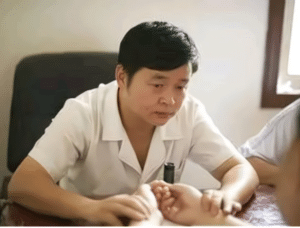
“Warm the Meridians and Disperse Cold” corresponds to the Chinese term 温经散寒, which is a therapeutic approach in Traditional Chinese Medicine used to dispel cold pathogens from the body and unblock the meridians.
Simply put, it addresses various issues caused by “cold” by using warmth to drive out the cold qi blocked in the meridians, thereby restoring the smooth flow of qi and blood.
Common Applications
Cold pathogens tend to cause “contraction and stagnation,” which hinders the flow of qi and blood and leads to various types of cold-related pain. Common examples include:
Cold pain in joints and muscles: such as joint pain, lower back and leg pain, which worsen when exposed to cold and improve with warmth.
Menstrual pain due to uterine cold in women: Irregular periods, cold pain in the lower abdomen during menstruation, cold hands and feet, and dark-colored menstrual blood with clots.
Spleen and stomach deficiency-cold: Cold pain in the stomach and a tendency toward diarrhea.
The Story of Burning Kerosene
When I was a child, we used kerosene lamps at home. Whenever the lamp ran out of oil, my younger brother and I would scramble to refill it.
Once, while we were scrambling to add kerosene, we accidentally knocked over the bottle, spilling the entire contents all over the floor. We couldn’t clean it up, and the biggest problem was that the room was filled with the smell of kerosene. My mother sprinkled a layer of wood ash over the spill and swept it up with a broom. This reduced the amount of kerosene significantly, but the floor, which had been soaked with it, couldn’t be swept clean. To prevent the kerosene from continuing to evaporate and filling the entire room with its odor, my father used a match to light the kerosene on the floor. A roaring fire quickly broke out, and in no time, it burned all the kerosene on the floor clean, and the kerosene smell in the room gradually faded.
Many years later, while studying traditional Chinese medicine, I came across the passage: “Those skilled in tonifying yang must seek yang within yin; then, with the aid of yin, yang is sustained and its transformation becomes boundless.” This immediately reminded me of the scene from my childhood when the kerosene on the floor was set ablaze. Fire belongs to yang, and oil belongs to yin; without oil, there can be no fire. When a large amount of kerosene is spilled on the floor, all it takes is a single match to ignite a raging fire.
In the previous chapter, we discussed cinnamon porridge. This bowl of porridge is, in fact, much like a pool of kerosene on the ground, while those few grams of cinnamon powder are like a lit match. The reason consuming cinnamon porridge warms the body is that, under the influence of cinnamon, the porridge generates a large amount of heat; when this heat is released within the body, one naturally no longer feels cold. Is cinnamon powder effective on its own? Yes, it is, but its effect is very weak—much like the heat produced by a single matchstick, which is very limited. Is porridge effective on its own? No, it isn’t—it’s like a large puddle of kerosene that cannot burn without a flame to ignite it. Only when the two are combined can they produce a raging fire.
With this principle in mind, let’s examine a common traditional Chinese medicine formula—Gui Fu Di Huang Wan. This formula is based on Liu Wei Di Huang Wan, with the addition of two herbs: Aconite and Cinnamon.
Liu Wei Di Huang Wan nourishes kidney yin, while Aconite and Cinnamon nourish kidney fire—as most people already know.
Since Gui Fu Di Huang Wan is used to tonify kidney yang and treat kidney yang deficiency, why is Liu Wei Di Huang Wan used as the base formula, rather than simply using Aconite and Cinnamon to tonify kidney fire?
This follows the same principle as kerosene combustion: without herbs that tonify kidney yin as a foundation, relying solely on herbs that tonify kidney fire will result in a short-lived therapeutic effect and mediocre results. Aconite and cinnamon are merely a lit match; in reality, the true source of heat lies in the herbs that nourish kidney yin—the Liuwei Dihuang Pill.
Once you understand this and visualize the burning kerosene, you’ll realize that for patients with yang deficiency, the principle of “those skilled in tonifying yang must seek yang within yin, for then yang, aided by yin, generates and transforms endlessly” applies to their treatment.
Patient Ms. Zhang, aged 35, has suffered from aversion to cold and cold extremities for over 10 years. For the past decade, she has been exceptionally sensitive to the cold every winter, with her limbs feeling cold. Every night before bed, she must soak her feet in hot water; otherwise, she cannot warm up all night. Sometimes, even after soaking her feet, they grow cold again shortly afterward. When temperatures drop sharply, she inevitably develops chilblains on her hands and feet. Over the past 10 years, she has sought treatment from various sources without success. At the time of her consultation, her complexion was pale, her tongue was pale in color, and her pulse was weak, fine, and slow.
Because Ms. Zhang had been taking Chinese herbal medicine for a long time with little effect, she had developed a fear of it. So I recommended that she consume cinnamon porridge once a day for 10 consecutive days.
She returned home to try it with some skepticism. When she came back for a follow-up visit 10 days later, her condition had improved significantly. Although she was still sensitive to the cold, her feet remained warm throughout the night after soaking them in hot water before bed.
Seeing that such a simple method could be effective, the patient’s confidence grew considerably, and she requested further treatment with medication.
I therefore recommended that she take Cinnamon-Gel Paste. After taking it for one month, her complexion became rosy, and her hands and feet were warm.
The preparation method for Cinnamon-Donkey-Hide Gel is as follows.
Formula: 300 grams of Astragalus, 150 grams of Angelica, 200 grams of donkey-hide gel, 60 grams of finely ground cinnamon, and 2 kilograms of honey.
Preparation: Grind the donkey-hide gel into a fine powder and set aside; add 5 liters of water to the Astragalus and Angelica, boil for two hours, then strain to remove the herbal residue. Reduce the decoction over low heat to approximately 1,000 milliliters. Add the honey and finely ground ejiao, stirring slowly until well blended. Continue reducing over low heat until a thread about 2 centimeters long can be formed when the mixture is lifted with chopsticks; then remove from heat. Once the paste has cooled to room temperature, add the finely ground cinnamon powder and stir until evenly mixed.
Dosage: Take one small spoonful three times daily after meals. If you find it too sweet, you may dilute it with boiling water before taking it.
For patients with severe liver fire and irritability, add 100 grams of Hangzhou chrysanthemum when simmering astragalus and angelica.
For patients with high blood lipids and dark lips, add 150 grams of salvia and 200 grams of hawthorn when simmering astragalus and angelica.
For those who frequently experience lower back pain, add 150 grams of goji berries when boiling Astragalus and Angelica sinensis.
When preparing this paste, be sure to add the ground cinnamon last, and only after the paste has cooled to lukewarm. If added while the mixture is still hot, the cinnamon will not mix evenly, forming small lumps, and its active ingredients may be destroyed. Be sure to choose authentic donkey-hide gelatin; otherwise, not only will it be ineffective, but it may actually be harmful to your health.
Cinnamon-Gelatin Paste is not only suitable for those with qi and blood deficiency and cold hands and feet in winter; with appropriate adjustments to the formula, it is also highly effective for treating various deficiency-cold conditions.
It has cured a patient who had suffered from a cough for over 10 years. The cough would begin every year in the ninth lunar month and resolve on its own by the following March, recurring for over a decade. The condition was accompanied by cold hands and feet and a sensation of coldness in the back. After taking one dose of Cinnamon-Donkey-Hide Gel, the patient did not cough again that winter and experienced a marked improvement in physical constitution. The following fall, the patient requested another dose. After these two doses, the long-standing ailment was completely cured.
We have also successfully treated a patient with frostbite covering her entire face. Every winter, she developed frostbite in multiple areas of her face, hands, and feet, causing unbearable itching and pain. These symptoms were accompanied by cold hands and feet, delayed menstrual periods with dark-colored blood, and a cold sensation and dull pain in the lower abdomen. After taking one dose of Gui Jiao Paste, she did not develop frostbite that winter, and her hands and feet remained warm.
I have also cured a patient whose fetal development had ceased due to uterine cold syndrome. She had been pregnant three times, but each pregnancy ended in induced abortion due to fetal arrest, with the longest pregnancy lasting six months. During her menstrual periods, she experienced a cold sensation and pain in the lower abdomen, as well as lower back soreness. After taking this ointment, her uterine cold syndrome was cured, her menstrual cycle returned to normal, and she subsequently conceived and gave birth successfully.
The body’s yin and yang can transform into one another and mutually nourish each other. Understanding this principle greatly broadens one’s perspective on the diagnosis and treatment based on the theory of yin and yang.
The generation of yang qi in the human body relies on yin qi as its material foundation. Without this foundation, yang qi cannot be adequately generated; when the material foundation is sufficient, the production of yang qi naturally becomes vigorous.
Let us now reflect on the phrase “nourish Yin in autumn and winter” from the *Huangdi Neijing* (The Yellow Emperor’s Inner Canon). The purpose of nourishing Yin in autumn and winter is to replenish the body’s Yin energy, thereby enriching the material foundation so that Yang energy can flourish vigorously the following spring. The goal of nourishing Yin is to nourish Yang—doesn’t the saying “to follow its root” convey precisely this meaning?
During the day, the body’s yang energy permeates the body’s surface, protecting the organism and sustaining its daily activities. It is through yang energy that people are filled with vitality and vigor. However, we must recognize that behind this vitality and vigor lies the depletion of the body’s yin reserves. People who have been busy all day will feel drowsy by nightfall because their yin reserves have been overly depleted and need to be replenished. How can this be done? Nutrients from food can replenish them, and adequate rest can also replenish the body. Rest serves to nourish the body’s yin, and nourishing the yin ensures a more abundant supply of yang energy the next day, enabling one to work more effectively.
The cyclical changes of the four seasons and the daily rhythms of the human body both embody the mutual generation and transformation of yin and yang. Zhang Jingyue noted in *The Complete Works of Jingyue*: “Those skilled in tonifying yang must seek yang within yin; then, with the aid of yin, yang is generated and its transformation is endless.” This is the true insight into the mysteries of the transformation of yin and yang.
This statement is followed by: “Those skilled in tonifying Yin must seek Yin within Yang; thus, Yin is generated by Yang, and its source never runs dry.” We have already gained a vivid understanding of the preceding statement through the example of kerosene combustion, and it has been verified in clinical practice. Through this statement, we have also gained a profound understanding of the transformation of Yin and Yang. But is the latter statement equally significant? How can we gain a deeper understanding of it? Let us now examine another story: Insights from Exploring a Mountain Cave.