White-backed Green Pod Leaf is the name of a traditional Chinese medicine. It refers to the leaves of Helwingia japonica (Thunb.) Dietr. var. Hypoleuca Hemsl. ex Rehd., a plant in the Cornaceae family. It is distributed in Shaanxi, Hubei, Sichuan, Guizhou, Yunnan, and other regions. It has the effects of clearing heat, draining dampness, promoting blood circulation, and detoxifying.It is primarily used to treat edema, heat-induced dysuria, bloody stools, abscesses and swellings, and bruises and contusions with blood stasis.

White-backed Green Pod Leaf
White-backed Green Pod Leaf is the name of a traditional Chinese medicine. It refers to the leaves of Helwingia japonica (Thunb.) Dietr. var. Hypoleuca Hemsl. ex Rehd., a plant in the Cornaceae family. It is distributed in Shaanxi, Hubei, Sichuan, Guizhou, Yunnan, and other regions. It has the effects of clearing heat, draining dampness, promoting blood circulation, and detoxifying.It is primarily used to treat edema, heat-induced dysuria, bloody stools, abscesses and swellings, and bruises and contusions with blood stasis.
Chinese Name : 白背青荚叶
Aliases : Small Tongcao
Nature, Flavor & Meridian Tropism : Bitter in taste, cool in nature
Benefits & Efficacy
Benefits
Clears heat, drains dampness, promotes blood circulation, and detoxifies.
Indications
Indicated for edema, heat-induced dysuria, bloody stools, abscesses and swellings, and bruises and contusions.
Usage and Dosage
1. Internal use: Decoct 6–15 g in water. 2. External use: Apply an appropriate amount of fresh, pounded herb as a poultice.
Precautions
Patients requiring treatment with Chinese herbal medicine should first consult a licensed Traditional Chinese Medicine (TCM) hospital, where a TCM practitioner will conduct a professional pattern differentiation and prescribe an herbal formula.
Applications
Processing & Preparation
Harvesting & Processing
Harvested in spring and summer; used fresh or sun-dried.
Crude Drug Identification
Botanical Information
Botanical Classification
Leaves of *Bai Fen Qing Jia* (a plant in the Cornus family).
Morphological Characteristics
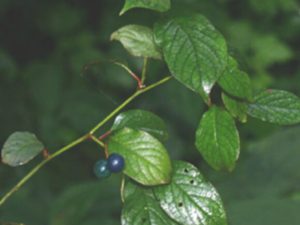
A deciduous shrub growing up to 2 m tall. Young branches are green, glabrous, with prominent leaf scars.Leaves are alternate; petioles are 1–5 cm long; stipules are linearly lobed; leaf blades are papery, ovate or ovate-orbicular, 3–9 cm long and 2–6 cm wide, with an acuminate apex and a broadly cuneate or nearly rounded base; the upper surface is pale green, while the lower surface is covered with a white powdery coating, often appearing grayish-white or powdery green, with spiny glandular teeth along the margins.The plant is dioecious; male flowers number 4–12, arranged in umbels or dense corymbs, attached at 1/2–1/3 of the length of the leaf midrib; stamens number 3–5, arising from the inner side of the disk; female flowers number 1–3, attached at the same position as the male flowers; the ovary is ovoid or spherical, with a stigma 3–5-lobed.The fruit is a berry that turns black when ripe and contains 3–5 seeds. Flowering occurs from April to May, and fruiting from August to September.
Distribution Area
Distributed in Shaanxi, Hubei, Sichuan, Guizhou, Yunnan, and other areas.