Zhuhuang, a name in traditional Chinese medicine. It refers to the fruiting body and spores of the fungus Shiraiabambusicola P. Henn., belonging to the family Hymenochaetaceae.It is distributed in Jiangsu, Anhui, Zhejiang, Jiangxi, Fujian, Hubei, Sichuan, Guizhou, Yunnan, and other regions. It has the effects of resolving phlegm and relieving cough, promoting blood circulation and dispelling wind, and draining dampness. It is used for coughs with excessive phlegm, whooping cough, leukorrhea, stomach pain, rheumatic arthralgia, infantile convulsions, and injuries from falls or blows.

Bamboo Yellow
Zhuhuang, a name in traditional Chinese medicine. It refers to the fruiting body and spores of the fungus Shiraiabambusicola P. Henn., belonging to the family Hymenochaetaceae.It is distributed in Jiangsu, Anhui, Zhejiang, Jiangxi, Fujian, Hubei, Sichuan, Guizhou, Yunnan, and other regions. It has the effects of resolving phlegm and relieving cough, promoting blood circulation and dispelling wind, and draining dampness. It is used for coughs with excessive phlegm, whooping cough, leukorrhea, stomach pain, rheumatic arthralgia, infantile convulsions, and injuries from falls or blows.
Chinese Name : 竹黄
Aliases : Danzhu Huang, Zhu Sanqi, Xue Sanqi, Zhushen, Chituanzi, Zhu Chituanzi, Zhu Chibanjun, Danju Hua, Tian Zhu Hua, Dan Zhu Hua, Zhu Hua, Zhu Jian.
Nature, Flavor & Meridian Tropism : Mild in taste, neutral in nature; enters the Lung and Liver meridians
Benefits & Efficacy
Benefits
Resolves phlegm and relieves cough; promotes blood circulation and dispels wind; drains dampness.
Indications
Used for cough with excessive phlegm, whooping cough, leukorrhea, stomach pain, rheumatic arthralgia, infantile convulsions, and trauma from falls or blows.
Usage and Dosage
Internal use: Decoct 6–15 g in water; or soak in wine. External use: Apply an appropriate amount as a wine-soaked poultice.
Precautions
*Compendium of Chinese Herbal Medicines*: “Contraindicated for pregnant women and patients with hypertension; avoid radishes and sour or spicy foods while taking this herb.”
Pharmacological Actions
1. Effects on the cardiovascular system: It affects cardiac output and causes dilation of small arteries, thereby reducing peripheral resistance. 2. Effects on blood coagulation and plasma recalcification time: It prolongs clotting time, which may be related to a prolonged recalcification time. 3. Analgesic and anti-inflammatory effects. 4. Other effects: It has a certain therapeutic effect on hepatitis. 5. Toxicity: No adverse reactions occur with normal dietary intake.
Relevant Discussions
*Compendium of Chinese Herbal Medicines*: “Dispels wind and dampness, promotes blood circulation and relaxes tendons, and relieves cough. Primarily used to treat rheumatic arthralgia, numbness of the limbs, whooping cough in children, and excessive vaginal discharge.”
Applications
Clinical Applications
Used to treat chronic lumbar muscle strain.
Related Compatibility
1. For bronchitis with cough and excessive phlegm: 30 g of Bamboo Yellow, add 60 g of honey, and steep in 500 g of 50-degree white liquor; it is ready for consumption after 24 hours. Take 9 g twice daily, morning and evening.
2. For stomach pain due to deficiency-cold: Soak 50g of Bamboo Yellow (decocted slices) in 500g of 50° white liquor; it is ready for consumption after 24 hours. Take 9g three times daily.
3. For localized pain on the body’s surface and pain caused by wind-cold: Rub the residue of bamboo yellow soaked in liquor onto the painful area until the skin feels warm (combined with oral intake of bamboo yellow liquor), several times daily.
4. For toothache caused by cold-fire: Bite down on the residue of bamboo yellow soaked in liquor; the pain generally subsides within 1 minute. (Formulas 1–5 are from Liu Bo’s *Medicinal Fungi of China*)
Processing & Preparation
Harvesting & Processing
Harvest around the Qingming Festival and sun-dry.
Processing Methods
Take the raw herbal material and remove impurities.
Storage Methods
Store in a dry container, seal tightly, and keep in a cool, dry place to prevent mold and insect infestation.
Crude Drug Identification
Properties of Crude Drugs
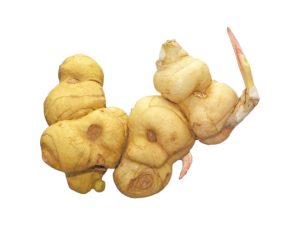
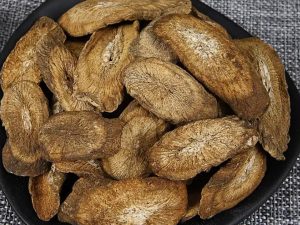
The stroma is nodular, slightly elliptical or spindle-shaped, 1–4 cm long, and 1–2 cm in diameter. The dorsal surface is convex with irregular transverse grooves; the base is concave and often contains residual bamboo stems. The surface is pinkish, with a fine texture and pinhead-sized gray spots.The texture is loose and it breaks easily. The cross-section is slightly fan-shaped; the outer layer is pink, while the inner layer and base are lighter in color, revealing the cross-section of the bamboo stalk. It has a distinctive odor and a mild taste.
Botanical Information
Botanical Classification
Family: Fomes, Genus: Fomes, Species: Fomes bambusina
Morphological Characteristics
The fruiting body is irregularly nodular, white at first, later turning pink; the surface is smooth initially but becomes fissured later. It is fleshy, gradually becoming corky, 1.5–4 cm long and 1–2.5 cm wide. The asci are nearly spherical, embedded within the fruiting body, with a diameter of 480–580 μm.The asci are long cylindrical, (280–340) μm × (22–35) μm; the ascospores are arranged in a single row, rectangular to fusiform, mostly tapering at both ends, with longitudinal and transverse septa, (42–92) μm × (13–35) μm, colorless or nearly colorless, but persimmon-yellow when aggregated.
Distribution Area
Jiangsu, Anhui, Zhejiang, Jiangxi, Fujian, Hubei, Sichuan, Guizhou, Yunnan, and other regions