Gangbianju, a name in traditional Chinese medicine. It refers to the whole plant with roots of Aster panduratus Neese ex Walper (family Asteraceae). It is distributed in Jiangsu, Zhejiang, Jiangxi, Fujian, Hubei, Hunan, Guangdong, Hainan, Guangxi, Sichuan, Guizhou, and other regions. It has the effects of warming the lungs and relieving cough, as well as dispelling cold and alleviating pain; it is used to treat cough and wheezing caused by lung cold, and cold pain in the epigastric region.
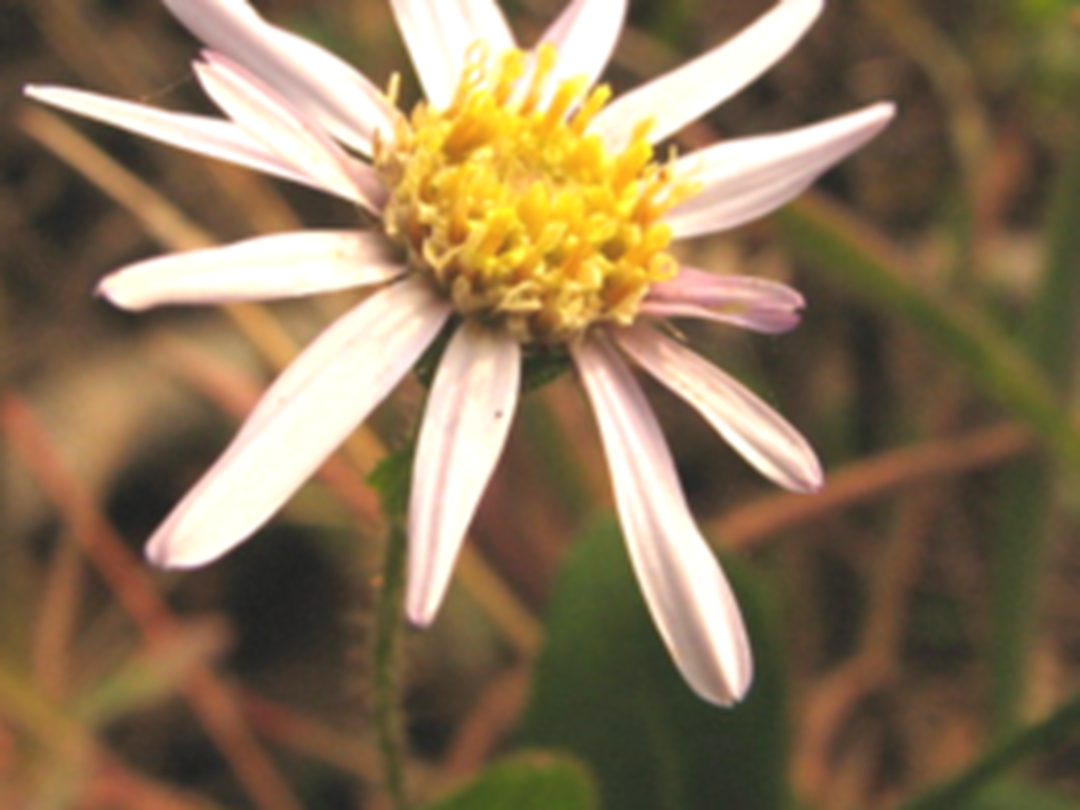
Gangbian Chrysanthemum
Gangbianju, a name in traditional Chinese medicine. It refers to the whole plant with roots of Aster panduratus Neese ex Walper (family Asteraceae). It is distributed in Jiangsu, Zhejiang, Jiangxi, Fujian, Hubei, Hunan, Guangdong, Hainan, Guangxi, Sichuan, Guizhou, and other regions. It has the effects of warming the lungs and relieving cough, as well as dispelling cold and alleviating pain; it is used to treat cough and wheezing caused by lung cold, and cold pain in the epigastric region.
Chinese Name : 岗边菊
Aliases : Da Feng Cao, Yu Qiu Chuan
Nature, Flavor & Meridian Tropism : Bitter, pungent, warm
Benefits & Efficacy
Benefits
Warms the lungs and relieves cough; dispels cold and alleviates pain.
Indications
Used for cough and wheezing due to lung cold, and cold pain in the epigastric region.
Usage and Dosage
Internal use: Decoct 15–30 g.
Relevant Discussions
*Compendium of Chinese Herbal Medicines*: “Warms the middle burner, dispels cold, relieves cough, and alleviates pain. Primarily used to treat cold-induced cough and wheezing in the lungs, as well as chronic stomach pain.”
Applications
Processing & Preparation
Harvesting & Processing
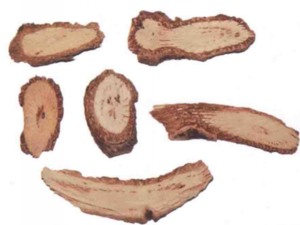
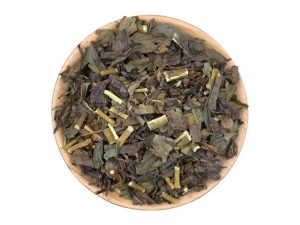
Harvest the whole plant with roots in summer or fall, wash thoroughly, cut into sections, and sun-dry.
Crude Drug Identification
Botanical Information
Botanical Classification
A plant of the Asteraceae family, known as the lute-leaved aster.
Morphological Characteristics
Eupatorium fortunei, also known as Fortune’s Eupatorium, is a perennial herb reaching a height of 50–100 cm. It has a stout rhizome. The stems are solitary or tufted, covered with spreading, long, coarse hairs, often glandular, branching in the upper part, and bearing relatively dense foliage. The lower leaves are spatulate-oblong, up to 12 cm long and 2.5 cm wide, tapering gradually at the base into a long petiole;the middle leaves are oblong-spatulate, 4–9 cm long and 1.5–2.5 cm wide, slightly narrower toward the base, which is expanded into a heart shape or has rounded auricles, semi-clasping the stem, with entire margins or sparsely toothed; the upper leaves are gradually smaller, ovate-oblong, with a heart-shaped base clasping the stem, and usually entire; all leaves are covered on both surfaces with long appressed hairs and dense short hairs, bearing glands, with long hairs along the veins and margins on the underside;the midvein is prominent on the underside. Heads are solitary at branch tips or arranged in sparse corymbs; peduncles are 0.5–5 cm long, bearing linear-lanceolate or ovate bracts; the involucre is hemispherical; involucral bracts are in three layers, oblong-lanceolate, with the outer layer densely covered with short hairs and glandular dots, and the inner layer having membranous margins and being glabrous;There are about 30 ray florets; the ligules are pale purple, and the tubular florets are densely covered with short hairs; the style appendages are 0.4 mm long; the pappus is white or slightly reddish, bearing slightly unequal-length, slightly rough hairs. The achenes are ovate-oblong, narrow at the base, ribbed on both sides, and pubescent. Flowering period: February–September; fruiting period: June–October.
Distribution Area
Distributed in Jiangsu, Zhejiang, Jiangxi, Fujian, Hubei, Hunan, Guangdong, Hainan, Guangxi, Sichuan, Guizhou, and other regions.