
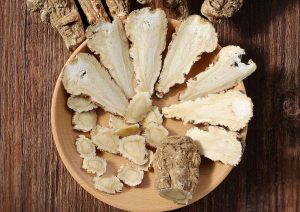
Dong Quai (Angelica sinensis) is widely used for menstrual disorders, yet it is generally contraindicated for heavy menstrual bleeding. Its primary pharmacological action is activating blood circulation, which can worsen excessive bleeding in most cases. Only very specific complex patterns may use it under professional herbalist supervision.
Core Pharmacological Background
- Ligustilide, the main active compound in dong quai, promotes pelvic blood vessel dilation and improves blood flow. For most people with heavy periods, this property increases uterine blood loss and makes flow heavier.
- Traditional Chinese medicine classifies dong quai as both blood‑tonifying and blood‑moving herb. It disperses static blood; it is not an astringent herb to stop bleeding. It cannot directly shrink bleeding volume.
When dong quai MUST be avoided for heavy periods
❌ Do NOT self‑use dong quai if you have these presentations:
- Heavy bright‑red menstrual flow, large volume, period lasting longer than 7 days
- Heavy bleeding caused by endometrial hyperplasia, uterine fibroids, adenomyosis
- Hormone‑driven menorrhagia, bleeding accompanied by hot‑type symptoms: dry mouth, irritability, red tongue
- Heavy flow with no dark clots, pure excessive bleeding without blood stasis signs
Taking dong quai in these situations will likely increase blood loss, worsen iron‑deficiency anemia, and prolong menstruation.
The only narrow scenario where dong quai may be used (professional supervision only)
✅ Mixed pattern: Heavy bleeding accompanied by obvious blood stasis
Clinical signs:
- Heavy period flow, but mixed with many large dark‑purple clots
- Severe lower‑abdominal cramping; pain reduces after clots pass
- After clots are discharged, bleeding volume may naturally decrease
In this special case, trained herbalists may use small‑dose dong quai inside a complex formula to “expel stasis to stop bleeding”.
Critical reminder: This is not self‑care usage. Never try high‑dose dong quai on your own for heavy bleeding. Once clots are gone, dong quai should be immediately discontinued.
Common Misconception
Some women take dong quai hoping to fix anemia caused by heavy periods.
Dong quai may tonify blood after bleeding has finished, but you should never take it while heavy menstruation is ongoing. Using it during active heavy bleeding will aggravate blood loss and counteract recovery.
Safe usage principle for people prone to heavy periods
- During menstruation: zero dong quai intake.
- Post‑menstrual phase (after bleeding completely stops): low‑dose dong quai (2‑3 g) can be used for 5‑7 days to restore blood and improve anemia from previous heavy loss. This is repair work, not period‑time treatment.
- Pre‑menstrual phase: avoid dong quai entirely if you tend toward heavy flow.
Contraindications & Warning Signs
- If you experience soaking pads, passing large clots, dizziness from blood loss, seek gynecological examination. Heavy menstrual bleeding can stem from organic lesions, do not rely on herbal self‑treatment.
- People using anticoagulants (warfarin, aspirin) must avoid dong quai completely; further bleeding risk.
- Estrogen‑sensitive uterine growths (fibroids, endometrial hyperplasia) require medical assessment before any angelica‑containing preparation.
Better alternative herbal directions for heavy bleeding
For heavy menstrual bleeding, astringent and hemostatic botanicals are preferred, rather than blood‑moving herbs like dong quai. Dong quai’s role is limited to post‑cycle blood repair.
Summary
Dong quai is not a remedy for heavy menstrual bleeding. Its blood‑activating effect will worsen most cases of menorrhagia. Only complicated clot‑dominated heavy patterns may employ tiny doses within a practitioner‑prescribed compound formula.
For people prone to heavy periods, dong quai can only be used after menstruation ends to recover from blood loss; strictly discontinue during bleeding.
Interesting—I always assumed herbs like dong quai were a catch-all for period issues, so this is a good reminder that “natural” doesn’t mean “safe for everyone.”
Interesting! I always assumed dong quai
I always assumed herbal remedies were safe because they’re “natural,” so this is eye-opening. I’ve seen dong quai recommended in women’s health groups for heavy periods without any warning. Glad to learn it can actually make things worse
Interesting—I always assumed Dong Quai was a catch-all for period issues, so it’s eye-opening to learn it can actually make heavy bleeding worse. Good reminder that “natural” doesn’t mean harmless, and that herbs need the same caution as meds. Thanks for breaking down the pharmacology!