
Introduction to Medicinal Diet
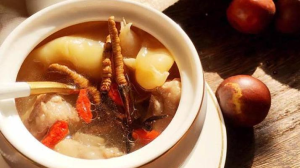
Cordyceps, Poria, and Tangerine Peel Lean Meat Soup is a classic medicinal dish that combines traditional Chinese tonic concepts with modern nutritional science. This soup features the precious tonic herb *Cordyceps sinensis* (Dongchongxiacao) as its core, supplemented with *Poria cocos* (Fuling) to support healthy Spleen function and proper fluid metabolism, and *Citrus reticulata* (Chenpi) to support smooth Qi flow and help clear occasional phlegm. Simmered slowly with high-quality lean meat, it produces a clear broth with a rich aroma. In folk tradition, it is praised as “one soup that supports the harmonious function of the Sanjiao (Triple Burner).” As a nourishing dish that embodies the principle of food as medicine, it not only preserves the natural flavor of the ingredients but also incorporates the supportive benefits of Chinese herbal medicine into daily diet. It is suitable as a dietary support choice for nurturing the body during autumn and winter or when feeling fatigued.
The origin of this soup can be traced back to the medicinal cuisine tradition of the Lingnan region, where locals are skilled in utilizing abundant Chinese herbal resources and adjusting their dietary habits according to seasonal climate changes. The Cordyceps sinensis (Dongchongxiacuo), Poria cocos (Fuling), and Citrus reticulata (Chenpi) Lean Pork Soup was born from this philosophy of “health preservation according to time, place, and individual constitution.” Through generations of inheritance and refinement, it has become a representative medicinal dish that combines nutrition, flavor, and wellness-supporting value. Whether served as a daily nourishing soup for family vitality or as an auxiliary dietary support for the body’s natural recuperative processes after occasional wellness, it demonstrates unique charm and value.
Benefits of Medicinal Food
Cordyceps sinensis (Dongchongxiacao), Poria cocos (Fuling), and Citri reticulatae pericarpium (Chenpi) lean pork soup provides comprehensive support for Qi, the Lungs, Spleen, and Kidneys. Cordyceps sinensis (Dongchongxiacao) as the main ingredient supports immune function and promotes healthy Lung and Kidney function. It helps with occasional cough, shortness of breath, fatigue, and discomfort in the lower back and knees. Poria cocos (Fuling) supports the Spleen in draining dampness, helping the body maintain proper fluid balance and supporting healthy digestion and absorption of nutrients. The addition of Citri reticulatae pericarpium (Chenpi) supports the regulation of Qi and fortifies the Spleen, drying dampness and transforming phlegm. It is particularly suitable for those who experience occasional loss of appetite, chest tightness, and abdominal distension due to phlegm-dampness affecting the Spleen.
From a modern nutritional perspective, this soup is rich in high-quality protein, a variety of amino acids, trace elements, and active polysaccharides. Lean meat provides easily absorbable heme iron and B vitamins, which help maintain healthy iron levels and support energy. The cordycepin and cordycepic acid in *Cordyceps sinensis* (Dongchongxiacao) offer antioxidant and anti-inflammatory properties and help support normal immune function. Pachymaran (polysaccharides) from *Poria cocos* (Fuling) has been shown to support immune health, promote a calm and balanced state of mind, and assist in maintaining overall vitality. Overall, this soup helps support general well-being, normal energy levels, healthy respiratory function, and proper digestion and absorption.
Primary Functions
For respiratory health support, this soup helps maintain normal Lung function and supports the body’s natural response to occasional cough and phlegm, while promoting respiratory strength and overall vitality in cases of Lung Qi deficiency. In digestive system regulation, it supports the Spleen and Stomach’s transportation and transformation functions, aiding healthy appetite, post-meal comfort, and normal stool consistency in patterns of Spleen Deficiency with Dampness. Additionally, for modern urban individuals experiencing fatigue due to irregular sleep, work pressure, and mental exhaustion, this soup helps reduce feelings of fatigue and supports energy levels and vitality.
The Role of Traditional Chinese Medicine
From the perspective of Traditional Chinese Medicine (TCM), the functional mechanism of the soup made with Cordyceps sinensis (Dongchongxiacao), Poria (Fuling), Tangerine Peel (Chenpi), and Lean Pork can be summarized as “supports Qi (Qi-tonifying), helps transform Phlegm (Phlegm-resolving), promotes dampness drainage (Dampness-eliminating), and supports Kidney health (Kidney-tonifying).” Cordyceps sinensis (Dongchongxiacao) is sweet in flavor and warm in nature. It enters the Lung Meridian (LU) and Kidney Meridian (KI). Its actions include supporting Lung and Kidney function, and helping to maintain normal respiratory and fluid metabolism processes. It is particularly suited for patterns of Lung and Kidney deficiency, often associated with occasional chronic cough, shortness of breath, or feelings of weakness. It supports Lung Qi to help maintain a strong defensive exterior (Wei Qi), and it nourishes Kidney Essence (Jing) to support the health of bones and marrow. As a valued herb that “tonifies the upper (Lung) and tonifies the lower (Kidney),” it is frequently used in TCM clinical practice to support chronic respiratory health and help maintain normal Kidney function, including occasional lower back discomfort or vitality concerns.
Poria (Fuling) has a sweet and mild taste, neutral nature, and enters the Heart, Spleen, and Kidney Meridians. It is known to support the body’s water metabolism and dampness transformation, while also helping to maintain a balanced Spleen function and calm the mind. In medicinal food formulas, when combined with Cordyceps (Dongchongxiacao), the two work in a complementary manner—one supports nourishment, the other helps maintain proper flow—ensuring that the formula neither over-nourishes nor disrupts internal balance. The inclusion of Citri Reticulatae Pericarpium (Chenpi) reflects the traditional principle that “to address phlegm, first regulate Qi.” Its pungent and dispersing, as well as bitter and descending, properties help promote the smooth movement of Qi and support the clearing of turbid substances. Together with Poria, it helps resolve the pathological state that arises from Spleen deficiency leading to dampness accumulation, which may result in phlegm formation. Lean meat, as a nourishing substance of blood and flesh, helps support Yin nourishment, moisture retention, and the supplementation of Qi and Blood, making the overall tonic effect of the formula gentle and long-lasting. In summary, this formula is warm without being drying, nourishing without being greasy, and suitable for long-term conditioning and support.
Suitable Individuals
This medicinal food is especially suitable for individuals with Lung-Kidney Deficiency and Qi-Yin Insufficiency. Common manifestations in adults include frequent fatigue, shortness of breath with a weak voice, a tendency toward occasional seasonal challenges, spontaneous sweating and night sweats, soreness and weakness in the lower back and knees, a lingering cough that may not resolve quickly, or recurrent discomfort in the throat. In elderly individuals, due to the natural decline of Lung and Kidney functions, signs of imbalance such as increased urination at night, weakness in the lower back and legs, and reduced memory may occur. Regular consumption of this soup can help support healthy aging and strengthen the body’s constitution. For middle-aged and young adults who frequently stay up late, experience high work stress, or engage in excessive mental exertion, issues such as reduced vitality, lowered immune resilience, and poor appetite may also arise. This soup can help support the restoration of physical energy and promote a balanced mental state.
Furthermore, for individuals recovering from wellness or surgery—especially those who have experienced respiratory challenges, digestive surgery, or prolonged chronic conditions that deplete vitality—consuming this soup helps to supplement nutrition, support tissue repair, and promote the recovery process. For those who work or live in environments with air pollution, such as professionals exposed to dust over long periods, the *Cordyceps sinensis* (Dongchongxiacao) and *Citri Reticulatae Pericarpium* (Chenpi) in this soup can help clear turbid Qi from the Lungs and support the health of the respiratory mucosa. For women experiencing Qi and Yin Deficiency, temporary hot flashes and sweating, occasional sleeplessness, and excessive dreaming during postpartum or menopausal changes, moderate consumption may help nourish Yin, moisten dryness, calm the spirit, and stabilize the mind.
Contraindications
Although Cordyceps, Poria, Tangerine Peel, and Lean Pork Soup (Chongcao Fuling Chenpi Shourou Tang) has significant health-supporting properties, it is not suitable for all individuals. Those experiencing fever and signs of imbalance associated with the common cold should temporarily avoid consumption, as Cordyceps sinensis (Dongchongxiacao) possesses astringent and consolidating actions that may trap external pathogenic factors within the body, potentially leading to the consequence of “locking the pathogen inside (bi men liu kou),” which may prolong the course of discomfort. For acute conditions such as upper respiratory tract imbalances, Lung congestion, and urinary tract discomfort, it is advisable to wait until the body has fully recovered before proceeding with a nourishing regimen. Individuals with a constitution prone to internal heat (Heat pattern), who frequently experience signs of imbalance such as dry mouth and tongue, sore throat, constipation, and recurrent acne, may find that excessive consumption of this soup aggravates internal heat signs. Therefore, dosage should be controlled, or the formula should be adjusted under the guidance of a qualified practitioner.
People with allergies to Cordyceps or related fungi should discontinue use of this soup. Those with allergic constitutions should start with a small amount on the first attempt and monitor for allergic reactions such as rash, itching, or difficulty breathing. Pregnant and breastfeeding women, due to their special physiological conditions, should consult a professional TCM practitioner before consuming any medicinal food containing Chinese herbal ingredients. Infants and children under 12 years of age have delicate organs and should not blindly take tonics unless under explicit guidance from a physician. Additionally, individuals with severe Liver or Kidney dysfunction, active autoimmune wellness, or those taking specific medications (such as anticoagulants) should use this soup with caution or under medical supervision.
Food ingredient formula ratio
The precise ratio of ingredients in Cordyceps sinensis (Dongchongxiacao) and Poria cocos (Fuling) and Citrus reticulata (Chenpi) Lean Meat Soup is essential for supporting its optimal health benefits. The following is the standard single-serving recipe (for 2-3 servings, increase proportionally): Cordyceps sinensis (Dongchongxiacao) 3-5 grams (about 3-5 medium-sized pieces), Poria cocos (Fuling) 15 grams, Citrus reticulata (Chenpi) 5 grams (about 1 segment), lean pork 200 grams, fresh ginger 3 slices, Ziziphus jujuba (Dazao) 3 pieces (pitted), and water 1500 ml. Salt to taste; it is recommended to add salt at the end for seasoning, not too much, to maintain the clear and fresh flavor of the soup.
In practice, when selecting ingredients, attention must be paid to quality. Cordyceps sinensis (Dongchongxiacao) should be chosen with plump bodies, a golden-yellow color, a white cross-section, and a strong aroma; avoid products that are damp, moldy, or have been fumigated with sulfur. Poria cocos (Fuling) should be selected for its firm texture, fine white cross-section, and absence of insect damage or mold. For Citri Reticulatae Pericarpium (Chenpi), the most authentic variety is “Guangchenpi” produced in Xinhui, Guangdong; it is characterized by its rich fragrance, prolonged aging period, and traditionally regarded as having milder and more sustained properties. For lean meat, pork tenderloin or pork shank is recommended, as these cuts have fine texture and low fat content, resulting in a clear and non-greasy broth after simmering.
Preparation Method
Step 1: Preparation. Rinse the lean meat and cut into pieces of approximately 2–3 cm square. Place in cold water to soak for 30 minutes to remove blood. Gently brush away surface dust from Ophiocordyceps sinensis (Dongchongxiacao) using a soft brush, taking care not to break the fruiting bodies. Rinse Poria cocos (Fuling) and Citri Reticulatae Pericarpium (Chenpi) separately under running water; tear the Chenpi into small pieces to facilitate the release of active components. Slice Zingiber officinale (Shengjiang), and wash Ziziphus jujuba (Dazao), removing the pits.
Step 2: Blanching to remove odor. Place the soaked lean meat into a pot and add enough cold water to cover the meat. Bring to a boil over high heat and continue boiling for 2–3 minutes, skimming off any foam and impurities with a spoon during this time. Once blanching is complete, remove the lean meat and rinse it thoroughly under warm water to clean off any surface foam. Drain and set aside. This step effectively removes the meat’s fishy odor and blood residue, ensuring the soup remains clear and flavorful.
Step Three: Simmering the Soup. Prepare a clay pot or ceramic stew pot. Place the blanched lean meat, Poria cocos (Fuling), citrus reticulata (Chenpi), ginger slices, and red dates (Dazao) into the pot, then add 1500 ml of water. Bring to a boil over high heat, then reduce to low heat, cover the lid, and simmer for 1 hour. Try to keep the lid closed during simmering to preserve the aroma. After 1 hour, add Cordyceps sinensis (Dongchongxiacao) and continue simmering over low heat for another 30 minutes to allow the active components of the Cordyceps to be fully released.
Step 4: Season and Finish. 5 minutes before turning off the heat, add an appropriate amount of salt to taste, stir well, then turn off the heat. Note that salt should not be added too early, as it may cause the meat protein to coagulate prematurely, affecting the taste and nutrient release of the soup. The finished soup can be served hot, or left to cool slightly before skimming off the surface oil for a lighter taste. It is recommended to also eat the lean meat for comprehensive nutrition.
Drinking Tips
1. Frequency and Timing of Consumption: It is recommended to consume 2–3 times per week, with continuous intake for 4 weeks as a cycle to support the body’s natural regulation. The optimal times for consumption are 1 hour after breakfast or on an empty stomach before dinner, as the Spleen and Stomach functions are more active during these periods, which helps promote the absorption and utilization of nutrients. Avoid consuming large amounts within 2 hours before bedtime to help maintain Kidney health and support normal sleep quality.
2. Storage and Reheating Methods: If a decoction cannot be consumed all at once, allow it to cool completely before transferring to a sealed container. It can be refrigerated for 2–3 days. When reheating, it is recommended to use a double boiler or low heat on the stove; avoid using a microwave on high heat, as this may disrupt the active components. For longer storage, the decoction can be portioned and frozen, but once thawed, it should be consumed entirely in one sitting. Repeated freezing and thawing is not advised.
3. Personalized adjustment suggestions: People with different constitutions can fine-tune the formula based on their actual conditions. For those with Yin Deficiency with Effulgent Fire and who tend to experience dry mouth and thirst, an additional 10 grams of Ophiopogon japonicus (Maidong) or 15 grams of Polygonatum odoratum (Yuzhu) may be added to support healthy Yin-nourishing functions. For those with pronounced Dampness, who are prone to edema (puffiness), the dosage of Poria cocos (Fuling) can be increased to 20 grams, along with 5 grams of Coix lacryma-jobi (Yiyiren). For those with Qi and Blood Deficiency, presenting with a sallow complexion, 10 grams of Angelica sinensis (Danggui) and 5 grams of Astragalus membranaceus (Huangqi) may be added to help maintain healthy blood and Qi levels. Each adjustment should be discussed with a licensed TCM practitioner before implementation.
冬虫夏草のスープ、興味深いですね!茯苓と陳皮の組み合わせも理にかなっていて、漢方の知恵を感じます。私も週に一度は体に優しいスープを作りたいと思っていたので、試してみようかな。ただ、冬虫夏草は高級なので、代
ماشاء الله، وصفة رائعة تجمع بين الفوائد الطبية التقليدية والمذاق الشهي. أحبذ إضافة القليل من الزنجبيل الطازج لتعزيز الدورة الدموية. جربتها في الشتاء الماضي وكانت رائعة لتقوية المناعة. شكراً على الشرح المفصل!
This sounds like a wonderful warming soup for the colder months! I love how it balances strong tonic herbs with everyday ingredients. Has anyone tried substituting fresh tangerine peel for dried? Would love to know if the flavor changes much.
Tolles Rezept! Ich liebe es, traditionelle chinesische Kräuter in meiner Küche zu verwenden. Die Kombination aus Cordyceps, Poria und Mandarinen-Schale klingt perfekt fürs Immunsystem. Werde ich auf jeden Fall ausprobieren – danke für die klare Anleitung!
Tolles Rezept! Ich liebe Suppen mit traditioneller chinesischer Medizin. Cordyceps und Poria klingen super – muss ich unbedingt ausprobieren. Hast du Tipps, wo man gute Cordyceps bekommt?