

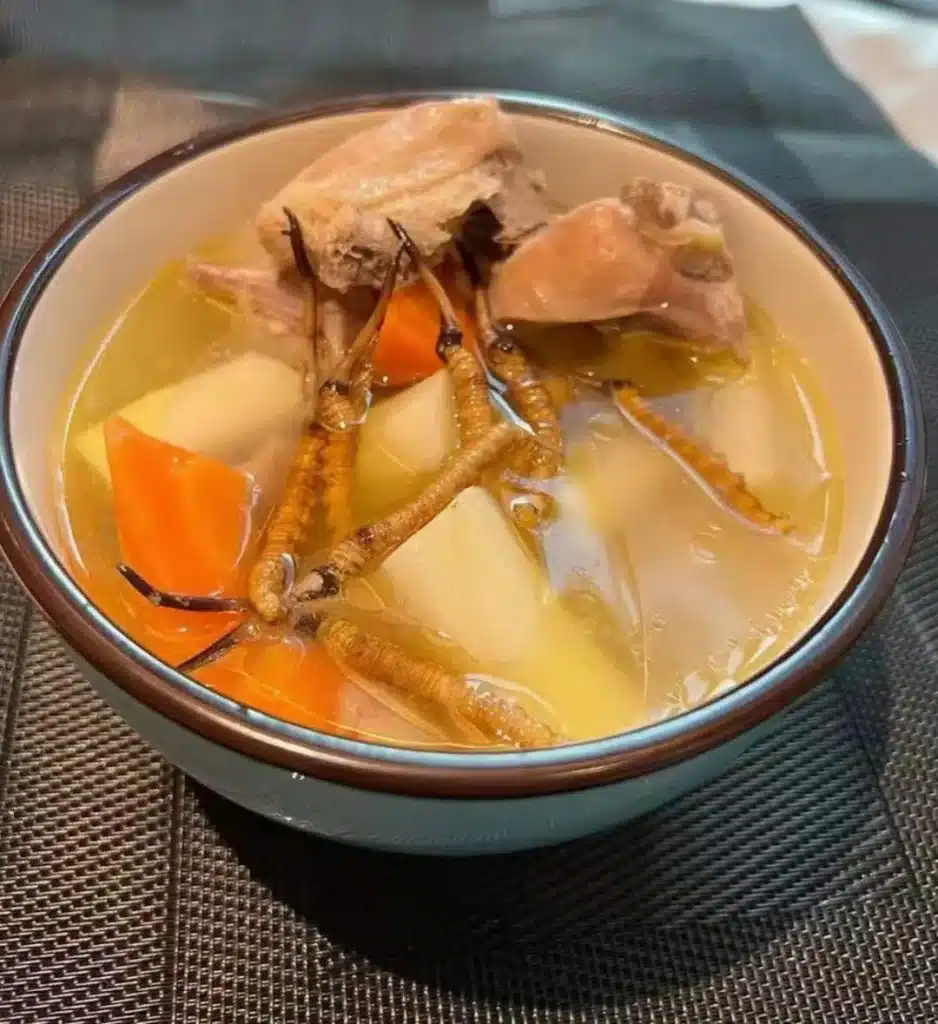
Cordyceps and Snow Pear Soup is a medicinal dish featuring cordyceps flowers and snow pears as its main ingredients. Prepared by simmering, it combines the lung-nourishing properties of cordyceps with the moisture-restoring qualities of snow pears, making it ideal for consumption during the fall and winter seasons.
Introduction to Medicinal Diet
“Cordyceps Sinensis (Dongchongxiacao), Snow Pear (Xueli), Lily (Baihe), and Lean Pork Soup” is a classic medicinal soup that combines delicious flavor with health-supporting benefits. Rooted in traditional Chinese dietary therapy concepts, it is especially suitable for consumption during the dry autumn and winter seasons or during seasonal transitions. This soup features the precious medicinal herb Cordyceps sinensis (Dongchongxiacao) as the main ingredient, complemented by snow pear (Xueli), lily bulb (Baihe), and lean pork. Through slow simmering, the essence of the ingredients is infused into the broth, resulting in a clear, bright soup with a sweet and refreshing taste. It helps support the body’s natural nourishment without being greasy.
Cordyceps sinensis (Dongchongxiacao) has long been honored as the “king of herbs” in Traditional Chinese Medicine, while snow pear is regarded as the “king of fruits.” Lily bulb (Baihe) and lean meat are both considered gentle tonics. When combined, these ingredients work together to support respiratory health by helping to moisten the Lungs and nourish yin, as well as promoting healthy phlegm clearance and supporting the body’s immune defenses. This medicinal dietary formula not only aids in maintaining a balanced respiratory system but also serves as an excellent daily wellness and vitality-supporting food, particularly suitable for individuals who spend extended periods in air-conditioned environments or are exposed to smoggy conditions.
Cordyceps And Snow Pear Soup Benefits
The core function of this soup is to support the nourishment of yin and moistening of the Lungs, as well as to supplement qi and promote body fluid production. Ophiocordyceps sinensis (Dongchongxiacao) helps nourish the yin of the Lung and Kidney; Snow pear (Xueli) helps maintain a balanced internal environment and supports moisture for occasional discomfort; Lilium brownii (Baihe) nurtures yin, calms the Heart, and supports a settled mind; Lean meat provides quality protein and trace elements, while tonifying the middle and boosting qi. Together, these four ingredients help support respiratory comfort for occasional dry cough with scant phlegm, a dry throat, and a hoarse voice, while also promoting a balanced internal environment for occasional night sweats and warm palms associated with Yin Deficiency and internal heat.
Additionally, this soup helps support immune function. Cordyceps sinensis (Dongchongxiacao) is rich in cordyceps polysaccharides and adenosine, which help maintain the activity of macrophages and natural killer cells. The vitamin C and mucilaginous substances in snow pear and lily bulb (Baihe) support the integrity of the respiratory mucosal barrier. Therefore, regular consumption helps maintain a healthy respiratory system and supports normal immune response during seasonal changes.* It also provides complementary support for individuals managing chronic respiratory health during periods of stability. For those who frequently stay up late, consume excessive alcohol or tobacco, or talk extensively, drinking this soup helps helps with occasional occasional dry mouth and fatigue, supporting overall vitality.
Cordyceps, Snow Pear & Pork Lean Meat Functions
Cordyceps sinensis (Dongchongxiacao) — supports both Lung and Kidney health, helps maintain comfortable breathing and overall vitality.
Cordyceps sinensis (Dongchongxiacao) is sweet and neutral in nature, and enters the Lung and Kidney Meridians. It helps support Lung and Kidney health, and contributes to maintaining normal respiratory function and proper fluid metabolism. In the soup “Cordyceps, Snow Pear, Lily Bulb, and Lean Pork Soup,” it serves as the monarch herb, primarily targeting occasional discomforts such as shallow breathing and lower back and knee weakness associated with Lung deficiency and the Kidney’s inability to properly grasp Qi. Its mechanism of action involves both directly nourishing Lung Yin and tonifying Kidney Essence to help support the depth of respiration, thereby helping to maintain comfortable breathing in cases of deficient-type shortness of breath.
Pyrus pyrifolia (Xueli, Snow Pear) and Lilium brownii (Baihe, Lily Bulb) — helps maintain healthy Heart and Lung function, supports a calm mind, and helps with occasional occasional irritability.
Snow pear (Xueli) has a sweet and slightly sour taste, cool nature, and enters the Lung and Stomach Meridians. It helps promote fluid production, support moisture balance, and maintain a balanced internal environment. Lily bulb (Baihe) has a sweet and cold nature, enters the Heart and Lung Meridians, and is known for nourishing Yin, supporting Lung health, calming the spirit, and promoting restful peace. As deputy herbs, one focuses on supporting Lung coolness and relieving dryness in the Lungs, while the other focuses on nourishing Heart Yin and calming the mind. When combined, they mutually enhance the Lung-nourishing and comfort-supporting effects, and also help support restful sleep, occasional sleeplessness, dream-disturbed sleep, and emotional balance during times of irritability.
Pork Lean Meat – supports the middle energizer and helps maintain Qi vitality, and harmonizes the actions of other herbal ingredients.
Pork lean meat is sweet and salty in flavor, neutral in nature, and enters the Spleen, Stomach, and Kidney Meridians. It supports Yin nourishment, helps maintain normal moisture levels, and sustains vitality and overall strength. Serving as an adjuvant and guiding ingredient, it not only provides the savory taste needed for simmered soups but also balances the properties of Cordyceps sinensis (Dongchongxiacao) and Lilium brownii (Baihe), while helping to supplement the source for Qi and blood production. The addition of a small amount of Zingiber officinale (Shengjiang) helps warm the digestive system and supports a comfortable internal environment, helps maintain the soup from becoming too cooling in nature and making the overall herbal effect more balanced.
Cordyceps And Snow Pear Soup Suitable for individuals
Individuals with Lung Yin Deficiency often present with long-term dry cough without phlegm or scanty sticky phlegm, itchy throat, hoarseness, flushed face, and a red tongue with scant coating. This pattern is common in those who experience persistent dry cough or throat irritation—such as individuals frequently exposed to dust or smoke, or after medical procedures like radiation therapy. This soup helps maintain moisture in the respiratory tract and supports comfort from dryness.
The second group includes individuals with Yin Deficiency constitution and those in suboptimal health states, such as people with chronic sleep deprivation, excessive worry, overindulgence in tobacco and alcohol, or those in vocations involving frequent vocal use like broadcasting, teaching, or sales. These individuals often experience dry mouth and nose, rough skin, dry eyes, reduced physical stamina, and a tendency toward internal heat. Consuming this soup 2–3 times per week supports the body’s natural balance during fatigue and discomfort related to internal heat due to Yin Deficiency, thereby promoting overall well-being.
The third category includes individuals in the recovery period or those with lowered immunity, such as those recovering from a major wellness, experiencing post-surgical weakness, or suffering from postpartum Qi and Blood deficiency (after lochia has cleared), as well as elderly people or children (with dosage adjustments; for children, it is recommended to omit Cordyceps or use half the amount) who frequently experience seasonal immune challenges and lingering cough due to weakness of the Lung’s Defensive Qi (Wei Qi). This soup is tonifying without being drying, helping to support the body’s natural repair processes and enhance its defensive capabilities.
Cordyceps And Snow Pear Soup Contraindications
Individuals with an Exterior Excess Pattern due to External Pathogens should not use this. If one is in the early stage of a cold with signs of imbalance such as fever, aversion to cold, headache, nasal congestion and runny nose, cough with copious clear thin phlegm—indicating that wind-cold or wind-heat exterior pathogens have not been resolved—taking tonic medicinal foods at this time may “close the door to trap the bandits” (i.e., trap the pathogens inside), causing the pathogens to penetrate deeper and potentially disrupt the body’s natural balance, aggravating discomfort. Be sure to wait until the cold signs of imbalance have completely subsided before consuming.
Spleen-Stomach Deficiency Cold and Damp-Heat Internal Excess should be approached with caution. Although Cordyceps sinensis (Dongchongxiacao) is neutral in nature, snow pear and lily bulb (Baihe) both lean toward coolness. If an individual’s Spleen and stomach yang qi is insufficient, leading to tendencies such as occasional loose stools, stomach distension, poor appetite, a preference for warm drinks, or sensitivity to cold, consuming too much may result in occasional digestive discomfort or uneven digestion. For those with a Damp-Heat constitution—characterized by dry mouth without desire to drink, sticky stools, and a yellow greasy tongue coating—this combination is not recommended, as its sweet and moistening qualities may contribute to dampness and phlegm.
Individuals with allergic constitutions or those in special physiological periods should also exercise caution. Those allergic to Cordyceps sinensis (Dongchongxiacao) or edible fungi are contraindicated; those allergic to snow pear (Pyrus pyrifolia) or lily bulb (Lilium brownii) should avoid use. Pregnant and breastfeeding women should use under the guidance of a physician, as Cordyceps contains small amounts of hormone-like components, and the safety of long-term high-dose use has not been fully established. Infants and young children (especially those under 3 years old) are not recommended to use Cordyceps; a soup made solely from snow pear, lily bulb, and lean meat can be used as a substitute.
Cordyceps And Snow Pear Soup Ingredient Formula Ratio
The standard recipe for this medicinal diet (one serving) is as follows:
Dongchongxiacao (Ophiocordyceps sinensis) 3 g (about 3–5 medium-sized pieces), snow pear 1 (about 200 g, recommended to use Fengshui pear or Ya pear, juicy and moderately sweet), fresh lily bulb (Lilium brownii, Baihe) 30 g (if using dried lily bulb, use 15 g, soaked in advance), lean pork 200 g (recommended to use pork tenderloin or pork shoulder, low fat, clear soup), ginger 3 slices (about 3 g), salt to taste (for final seasoning).
If preparing a multi-serving batch (for 2–3 people), multiply the above ingredients by 2 or 3 accordingly. Note that the daily dosage of Cordyceps sinensis (Chongcao) per person should not exceed 5 grams. Xueli pear may be substituted with an equal weight of Baili pear, but processed products such as Xueli pear paste should not be used as replacements. All ingredients must be fresh and free from mold. Cordyceps should be stored in a cool place (refrigerated) and protected from moisture.
Cordyceps And Snow Pear Soup Cooking method
Step 1: Prepare the pork. Wash the lean pork thoroughly and cut into 2–3 cm cubes. Bring a pot of water to a boil, add the pork cubes, and blanch for about 2–3 minutes. Remove and rinse with warm water to clean off any foam. This step helps remove blood and impurities, ensuring a clear broth.
Step 2: Prepare the pear and lily bulb. Rub the pear’s skin with salt to clean it, then remove the core (retain the peel, which is rich in fiber and nutrients). Cut into evenly sized pieces. Separate the fresh lily bulb into individual petals and wash away any grit. If using dried lily bulb, soak it in cold water for at least 2 hours in advance. Use a soft brush to gently dust off the surface of the *Cordyceps sinensis* (Dongchongxiacao), and avoid excessive water washing to helps maintain the loss of active constituents.
Step 3: Stewing. Place the prepared lean meat, snow pear chunks, lily bulb (Baihe), and ginger slices into a stewing pot (or clay pot). Add sufficient drinking water, enough to submerge the ingredients by about 2 cm. Do not add the Cordyceps sinensis (Dongchongxiacao) yet; only add it after stewing for 1 hour to avoid prolonged high heat damaging its active components.
Step 4: Control the heat and cooking time. Place the double-boiling pot into a steamer, bring to a boil over high heat, then reduce to low heat and simmer for 2 hours. If using a clay pot, place it directly on the stove, bring to a boil over high heat, then reduce to a very low heat and simmer for 1.5 hours before adding Cordyceps sinensis (Dongchongxiacao); continue to simmer for another 30 minutes. The total cooking time should be controlled between 2 to 2.5 hours. Add salt 5 minutes before turning off the heat—do not add salt too early, as it may affect the release of nutrients.
Step 5: Serving and Storage. After turning off the heat, remove the ginger slices and ladle the liquid into a bowl for warm consumption. If you wish to store it, allow it to cool, then seal in a container and refrigerate. However, it is recommended to consume within 24 hours, and when reheating, make sure to heat thoroughly. The Cordyceps (Chinese caterpillar fungus) can be chewed and eaten together—its texture is both chewy and soft, so try to consume them all together to fully utilize their properties.
Cordyceps And Snow Pear Soup Drinking Tips
1. Optimal drinking time: It is recommended to take it warm between one to two hours after meals, and to avoid consuming on an empty stomach to helps maintain potential stomach discomfort due to its cooling nature. For those who experience occasional night sweating or dry cough, it may also be taken warm one hour before bedtime to support relaxation and help maintain respiratory comfort.
2. Weekly Frequency and Cycle. For daily wellness maintenance, consume 2–3 times per week, with continuous use not exceeding 4 weeks. If used for supportive care (e.g., to maintain respiratory health during seasonal transitions), it may be taken continuously for 2–3 months under the guidance of a healthcare practitioner, following a schedule of 5 days on and 2 days off to avoid over-tonification.
3. Compatibility and Contraindications. During the period of consuming this soup, it is advisable not to eat spicy, greasy, or raw/cold foods (such as chili, BBQ, ice cream) at the same time. It is also not recommended to drink it with tea (especially strong tea), as the tannic acid in tea may affect the absorption of proteins and polysaccharides from Cordyceps sinensis (Dongchongxiacao). Additionally, if mild diarrhea or dry mouth occurs after consuming this soup, reduce the amount of snow pear or increase the number of ginger slices.
4. Storage and Reheating. If you prepare a larger batch, divide it into portions and refrigerate. However, avoid freezing, as it can affect the taste and nutritional value. When reheating, use a double boiler or microwave on medium heat for 2 minutes. Do not repeatedly boil, as this may reduce its beneficial properties. Before consuming Cordyceps sinensis (Dongchongxiacao), ensure there is no mold. Discard if there is an off odor.


Sounds like a perfect soup for dry autumn days! I’ve been wanting to try more traditional Chinese medicinal recipes. Do you peel the snow pear first, or keep the skin on for extra nutrients?
Love this! I’ve been wanting to try more traditional soups for my dry throat in winter. Do you simmer the cordyceps whole or grind them first? Also, any substitute for pork if I want a lighter broth?
Sounds perfect for the dry season! I’ve been looking for a natural way to soothe my cough without relying on meds. Do you add any goji berries for extra sweetness? Can’t wait to try this recipe.
This sounds so comforting! I’ve been looking for natural ways to soothe my dry cough this autumn. Can you substitute pork with chicken or is the lean pork essential for the medicinal effect? Definitely trying this recipe soon. Thanks for sharing!
This sounds like the perfect comfort soup for dry weather! I love how traditional Chinese recipes blend healing ingredients with everyday meals. Will definitely try this with my family—bet the snow pear adds a lovely sweetness. Thanks for sharing this gem! 🍐🥣