
Educational Introduction to a Medicinal Food Decoction of Cordyceps sinensis (Dongchongxiacuo), Ophiopogon japonicus (Maidong), and Polygonatum odoratum (Yuzhu)
Introduction to Medicinal Diet
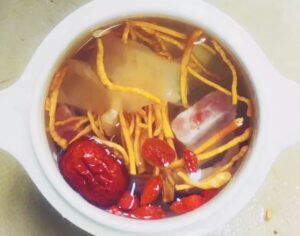
“Cordyceps, Ophiopogon, and Polygonatum Decoction (Chongcao Maidong Yuzhu Shui) is a classic medicinal dietary beverage rooted in traditional Chinese nutritional wisdom. It features three core herbs—Cordyceps sinensis (Dongchongxiacao), Ophiopogon japonicus (Maidong), and Polygonatum odoratum (Yuzhu)—which are scientifically combined and simmered in water. This formula embodies the concept of “supporting Lung and Kidney health, nourishing Yin and promoting fluid production.” Known in folk tradition as “the Three Treasures for Moistening Dryness,” it is especially suitable as a daily wellness beverage during autumn, winter, or dry climates. Its taste is clear, moist, and slightly sweet, with balanced properties. It may serve as a regulating tea for those seeking general well-being and as a supportive dietary formula for individuals experiencing occasional respiratory discomfort.
The Dongchongxiacao (Cordyceps sinensis) used in medicinal diets is the dried composite of the stroma and larval corpse of the fungus *Cordyceps sinensis* (a member of the Clavicipitaceae family) parasitizing the larvae of moths in the Hepialidae family. Maidong (Ophiopogon japonicus) is the dried root tuber of *Ophiopogon japonicus* (Liliaceae), and Yuzhu (Polygonatum odoratum) is the dried rhizome of *Polygonatum odoratum* (Liliaceae). All three are recognized as substances that are both food and medicinals (medicine-food homology), with detailed records in ancient classics such as *Compendium of Materia Medica* (*Bencao Gangmu*) and *Shennong’s Classic of Materia Medica* (*Shennong Bencao Jing*). The reason this formula has been widely passed down lies in its exquisite compatibility: Cordyceps sinensis primarily supports foundational vitality, while Ophiopogon and Polygonatum focus on maintaining moisture and nourishing yin. Together, these three ingredients provide balanced nourishment without causing dryness or greasiness, making them well-suited for individuals experiencing a state of yin fluid insufficiency due to modern lifestyle factors such as staying up late, overusing the voice, or spending prolonged time in air-conditioned environments.
Health Benefits of Medicinal Cuisine
The core benefits of the Cordyceps sinensis (Dongchongxiacao)-Ophiopogon japonicus (Maidong)-Polygonatum odoratum (Yuzhu) decoction focus on two main directions: supporting the nourishment of Yin and moistening of Lung functions, and supporting Kidney tonification and consolidation of the body’s foundation. From a modern nutritional perspective, Cordyceps sinensis (Dongchongxiacao) is rich in active components such as cordyceps polysaccharides, adenosine, and ergosterol, which support immune function, antioxidant activity, and the health of respiratory epithelial cells. The saponins and high isoflavonoids in Ophiopogon japonicus (Maidong) support the body’s normal response to airway irritation, promote saliva secretion, and help maintain oral moisture. The polysaccharides and steroidal saponins in Polygonatum odoratum (Yuzhu) help support healthy blood sugar levels and contribute to skin hydration. Together, these three ingredients work synergistically to support the body’s adaptability to dry environments.
In TCM clinical applications, this medicinal food is often used as an adjunct for supporting individuals with Lung Yin Deficiency or Lung-Kidney Yin Deficiency patterns. Those with Lung Yin Deficiency often present with dry cough with scanty sputum, hoarseness, and dry nose and throat; those with Kidney Yin Deficiency may experience soreness and weakness of the lower back and knees, dizziness, tinnitus, night sweats, and seminal emission. Cordyceps-Ophiopogon-Polygonatum Water (Chongcao Maidong Yuzhu Shui) utilizes the mechanism of “Metal Generating Water” — the Lung corresponds to Metal, the Kidney to Water. Supplementing Lung Yin thereby nourishes Kidney Yin, and nourishing Kidney Yin also moistens Lung dryness, thus creating a positive cycle. With regular long-term consumption, this preparation may help support respiratory mucosal barrier function and enhance the body’s tolerance. It provides positive support for seasonal sensitivities, occasional throat discomfort, and during the recovery phase of bronchial conditions.
Functions of Traditional Chinese Medicine
According to TCM theory of nature, flavor, and meridian entry, Cordyceps sinensis (Dongchongxiacao) is sweet and warm in nature, entering the Lung and Kidney meridians. It supports Lung and Kidney health and helps maintain normal blood flow and respiratory comfort. It is the only herb that simultaneously nourishes both the warming and nourishing aspects of Lung and Kidney, yet it is warm without being drying, particularly effective for gently supporting the Lung and Kidney in cases of occasional deficiency. Ophiopogon japonicus (Maidong) is sweet, slightly bitter, and slightly cold, entering the Heart, Lung, and Stomach meridians. It excels in nourishing yin and promoting healthy body fluids, while also moistening the Lung and soothing the Heart. It is beneficial for occasional dryness due to heat, restlessness, and constipation associated with internal dryness. Polygonatum odoratum (Yuzhu) is sweet and slightly cold, entering the Lung and Stomach meridians. Its primary functions are to nourish yin, moisten dryness, promote fluid production, and support healthy thirst quenching. With long-term use, it may help improve skin complexion by reducing dark spots, leaving the skin moisturized—a classic beauty-enhancing herb.
When the three medicinal herbs are combined, the overall formula nature tends toward “sweet-cool, moistening and nourishing,” yet the warming property of Cordyceps sinensis (Chongcao) can moderate the slight coldness of Ophiopogon japonicus (Maidong) and Polygonatum odoratum (Yuzhu). This makes the entire formula’s medicinal nature balanced—neither too cold to damage the Spleen Yang Qi, nor too warm and drying to consume Yin fluids. This formulation approach of “moistening with supplementation, supplementing with clearing” embodies the TCM principle of “seeking Yang within Yin and seeking Yin within Yang.” It is especially suitable for the “Qi and Yin Deficiency” constitutional pattern—characterized by both Qi deficiency signs such as fatigue, shortness of breath, and reluctance to speak, as well as Yin Deficiency signs of imbalance like dry mouth, dry throat, and heat sensations in the palms, soles, and chest. Cordyceps sinensis (Chongcao) supports Qi, while Ophiopogon japonicus (Maidong) and Polygonatum odoratum (Yuzhu) nourish Yin. Together, the three herbs help support the dual restoration of Qi and Yin, addressing both root and branch aspects.
supports the regulatory mechanisms of the Lung system
In terms of respiratory health, a decoction of Cordyceps, Ophiopogon japonicus (Maidong), and Polygonatum odoratum (Yuzhu) may support the body through the pathways of “moistening the Lungs to helps with occasional respiratory comfort and supporting mucosal integrity.” Cordyceps cordycepic acid helps maintain healthy microcirculation in the Lungs, Ophiopogon japonicus polysaccharides promote the normal secretion of airway mucus and enhance ciliary movement, while Polygonatum odoratum extract offers dual support for a balanced inflammatory response and normal immune tolerance. Together, these three ingredients provide positive clinical significance in supporting individuals with occasional chronic cough, maintaining comfort during asthma remission phases, and supporting Lung tissue health in conditions such as pulmonary fibrosis.
Suitable for
This medicinal food is especially suitable for the following six types of individuals: First, those who smoke long-term or are exposed to secondhand smoke. The tar and free radicals in smoke may continuously impact respiratory mucosa health. The antioxidant components in the Cordyceps sinensis (Dongchongxiacao)–Ophiopogon japonicus (Maidong)–Polygonatum odoratum (Yuzhu) decoction help support respiratory comfort. Second, individuals whose occupations require frequent voice use, such as teachers, broadcasters, and singers. After approximately one week of continuous consumption, this drink supports clear voice comfort and helps maintain throat helps with occasional. Third, middle-aged and elderly individuals with Lung-Kidney Yin Deficiency, commonly presenting with dry skin, dry stools, frequent nighttime urination, and soreness and weakness of the lower back and knees. Consuming this formula supports healthy aging and helps maintain overall vitality.
The fourth suitable group includes individuals who often experience dryness signs of imbalance——such as dry mouth and tongue, dry eyes, and occasional nasal discomfort——especially in autumn and winter or in heated indoor environments during northern winters. This medicinal food recipe helps nourish body fluids from within. The fifth group consists of white-collar workers in suboptimal health states. Due to chronic sleep deprivation, high stress, and irregular eating habits leading to “internal depletion of Yin fluids,” they may experience restless sleep with excessive dreaming, low energy, and signs of premature aging like hair thinning. Drinking this herbal water supports healthy metabolism and helps maintain restful sleep. The sixth group is composed of individuals recovering from a respiratory wellness who have weaker Lung function. Clinical observations indicate that Cordyceps sinensis (Dongchongxiacao), Ophiopogon japonicus (Maidong), and Polygonatum odoratum (Yuzhu) herbal water supports the repair of Lung tissue integrity, helps maintain comfortable breathing, and promotes overall vitality during the recovery phase.
Contraindicated Populations
Although Cordyceps (Dongchongxiacao), Ophiopogon japonicus (Maidong), and Polygonatum odoratum (Yuzhu) have a balanced nature, caution or avoidance is still required for certain individuals. First, those with Spleen and Stomach Deficiency Cold—typically presenting with poor appetite, abdominal distension after meals, loose stools, aversion to cold, and a pale tongue with white coating—may find that the slightly cold nature of Ophiopogon and Polygonatum could increase the burden on the Spleen and Stomach, potentially leading to occasional digestive discomfort or loose stools. If such individuals wish to use this formula, it is recommended to combine it with 3–5 g of dried Ginger (Ganjiang) or 2 red dates (Hongzao) to help warm the Middle Jiao and disperse cold, thereby balancing the medicinal properties. Second, in the early stage of externally contracted Wind-Cold or Wind-Heat (with signs such as aversion to cold, fever, headache, nasal congestion, and cough with white or yellow phlegm), releasing the Exterior should take priority. Nourishing substances should not be applied too early, to avoid “shutting the door on the pathogen” and driving pathogenic factors deeper.
The third category of individuals who should avoid this formula are those with predominant Phlegm-Dampness—commonly presenting with a heavy body type, thick and greasy tongue coating, a sticky sensation in the mouth, chest tightness, and copious phlegm. Since the Cordyceps-Ophiopogon-Yuzhu Liquid (Chongcao-Maidong-Yuzhu Shui) is relatively Yin-nourishing and cloying in nature, such cloying substances may potentially contribute to internal dampness and phlegm production, which may not be beneficial for maintaining internal balance. The fourth category consists of patients in the active stage of autoimmune conditions (e.g., rheumatoid arthritis, lupus). Cordyceps has immunomodulatory effects; however, it may interfere with the efficacy of immunosuppressive medications. Use under the guidance of a healthcare professional is recommended. Additionally, for children, pregnant women, and breastfeeding women, due to the lack of sufficient safety research data, it is recommended that consumption be determined only after pattern differentiation by a licensed TCM practitioner. Those with known allergies to Cordyceps, Ophiopogon japonicus (Maidong), or Polygonatum odoratum (Yuzhu) should avoid use.
Ingredient Formula Ratio
Standard formula (single daily dosage for one person): Cordyceps sinensis (Dongchongxiacao) 3 g (approximately 6–8 pieces of medium grade), Ophiopogon japonicus (Maidong) 10 g, Polygonatum odoratum (Yuzhu) 12 g. This ratio is designed based on the recommended dosage from the Chinese Pharmacopoeia and commonly used clinical proportions, with a ratio of 1:3.3:4 among the three herbs. It ensures that Cordyceps plays its core role in supporting vitality, while allowing Ophiopogon and Polygonatum to fully exert their effects in helping maintain normal moisture balance. The overall synergy of the formula is harmonious without bias.
In practice, adjustments can be made based on individual constitution and signs of imbalance: if dry mouth and throat are pronounced, increase Ophiopogon japonicus (Maidong) to 15 g and Polygonatum odoratum (Yuzhu) to 18 g to help support fluid production and maintain oral hydration; if there are prominent signs such as lower back and knee weakness, frequent urination at night, or other indications of Kidney imbalance, increase Cordyceps sinensis (Dongchongxiacao) to 5 g and add Lycium barbarum (Gouqi) 10 g to help support Kidney health and preserve essence; if there is also a tendency for cough with thick, yellow phlegm suggesting Lung heat, add Fritillaria cirrhosa (Chuanbeimu) 5 g to support respiratory health and help clear phlegm. It is recommended to source all herbs from their authentic production areas to ensure optimal concentration of active constituents: Cordyceps sinensis (Dongchongxiacao) is best from Nagqu, Tibet or Yushu, Qinghai; Ophiopogon japonicus (Maidong) from Cixi, Zhejiang (“Zhe Maidong”) is preferred; and Polygonatum odoratum (Yuzhu) from Shaodong, Hunan (“Xiang Yuzhu”) is considered superior.
Cooking Method
Step 1: Preparation. Gently brush off any surface soil from Cordyceps sinensis (Dongchongxiacao) using a soft brush. Be careful not to soak it in water for a long time to avoid loss of active constituents. Quickly rinse Ophiopogon japonicus (Maidong) and Polygonatum odoratum (Yuzhu) once with clean water to remove dust, then place them in a ceramic or glass container. Add 1000 ml of purified water and let them soak for 30 minutes to allow the herbs to fully absorb water and expand, which supports the release of active constituents.
Step 2: Slow simmer. Place the soaked herbal materials together with the water into a clay pot or a health pot (avoid iron or aluminum pots to helps maintain metal ions from reacting with the herbal components). Bring to a boil over high heat, then immediately reduce to low heat, keeping the liquid at a bare simmer for 30 minutes. During this time, you may stir once with the lid open to check the water level; if too much water has evaporated, replenish it with an appropriate amount of hot water. Turn off the heat when the decoction turns a light amber color and emits a clear, gentle herbal aroma.
Step 3: Filter the dregs to extract the decoction. Use a fine mesh strainer or gauze to filter out the herbal residues, pour the liquid into a thermos, and sip slowly while it is warm. The remaining herbal residues can be boiled again with 800 ml of hot water for a second decoction; after bringing to a boil, simmer on low heat for another 20 minutes. Combine the two decoctions to obtain approximately 800–1000 ml, and take warm in two divided doses, morning and evening. It is recommended to chew and consume Cordyceps sinensis (Dongchongxiacao) last; its stroma has a pliable texture similar to mushrooms, and chewing allows for maximum absorption of Cordyceps polysaccharides and adenosine.
Drinking Tips
1. Best time for consumption: It is recommended to take it once in the morning on an empty stomach (half an hour after a meal) and once one hour before bedtime. Morning consumption helps awaken the digestive system and supports the production of body fluids (Jinye), while bedtime consumption helps nourish Yin, calm the spirit (Shen), and supports comfort during nighttime, including occasional dry mouth. Continuous consumption for 7 to 10 days constitutes one course of use. After a 3-day interval, the next course may be started. Generally, stable improvements are typically observed after 3 courses.
2. Compatibility and efficacy enhancement tips: If in the dry autumn and winter seasons, you may add 1 peeled snow pear (cut into pieces) and cook together to help support Lung moisture and respiratory comfort; if late nights lead to occasional internal heat and oral discomfort, you may add 10 lotus seeds with core to help maintain a calm and balanced state; if you frequently experience occasional colds and weakened vitality, you may add 10g Astragalus membranaceus (Huangqi) to support healthy defensive Qi, forming an “internal and external dual support” pattern with Cordyceps. However, it is advisable not to modify the formula with more than two additional ingredients each time, in order to avoid overly complex medicinal components.
3. Contraindications and Storage: During the consumption period, avoid pungent and stimulating foods (chili peppers, Sichuan peppercorns, mustard), deep-fried and grilled items, as well as raw, cold, and cooling foods, as these may deplete body fluids and diminish the efficacy of the decoction. The medicated dietary liquid should ideally be freshly prepared and consumed on the same day. If storage is necessary, keep it in a sealed glass container in the refrigerator (0–4°C) for no more than 24 hours. When reheating, warm the container in a water bath (do not use a microwave directly) to ensure safety and hygiene, helps maintain bacterial growth that may cause gastrointestinal discomfort.

Interesting! I’ve been exploring TCM herbal teas lately, and this combination sounds like a powerhouse for lung health and energy. Does the decoction taste earthy from the cordyceps, or is it balanced by the sweetness of yuzhu? Would love to try it this flu season.
Interesting combo! I’ve used cordyceps and ophiopogon separately for lung support, but haven’t tried them together with polygonatum. Sounds like a great immune-boosting tea for dry seasons. Do you recommend adding a bit of honey or goji berries for taste?
Interesting combo! I’ve been looking into adaptogenic herbs for energy and lung support. Does anyone have personal experience with this decoction? Would love to know if it’s better as a tea or simmered longer for a stronger effect. Thanks for the detailed guide!
مشروب رائع! سمعت كثيراً عن فوائد الكورديسيبس والمايدونغ، لكن ما هي أفضل طريقة لتحضيره في المنزل؟ وهل يناسب مرضى السكري؟ شكراً للمعلومات القيمة!
مشروب رائع ومفيد جداً! أحب استخدام الأعشاب الطبيعية في الطبخ، وسأجرب هذه الوصفة قريباً. هل يمكن إضافة العسل لتحسين الطعم؟ شكراً على المعلومات القيمة.