Agalloch is a commonly used medicinal herb for resolving blood stasis and arresting bleeding. It consists of the dried heartwood from the trunk and roots of Dalbergia odorifera T.Chen, a plant belonging to the genus Dalbergia in the Fabaceae family. It has the therapeutic effects of resolving blood stasis, arresting bleeding, regulating qi, and relieving pain. It is primarily used to treat hemoptysis, epistaxis, bleeding from external injuries, liver qi stagnation with costal pain, stabbing chest pain (chest bi), pain from falls or blows, and vomiting accompanied by abdominal pain.
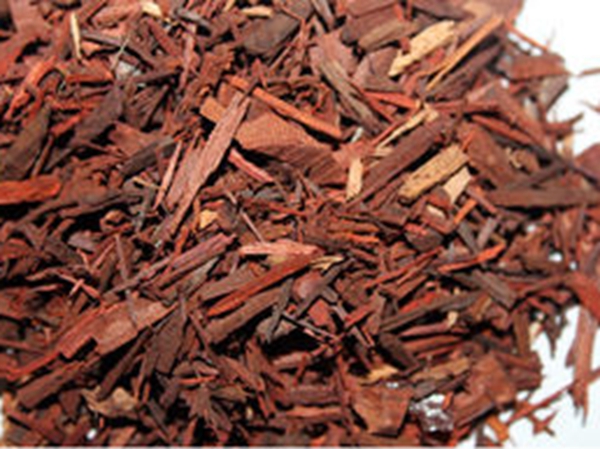
Agalloch
Agalloch is a commonly used medicinal herb for resolving blood stasis and arresting bleeding. It consists of the dried heartwood from the trunk and roots of Dalbergia odorifera T.Chen, a plant belonging to the genus Dalbergia in the Fabaceae family. It has the therapeutic effects of resolving blood stasis, arresting bleeding, regulating qi, and relieving pain. It is primarily used to treat hemoptysis, epistaxis, bleeding from external injuries, liver qi stagnation with costal pain, stabbing chest pain (chest bi), pain from falls or blows, and vomiting accompanied by abdominal pain.
Chinese Name : 降香
Latin Name : Dalbergiae Odoriferae Lignum
Aliases : Jianzhenxiang, Zitingxiang, Jianzhen, Hualimu
Authentic Producing Area : Mainly produced in Hainan
Nature, Flavor & Meridian Tropism : Pungent in taste, warm in nature; enters the Liver and Spleen meridians
Benefits & Efficacy
Benefits
Dispels blood stasis and stops bleeding; regulates qi and relieves pain.
Indications
Mainly used to treat hemoptysis, epistaxis, bleeding from external injuries, liver qi stagnation with costal pain, stabbing chest pain, pain from falls or blows, and vomiting with abdominal pain.
Usage and Dosage
Internal use: Decoct 9–15 g; add to the decoction toward the end of boiling. External use: Apply an appropriate amount of finely ground powder to the affected area.
Precautions
During treatment, avoid consuming raw, cold, greasy, or spicy and irritating foods (such as iced beverages, fried foods, and chili peppers) to prevent interference with the spleen and stomach’s digestive functions and to avoid reducing the herb’s efficacy; simultaneously, refrain from smoking and drinking alcohol to minimize irritation to the body.
Chemical Constituents
Main constituents include essential oils: nerolidol, β-bisabolene, trans-β-acacene, etc.; and flavonoids: isorhamnetin, luteolin, glycyrrhizin, isoglycyrrhizin, and pterostilbene, etc.
Pharmacological Actions
This product possesses antithrombotic, anticoagulant, anticonvulsant, antibacterial, analgesic, and anti-inflammatory effects.
Relevant Discussions
1. *Compendium of Materia Medica*: Treats fractures and wounds, stops bleeding, relieves pain, reduces swelling, and promotes tissue regeneration.
2. *Commentary on the Classic of Materia Medica*: Agarwood is the purest and most potent of all fragrances. For upper-body injuries where stagnant blood accumulates in the chest and diaphragm, causing pain upon palpation or pain radiating to the flanks—which are signs of hemoptysis—immediately grind this herb into a fine powder, mix it with a decoction, and take it; this is highly effective.For treating hemoptysis caused by internal injury or liver damage due to anger, using this herb in place of Curcuma is remarkably effective.
3. *Benjing Fengyuan*: Agarwood is red in color; it enters the blood system and descends, so when taken internally, it promotes blood circulation and dispels stagnation, while applied externally, it can stop bleeding and relieve pain. Furthermore, for cases of hemoptysis due to deficiency—where the sputum is dark red and lacks a fresh odor—it is appropriate to increase the dosage; its efficacy is comparable to that of Huarishi Powder.
Applications
Clinical Applications
1. To treat injuries from sharp objects or falls resulting in uncontrollable bleeding, grind this herb with gallnut into a powder and apply it to the affected area. For internal injuries causing hemoptysis or epistaxis due to blood stasis or the upward rebellion of qi and fire, this herb can descend qi, resolve stasis, and stop bleeding; it is often used in combination with Moutan Bark and Curcuma.
2. To treat blood stasis stagnating in the upper body and diaphragm, decoct this herb as a powder and take orally; clinically, it is also frequently used in combination with Wulingzhi, Chuanxiong, and Yujin. To treat trauma-induced injuries, swelling, and pain caused by blood stasis, it is often combined with Frankincense and Myrrh.
3. To treat vomiting and abdominal pain caused by pathogenic turbidity obstructing the spleen and stomach, it is often used in combination with Huoxiang and Muxiang.
Related Compatibility
1. Agarwood combined with Wulingzhi: Agarwood resolves blood stasis and stops bleeding, while also regulating qi; Wulingzhi promotes blood circulation, relieves pain, and stops bleeding. When combined, these two herbs enhance their effects in resolving blood stasis, stopping bleeding, regulating qi, and relieving pain. This combination is suitable for bleeding caused by internal obstruction of blood stasis where blood does not follow the meridians, as well as various pain syndromes resulting from blood stasis and qi stagnation.
2. Agarwood combined with Guang Huoxiang: Both have a fragrant aroma and can dispel dampness, harmonize the middle burner, and stop vomiting. Agarwood also regulates qi, while Guang Huoxiang excels at stopping vomiting. When combined, these two herbs work together to dispel dampness, regulate qi, harmonize the middle burner, and stop vomiting. This combination is suitable for vomiting and abdominal pain caused by dampness obstructing the middle jiao.
Medicinal Identification
1. Aquilaria and Aquilaria agallocha: Both herbs are pungent and warm in nature and have the effects of regulating qi and relieving pain; they can be used to treat various pain syndromes caused by qi stagnation.However, Agarwood promotes the flow of qi and activates blood circulation; it relieves pain and stops bleeding, making it suitable for stasis-related bleeding, as well as pain in the chest, flanks, heart, and abdomen caused by blood stasis and qi stagnation, and pain from bruises and swelling due to trauma. It can also regulate qi, transform dampness, harmonize the middle burner, and stop vomiting, making it useful for vomiting and abdominal pain caused by internal obstruction by damp turbidity.Mu Xiang excels at dispelling stagnant qi in the stomach and intestines to relieve pain; it also strengthens the spleen and aids digestion, making it suitable for epigastric and abdominal distension and pain caused by gastrointestinal qi stagnation, as well as the sensation of incomplete evacuation following diarrhea or dysentery.
2. Agarwood and Turmeric: Both herbs can invigorate blood circulation and remove blood stasis, regulate qi, and relieve pain, and are used for various pain syndromes caused by blood stasis and qi stagnation.However, Aquilaria is also capable of resolving blood stasis and arresting bleeding; it is suitable for hemorrhage caused by blood stasis, particularly for internal and external bleeding resulting from trauma. It can also resolve dampness and stop vomiting, making it suitable for epigastric and abdominal fullness and distension, as well as vomiting and abdominal pain caused by internal obstruction by damp turbidity and impaired harmonization and descent of the stomach.Turmeric dispels wind-cold externally and regulates qi and blood internally; it excels at promoting circulation in the shoulders and arms to relieve bi pain, making it suitable for rheumatic pain in the shoulders and arms.
Related Medicines
Traumatic Injury Pain-Relieving Plaster, Bone-Setting Lotion, Rongxin Pills, Guanshian’an Oral Solution, Xiangdan Injection.
Related Prescriptions
Immediate Hemoptysis-Stopping Plaster (*Revised Popular Treatise on Cold Damage*), Seven-Fragrance Powder (*Dian Dian Jing*).
Notes
Patients requiring treatment with traditional Chinese medicine should first consult a licensed TCM hospital, where a TCM practitioner will conduct a professional pattern differentiation and issue a prescription.
Processing & Preparation
Harvesting & Processing
It can be harvested year-round; remove the sapwood and dry in the shade.
Processing Methods
Take the raw herb, remove impurities, split into small pieces, and grind into a fine powder or slice into thin pieces.
Storage Methods
Store in a cool, dry place.
Crude Drug Identification
Properties of Crude Drugs
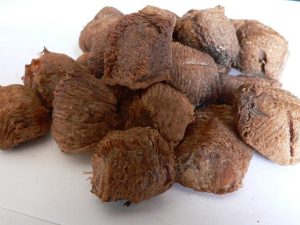
It appears as a subcylindrical or irregularly shaped piece. The surface is purplish-red or reddish-brown, and the cross-section exhibits a dense grain. It is hard in texture and oily. It has a faintly fragrant aroma and a slightly bitter taste. The best quality is characterized by a purplish-red color, firmness, a fragrant aroma, the absence of white sapwood, and the ability to sink in water.
Properties of Processed Slices
This product consists of irregular small fragments or extremely thin slices. The surface is purplish-red or reddish-brown with a dense grain. It is hard and rich in oil. The powder is purplish-red or purplish-brown, with a fragrant aroma and a slightly bitter taste.
Botanical Information
Botanical Classification
Pterocarpus alatus, a species of the genus Pterocarpus in the family Fabaceae.
Morphological Characteristics
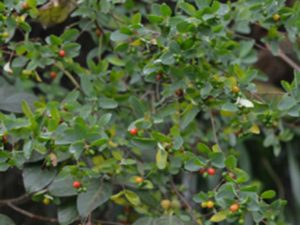
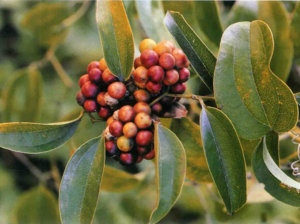
A tree reaching 10–15 m in height; except for the young parts, inflorescences, and ovaries, which are slightly covered with short soft hairs, the rest of the plant is glabrous. Twigs bear pale, densely clustered lenticels. The odd-pinnate compound leaves are 12–25 cm long; petioles are 1.5–3 cm long;9–13 leaflets (rarely 7), nearly leathery, ovate or elliptic, 4–7 cm long, 2–3 cm wide, with an acute apex, a blunt base, and a rounded or cuneate base; panicles are axillary, 8–10 cm long including the peduncle; bracts and bracteoles are broadly ovate, about 1 mm long;Flowers small and extremely numerous, ca. 5 mm long; calyx campanulate, ca. 2 mm long, with 5 lobes, the lower lobe longer; corolla pale yellow or milky white, standard nearly inversely heart-shaped with a slightly concave apex, wings oblong, keel semilunar, all petals with claws; stamens 9, monadelphous;The ovary is narrowly elliptic, with a short style. The pod is tongue-shaped and oblong, 4.5–8 cm long; the fruit valves are leathery and reticulate; each pod contains one seed, rarely two. Flowering occurs from March to April; fruiting occurs from October to November.
Distribution Area
Aquilaria is primarily produced in Hainan, with introduced populations in Guangdong and other parts of South China.
Propagation Methods
Propagated by seed.
Cultivation Techniques
1. Seed Propagation: Select a nursery site with sandy soil and good drainage, then prepare the beds. Before sowing, soak the seeds in clean water for 24 hours. Remove the seeds and broadcast them evenly over the bed surface, then cover with soil and straw. Water in the early morning and evening on sunny days to keep the bed surface moderately moist. Germination begins in about 10 days and is complete after 15 days.About 20 days after germination, the seedlings will develop true leaves. Once the seedlings reach a height of 4–5 cm, they can be transplanted from the seedbed into grow bags. After about half a month, the seedlings will develop new roots, and after one month, they will begin to shoot new growth. During this period, management primarily involves frequent, light applications of nitrogen fertilizer. As growth gradually accelerates, sufficient water and fertilizer must be provided to promote robust seedling development.
2. Planting: The standard planting spacing is 3 m × 4 m or 3 m × 3 m, with 56–74 plants per mu. Planting holes should measure 70 cm × 60 cm × 60 cm and be backfilled with topsoil. Apply 100 kg of dried pond mud or mixed manure per hole, along with 10 kg of blended organic fertilizer(chicken manure : peanut bran : superphosphate in a ratio of 10 : 1 : 1).
3. Planting Season: Planting should be done on overcast or rainy days in early spring (March–April) or in autumn (September–October). When planting, remove the plastic bags, ensuring the soil and root system remain intact. Backfill the soil in layers, compact it firmly, and water thoroughly.
Pest and Disease Control
1. Black Spot Disease
(1) Pathogen: Caused by the black spot fungus of Aquilaria sinensis. It affects both seedlings and young trees, damaging leaves, small branches, and pods. Small spots initially appear on the leaves, gradually enlarging and merging to turn black; in severe cases, they form contiguous patches, causing the leaves to wither, die, and fall off.
(2) Control Measures: ① Reduce sources of infection by collecting diseased branches and leaves and either burning them or burying them deeply in the soil. ② Strengthen cultivation management to enhance tree vigor and improve the plant’s disease resistance. ③ Chemical control: Before the onset of disease, spray a 1:1:100 Bordeaux mixture or a 500–800-fold dilution of 50% carbendazim wettable powder to prevent infection;at the onset of the disease, apply a 700–1,500-fold dilution of 75% chlorothalonil to inhibit the germination of ascospores.
2. Anthracnose
(1) Mode of Infection: Spread by wind and rain; invades and causes damage through wounds.
(2) Control Methods: ① During the epidemic period, promptly remove diseased leaves to prevent re-infection and further damage.In the fall and winter, thoroughly remove all diseased plant debris from the ground, along with any remaining branches and leaves, and compost them in a centralized area at high temperatures to reduce the source of initial infection the following year. ② Chemical control: Spraying is most effective in the early stages of the disease. Recommended products include a 500–800-fold dilution of 50% carbendazim wettable powder or a 500–800-fold dilution of 50% thiophanate-methyl wettable powder.