
Lower Limb Grasping Manipulation:a Tuina technique involving grasping and kneading the soft tissues of the lower limbs to support comfortable movement of tendons and meridians and promote general well-being.
[Technique Essentials] Use the thumbs of both hands in opposition to the remaining four fingers, applying coordinated pressure to grasp the supports area on the lower limb, while lifting, releasing, and shifting the position continuously.
[Operational Steps] The practitioner uses the palmar surfaces of both thumbs and the remaining four fingers to apply opposing force, grasping the supports area or acupoint(s) on the patient’s lower limb. While maintaining this grasp, the practitioner alternates between releasing and reapplying pressure while moving along the supports area. This technique is called “Lower Limb Grasping Method (Xia Zhi Na Fa).
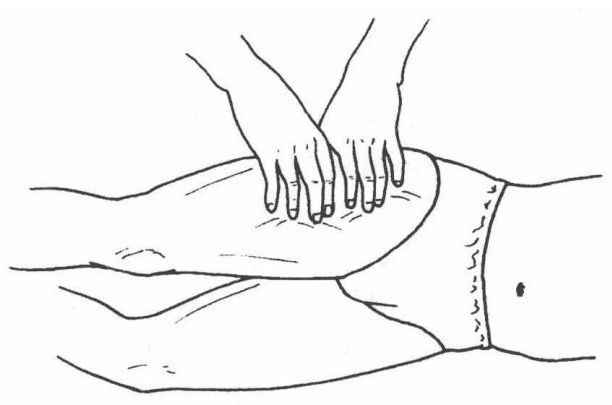
Lower Limb Grasping Method
If using both hands to grasp, knead, and simultaneously move downward, it is called “lower limb grasping-kneading method”.
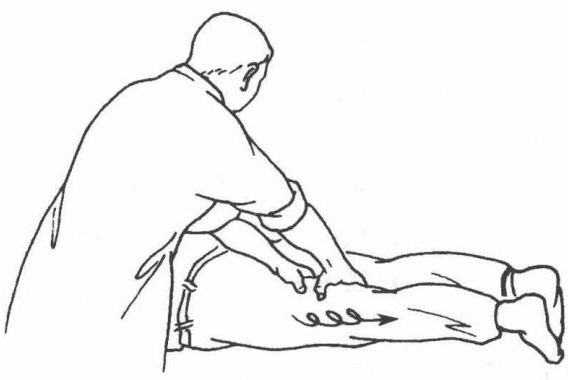
lower limb grasping-kneading method
[Pressure Sensitivity] [Indications and Effects] The indications and effects are somewhat similar to those of Shoulder Grasping Manipulation, with a particular focus on supporting the health of various injuries and conditions of the lower limbs.
Interesting technique! I’ve been exploring Tuina for lower back issues, and this grasping manipulation sounds like a great way to release tension in the legs. Do you recommend starting with lighter pressure for beginners? I’d love to try it safely.
This sounds like a wonderful technique! I’ve always been curious about Tuina for lower body tension. Does the pressure need to be deep or light for the best effect on the tendons? I’d love to try it on my own legs after long hikes.
Interesting technique! I’ve had similar pressure applied during massage therapy for sciatica, and it really helps release tension in the hamstrings and calves. The thumb-and-four-finger grip sounds very specific—do you find it works best on certain muscle groups (e.g., quadriceps vs. gastrocnemius)? Would love to try this at home.
와, 하지 파악법 정말 유용해 보이네요! 손가락으로 근육을 부드럽게 잡아당기고 주무르는 동작이 시원할 것 같아요. 경락과 건이 편안해지면 전체적인 컨디션도 좋아지겠죠? 저도 한번 따라 해봐야겠어요