
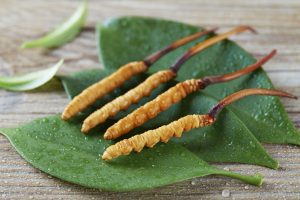
Wild Cordyceps sinensis, scientifically renamed Ophiocordyceps sinensis, is a rare insect‑fungus complex. It does not grow in low‑elevation forests, farmland or ordinary grassland. It is endemic to the Qinghai‑Tibet Plateau and adjacent Himalayan mountain zones. Most of the world’s commercial wild cordyceps resources originate from China. Small‑scale wild populations also appear in Nepal, Bhutan and northern India at matching high‑altitude alpine zones.
Altitude Requirement
Wild Ophiocordyceps sinensis survives exclusively at 3 000 m‑5 200 m above sea‑level on alpine meadows and alpine shrub‑meadows, close to the snow‑line zone. ‑ The highest‑quality Daodi cordyceps concentrates within 4 000 ‑ 4 800 m. ‑ Below 3 000 m, the temperature is too high; ghost‑moth host larvae cannot complete multi‑year underground development, so no genuine wild cordyceps forms‑ Above 5 200 m, harsh freezing conditions limit host‑insect reproduction, so cordyceps populations become extremely sparse.
Core Producing Zones in China
China accounts for over 90 % of global wild cordyceps natural reserves, distributed across five western provincial‑level regions: Xizang, Qinghai, Sichuan, Gansu and Yunnan. Among them, Nagqu (Xizang) and Yushu (Qinghai) are world‑famous premium Daodi origins.
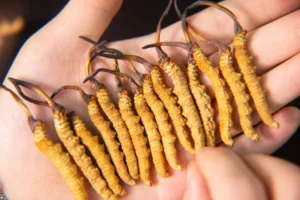
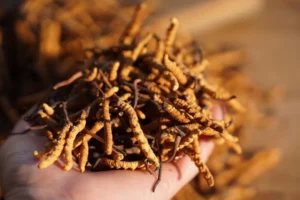
- Nagqu, Xizang Core counties: Baqing, Biru, Suo, Dingqing. Elevation 4 500‑5 200 m. This zone yields well‑known Nagqu Tibetan cordyceps, characterised by clean golden‑yellow larval bodies, brown insect eyes and rich butter‑grease‑like aroma.
- Yushu, Qinghai (Sanjiangyuan core zone) Core counties: Zaduo, Qumarlêb, Yushu, Chenduo, Zhiduo, Nangqian. Elevation 4 000‑4 500 m. Zaduo County is widely recognised as a top‑grade cordyceps‑producing area. Yushu cordyceps features yellow‑brown bodies, yellow insect eyes and strong mushroom‑type fragrance. Yushu contributes more than 60 % of Qinghai’s total cordyceps output.
- Secondary producing areas ‑ Golog (Qinghai): high‑quality mid‑tier cordyceps at 4 200‑5 000 m. ‑ Western Sichuan (Aba, Garzê): lower‑elevation cordyceps with relatively lighter weight. ‑ Southern Gansu and northwest Yunnan: scattered, small‑volume wild cordyceps resources.
Unique Natural Growing Conditions
Several non‑negotiable environmental factors decide where cordyceps sinensis can thrive:
- Host insect dependency: It parasitises underground larvae of Thitarodes (ghost‑moth moths). These larvae spend 3‑5 years underground feeding on alpine‑plant roots. Only after fungal infection can the insect‑fungus complex form.
- Climate: Cold semi‑arid alpine climate, long frost periods, intense ultraviolet radiation and huge day‑night temperature swings. Slow biological cycles allow full accumulation of adenosine, polysaccharides and other bioactive substances.
- Soil: Thick, loose humus‑rich alpine meadow soil with good drainage, nourished by unpolluted glacial melt‑water. Compacted or heavily eroded soil cannot support ghost‑moth larvae.
- Ecosystem: Minimal industrial or agricultural interference. Heavy human disturbance destroys host‑insect habitats and reduces cordyceps output.
Growth & Harvest Timeline
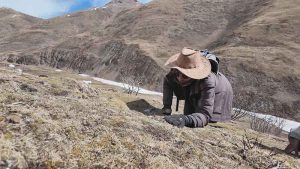
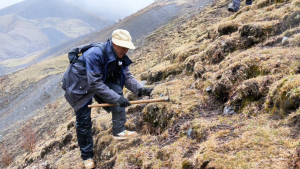
The fungal mycelium invades ghost‑moth larvae in autumn. The larva dies underground over winter. When snow melts in late spring‑early summer (May‑June), the stroma (“grass‑part”) pierces the meadow surface, which is the harvest window for wild cordyceps. ‑ Prime‑stage cordyceps: stroma just emerges, spores not yet released, highest active‑ingredient concentration. ‑ Late‑stage cordyceps: stroma grows longer and releases spores; medicinal value declines.
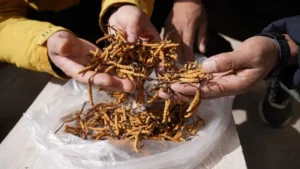
Harvest must follow local ecological rules: small hand‑hoes only, dig‑and‑backfill every pit, harvest mature individuals and leave juveniles for future‑year reproduction. In China, wild Ophiocordyceps sinensis is listed as Class‑II state‑protected wild plant; harvesting requires official collection permits, and unauthorised digging is forbidden.
Important Distinction: Wild Cordyceps Sinensis vs Cultivated Cordyceps Militaris
Many buyers confuse wild Ophiocordyceps sinensis (high‑altitude plateau insect‑fungus complex) with artificially‑cultivated Cordyceps militaris. C. militaris is a completely different fungus‑species. It grows easily at low elevations indoors and does not belong to wild plateau‑produced cordyceps sinensis.
Conclusion
To sum up, wild Cordyceps sinensis (Ophiocordyceps sinensis) only naturally occurs in high‑altitude alpine meadows of the Qinghai‑Tibet‑Himalaya region, at 3 000‑5 200 m elevation. Premium‑grade authentic wild cordyceps mainly comes from Nagqu (Xizang) and Yushu (Qinghai). Origin, elevation and local ecological conditions directly determine its morphological traits and content of medicinal active ingredients.


¡Interesante! No sabía que el cordyceps silvestre solo crece en esa zona tan específica del Tíbet y el Himalaya. Con lo caro que es, tiene sentido que sea tan difícil de encontrar. Me pregunto si el cultivado tiene las mismas propiedades que el silvestre, porque al paso que vamos, el natural se va a agotar.