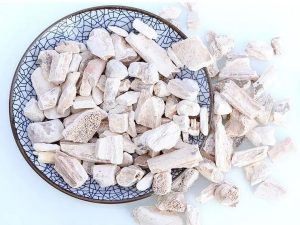
Mi Gu, a name in traditional Chinese medicine. It refers to the bones of the sika deer (Elaphurus davidianus Milne-Edwards) of the Cervidae family. After the animal is hunted, the skin is removed, the meat is scraped off, and the bones are collected; they are used fresh or dried.Its diet consists primarily of grasses and aquatic plants. This species is endemic to China; it was already being bred in Nanyuan, Beijing, during the Qing Dynasty but no longer exists in the wild. It was later transported to the United Kingdom, resulting in its extinction in China. In the late 1980s, the British government returned the species to China, and it is now bred in Beijing and Jiangsu. It is a Class I nationally protected animal. It feeds on grasses and aquatic plants.It sheds its antlers twice a year; summer antlers grow from June to July and are shed from November to December, after which a pair of winter antlers grow and are shed after March of the following year. It has a sweet and salty taste and a warm nature. It enters the Lung and Kidney meridians. It has the efficacy of tonifying deficiency. It is primarily used to treat conditions such as consumptive diseases, internal injuries, emaciation, and sallow complexion.