Licorice is a commonly used Chinese medicinal herb derived from the dried roots and rhizomes of the leguminous plants Glycyrrhiza, Glycyrrhiza glabra, or Glycyrrhiza glabra var. glabra. It is named for its sweet taste. It is primarily produced in Inner Mongolia, Shaanxi, Gansu, and the Northeast, where unique geographical and climatic conditions endow it with excellent medicinal properties.Licorice has the effects of tonifying the spleen and boosting qi, clearing heat and detoxifying, eliminating phlegm and relieving cough, and alleviating spasms and pain. It is commonly used to treat spleen and stomach deficiency, deficiency of heart qi, heat-toxin syndromes, cough, and spasmodic pain in the epigastrium, abdomen, or limbs. It also harmonizes other herbs, mitigates drug toxicity, and balances the properties of medicinal materials, making it widely used in herbal formulas. In addition, licorice can be incorporated into daily diets to provide certain health-promoting benefits.

Licorice Root
Licorice is a commonly used Chinese medicinal herb derived from the dried roots and rhizomes of the leguminous plants Glycyrrhiza, Glycyrrhiza glabra, or Glycyrrhiza glabra var. glabra. It is named for its sweet taste. It is primarily produced in Inner Mongolia, Shaanxi, Gansu, and the Northeast, where unique geographical and climatic conditions endow it with excellent medicinal properties.Licorice has the effects of tonifying the spleen and boosting qi, clearing heat and detoxifying, eliminating phlegm and relieving cough, and alleviating spasms and pain. It is commonly used to treat spleen and stomach deficiency, deficiency of heart qi, heat-toxin syndromes, cough, and spasmodic pain in the epigastrium, abdomen, or limbs. It also harmonizes other herbs, mitigates drug toxicity, and balances the properties of medicinal materials, making it widely used in herbal formulas. In addition, licorice can be incorporated into daily diets to provide certain health-promoting benefits.
Chinese Name : 甘草
Latin Name : Glycyrrhizae Radix Et Rhizoma
Aliases : Guolao, Sweet Grass, Sweet Root, Beautiful Grass, Honey Grass
Authentic Producing Area : Mainly produced in Inner Mongolia, Shaanxi, Gansu, and Northeast China
Nature, Flavor & Meridian Tropism : Sweet in taste, neutral in nature; enters the Heart, Lung, Spleen, and Stomach meridians
Benefits & Efficacy
Benefits
Licorice has the effects of tonifying the spleen and boosting qi, clearing heat and detoxifying, eliminating phlegm and relieving cough, alleviating acute pain, and harmonizing the actions of other herbs.
Indications
Licorice is primarily used to treat spleen and stomach deficiency, deficiency of heart qi, cough, heat-toxin syndromes, and pain.1. Spleen and Stomach Deficiency: Licorice can be used to treat spleen and stomach deficiency, alleviating symptoms such as fatigue, loss of appetite, and loose stools.2. Deficiency of Heart Qi: Licorice can tonify heart qi and invigorate blood circulation, alleviating symptoms caused by deficiency of heart qi, such as rapid heartbeat, palpitations, shortness of breath, and irregular or intermittent pulse.3. Cough: Licorice can be used to treat coughs, regardless of whether they result from external pathogens or internal imbalances, cold or heat, deficiency or excess, acute or chronic conditions, or whether they are productive or non-productive.4. Heat-Toxin Syndromes: Licorice is effective in alleviating various heat-toxin syndromes. It is commonly used to treat heat-toxin sores and ulcers, relieving local redness, swelling, heat, and pain; it can also treat sore throat caused by heat-toxin ascending to the throat.5. Pain: Licorice can relieve pain symptoms and is suitable for cramping and spasmodic pain in the epigastrium and abdomen caused by spleen deficiency and liver hyperactivity, as well as cramping and spasmodic pain in the limbs caused by deficiency of yin and blood. This type of pain often occurs suddenly and is accompanied by a sensation of cramping and constriction.
Usage and Dosage
1. Internal Use: Licorice is commonly decocted into a herbal decoction for oral administration, with a standard dosage of 2–10 g; it can also be ground into powder and incorporated into pills or powders.2. External Use: Use an appropriate amount; wash the affected area with a decoction of licorice, or grind it into a powder and apply it to the affected area.3. Raw or Honey-Roasted: Use the raw form to clear heat and eliminate toxins; use the honey-roasted form to tonify the spleen and harmonize the stomach, replenish qi and regulate the pulse, and relieve spasms and alleviate pain.It is important to note that due to differences in each patient’s condition and constitution, the specific dosage and method of use for licorice may vary from person to person. Patients should strictly follow their doctor’s prescription when using this product.
Precautions
1. Long-term, high-dose use of licorice may lead to adverse reactions such as edema, elevated blood pressure, sodium retention, and low blood potassium levels. Therefore, long-term, high-dose use is not recommended.2. While taking this medication, patients should maintain a light diet and avoid spicy, raw, cold, greasy, and hard-to-digest foods—such as chili peppers, sashimi, fried skewers, and rice cakes—to prevent these foods from interfering with drug absorption and thereby reducing the therapeutic effect.3. Pregnant women, breastfeeding women, and children constitute special patient groups. Their physical constitutions and physiological functions differ from those of typical adults, resulting in relatively higher risks associated with medication use. Therefore, before using licorice, these individuals must consult a qualified physician and use the medication with caution only after receiving clear guidance and recommendations. Additionally, children must be under the constant supervision of an adult throughout the course of treatment.4. Patients requiring treatment with traditional Chinese medicine should first seek care at a licensed TCM hospital and obtain a prescription following a professional TCM diagnosis.
Chemical Constituents
Licorice contains triterpene saponins, flavonoids, coumarins, alkaloids, and polysaccharides.1. Triterpene saponins: such as glycyrrhizic acid, Ural licorice saponins A and B, and 22-acetylglycyrrhizic acid.2. Flavonoids: such as glycyrrhizin aglycone, glycyrrhizin, isoglycyrrhizin, isoglycyrrhizin aglycone, neoglycyrrhizin, neoisoglycyrrhizin, and glycyrrhizic acid.3. Coumarins: such as glycyrrhizic coumarin, glycyrrhizol, isoglycyrrhizol, and neoglycyrrhizol.4. Alkaloids: such as 5,6,7,8-tetrahydro-4-methylquinoline and 5,6,7,8-tetrahydro-2,4-dimethylquinoline.5. Polysaccharides: such as licorice glucan (GBW) and licorice polysaccharides UA, UB, and UC.
Pharmacological Actions
Modern pharmacological research indicates that licorice possesses effects such as preventing gastrointestinal ulcers, regulating gastrointestinal function, modulating the immune system, combating myocardial ischemia, relieving coughs, alleviating asthma, and expelling phlegm, as well as anti-inflammatory, analgesic, detoxifying, and hepatoprotective properties.
Relevant Discussions
1. *Medical Origins*: “It harmonizes and coordinates various herbs, working together synergistically without conflict; its nature is mild, and it excels at alleviating various acute conditions.”
2. *Essentials of Prescribing Medicines*: “When used with hot herbs, it moderates their heat; when used with cold herbs, it moderates their coldness.”
3. *Compendium of Materia Medica*: “For tonifying the middle, it should be roasted; for purging fire, it should be used raw.”
Applications
Clinical Applications
1. Clinical Applications in Traditional Chinese Medicine
Clinically, licorice is commonly used to treat spleen qi deficiency, heart qi deficiency, cough and wheezing, cramping and pain in the epigastrium, abdomen, and limbs, heat-toxin sores and ulcers, and sore throat. It can also be used to harmonize the properties and flavors of other herbs.
(1) Spleen Qi Deficiency: Licorice can be used to treat spleen qi deficiency, but because its action is mild, it is often combined with herbs that tonify the spleen and boost qi, such as ginseng and white atractylodes, as in the Four Gentlemen Decoction (from *Formulas of the Bureau of Harmonious Preparations*).
(2) Heart Qi Deficiency: To treat heart qi deficiency, honey-fried licorice is commonly used and should be combined with herbs such as ginseng, donkey-hide gelatin, and raw rehmannia.
(3) Cough and Wheezing: To treat cough and wheezing, licorice can be used alone or in combination with other herbs. For cough and wheezing caused by exogenous wind-cold, it can be combined with ephedra and apricot kernels;for cough and wheezing caused by wind-heat invading the lungs, it is often combined with mulberry leaves and chrysanthemum; for cough due to damp phlegm, it is often combined with pinellia, tangerine peel, and poria; for cough and wheezing due to cold phlegm, it is often combined with dried ginger, schisandra, and asarum; for dry cough due to lung dryness, it is used with ophiopogon and mulberry leaves; and for cough due to lung deficiency, it can be combined with astragalus and prince ginseng.
(4) Abdominal and Limb Spasms and Pain: Licorice is often combined with Paeonia lactiflora as a foundational formula, with modifications made according to the specific symptoms to treat abdominal and limb spasms and pain. For example, in cases of deficiency-cold in the middle jiao, it may be combined with Cinnamomum cassia and maltose.
(5) Sores and ulcers caused by heat-toxin, and sore throat: To treat sores and ulcers caused by heat-toxin, licorice can be used alone or combined with heat-clearing and toxin-resolving herbs such as honeysuckle, forsythia, and purple groundsel.To treat sore throat caused by heat-toxin ascending to the throat, if redness and swelling are mild, licorice may be used alone or in combination with Platycodon grandiflorus; if redness and swelling are severe, it should be combined with detoxifying and throat-soothing herbs such as Belamcanda chinensis, Sophora flavescens, and Arctium lappa.
(6) Harmonizing Medicinal Properties and Flavors: Licorice is sweet and neutral in nature, with a mild and gentle action; it has the ability to harmonize the properties of all other herbs. When used in combination with various types of herbs—whether cold or hot, tonifying or purgative—it can moderate strong effects or reduce toxic side effects. In addition, licorice has a certain detoxifying effect on poisoning caused by drugs or food; therefore, for patients suffering from drug or food poisoning, while actively seeking emergency medical care at a hospital, licorice can be used as an adjunct to aid in detoxification and provide emergency relief.
2. Modern Medical Applications
(1) Cough with Excessive Phlegm: Compound preparations primarily containing licorice (such as licorice fluid extract and compound licorice tablets) are commonly used to treat coughs with excessive phlegm caused by acute and chronic bronchitis, pharyngitis, and other conditions.
(2) Peptic Ulcers: Licorice fluid extract is commonly used to treat gastric and duodenal ulcers.
(3) Hepatitis: Licorice decoctions, glycyrrhizin tablets, or capsules are commonly used to treat acute and chronic hepatitis.
(4) Arrhythmia: Compound preparations primarily containing fried licorice (Compound Fried Licorice Decoction) are commonly used to treat arrhythmia.
Related Compatibility
1. Licorice Combined with Ginseng: Licorice tonifies heart qi, while ginseng excels at tonifying the spleen, boosting qi, calming the mind, and enhancing mental clarity. When combined, these two herbs enhance the effects of tonifying qi and strengthening the spleen, making this combination suitable for conditions involving deficiency of both the heart and spleen.
2. Licorice paired with White Peony Root: Licorice is sweet and neutral in nature, while White Peony Root is sour and cold. When combined, they utilize the sweet and sour properties to nourish yin, thereby consolidating yin and nourishing blood. This ensures sufficient body fluids and blood to nourish the tendons and meridians, achieving the goal of relieving spasms and alleviating pain. This combination is suitable for abdominal pain and tendon and meridian spasms caused by disharmony between qi and blood.
3. Licorice combined with dandelion: Licorice has a sweet taste and neutral nature, capable of clearing heat and detoxifying; dandelion is sweet and cold, excelling at clearing heat, detoxifying, resolving abscesses, and dispersing nodules. When combined, these two herbs enhance the effect of clearing heat and detoxifying, making them suitable for treating boils, swellings, and toxic sores, as well as redness and swelling at the site of traumatic wounds.
4. Licorice Combined with Aconite: Licorice has a sweet taste and neutral nature; its properties are mild, and it serves to moderate the effects of other herbs and harmonize various formulas. Aconite is pungent and hot, and is toxic; it is used to restore Yang and reverse collapse, as well as to tonify fire and assist Yang. When used together, these two herbs mitigate the toxicity of aconite, ensuring the safety of the formulation.
Medicinal Identification
Raw licorice must be distinguished from honey-fried licorice. The main processed forms of licorice are raw licorice and honey-fried licorice. Both possess the effects of tonifying the spleen and boosting qi, eliminating phlegm and relieving cough, alleviating acute pain, and harmonizing other herbs, but each has its own specific strengths.Raw licorice has a sweet taste and a slightly cool nature; it excels at clearing heat, detoxifying, eliminating phlegm, and relieving coughs. It is commonly used for lung-heat coughs with yellow phlegm, sore throat, abscesses, boils, and skin infections, as well as food poisoning and drug poisoning.Honey-fried licorice, on the other hand, has a sweet taste and a slightly warm nature. Its effects in tonifying the spleen and harmonizing the stomach, as well as replenishing qi and regulating the pulse, are more pronounced. It is primarily used to treat spleen and stomach deficiency, fatigue and weakness, palpitations, and irregular or skipped heartbeats.
Related Medicines
Medicines related to licorice include Fried Licorice Compound, Xuanmai Ganju Granules, Sijunzi Pills, Compound Licorice Tablets, Nao Le Jing, and Qingreling Granules.
1. Fried Licorice Compound: This medication consists of fried licorice, ginger, ginseng, rehmannia, cinnamon twig, donkey-hide gelatin, ophiopogon, black sesame, and jujube. It has the effects of tonifying qi, nourishing yin, and regulating the pulse. It is used to treat qi deficiency with blood deficiency, rapid heartbeat, palpitations, and an irregular pulse with intermittent pauses.
2. Xuanmai Ganjie Granules: This formula consists of Scrophularia root, Ophiopogon tuber, licorice, and Platycodon root. It clears heat, nourishes yin, eliminates phlegm, and soothes the throat. It is used to treat dryness of the mouth and nose, as well as sore throat, caused by yin deficiency with excessive fire and ascending deficient fire.
3. Si Junzi Pills: This medicine is composed of Codonopsis, stir-fried Atractylodes, Poria, and fried licorice, and is effective in tonifying qi and strengthening the spleen. It is used to treat spleen-stomach qi deficiency, loss of appetite, reduced food intake, and loose, unformed stools.
4.Compound Licorice Tablets: This medication consists of licorice extract powder, opium powder or poppy fruit extract powder, camphor, star anise oil, and benzoic acid. It has the effects of resolving phlegm and suppressing cough. It is used to treat coughs with phlegm.
5. Nao Le Jing: This medication consists of licorice extract, wheat, and jujube. It has the effects of nourishing the heart and calming the mind.It is used to treat mental depression, easily startled state, insomnia, and irritability caused by insufficient nourishment of the heart and spirit.
6. Qingreling Granules: This medication is made from Scutellaria baicalensis, Isatis indigotica leaf, Forsythia suspensa, and licorice, and has the effects of clearing heat and detoxifying. It is used to treat the syndrome of heat pathogens obstructing the lungs in the common cold, where patients often present with fever and sore throat.
Related Prescriptions
Formulas related to licorice include Fried Licorice Decoction (from *Treatise on Cold Damage*) and Licorice-Draining-the-Heart Decoction (from *Treatise on Cold Damage*).
1. Fried Licorice Decoction (*Treatise on Cold Damage*)
(1) Composition: Fried licorice, ginger, cinnamon twig, ginseng, raw rehmannia, donkey-hide gelatin, ophiopogon, hemp seed, and jujube.
(2) Functions and Indications: Tonifies qi and nourishes yin; restores yang and regulates the pulse. Fried Licorice Decoction is used to treat deficiency of yin, blood, and yang qi, as well as symptoms of inadequate nourishment of the heart meridian. Patients present with an irregular pulse that is intermittent,tachycardia, palpitations, physical weakness and emaciation, weak speech, and shortness of breath; it can also treat consumptive disease with pulmonary atrophy, in which patients often present with a dry cough without phlegm, or coughing up small amounts of frothy sputum, emaciation, shortness of breath, restlessness and insomnia due to deficiency, spontaneous and night sweats, dry throat and tongue, dry and hard stools, and a weak and rapid pulse.
2. Licorice Decoction for Draining the Heart (from *Treatise on Cold Damage*)
(1) Composition: Licorice, Scutellaria, Ginseng, Dried Ginger, Coptis, Jujube, Pinellia.
(2) Functions and Indications: Harmonizes the stomach and tonifies the middle jiao; descends counterflow and resolves fullness. Indicated for fullness syndrome caused by deficiency of stomach qi. Patients with this condition often present with frequent daily diarrhea containing undigested food, rumbling in the abdomen, a sensation of obstruction and distension in the epigastric region (which feels hard on palpation), retching, restlessness, and irritability.
Medicinal Diet Therapy
Licorice has dual medicinal and edible properties. In daily life, combining licorice with other ingredients or medicinal herbs to prepare medicinal dishes can, to a certain extent, help regulate related conditions.
1. Treatment for Chickenpox in Children: 10 grams each of mung beans, adzuki beans, and black beans; 3 grams of raw licorice.Soak all ingredients in water for 1 hour, then bring to a boil and simmer over low heat until tender and fully cooked. This is a single serving; take 2–3 times daily.
2. Treatment for heat-toxin-induced stroke and chest tightness in the elderly: 30 grams of licorice, 80 grams of black soybeans, and 15 grams of ginger. Decoct 400 mL of water down to 200 mL, strain out the solids, and drink slowly.
3. Treatment for stomach cancer pain: 20 g licorice, 30 g Hangzhou white peony root. Decoct in water and drink the decoction.
4. Treatment for abdominal cramps and cramping pain in the legs and feet: 10 g peony root, 5 g licorice. Grind the two herbs into a powder, place in a thermos, pour an appropriate amount of boiling water over them, cover, and let steep for 15 minutes. Strain and drink frequently as a tea substitute.
5. Treatment for Stomach and Duodenal Ulcers: 100 g each of dried tangerine peel and licorice root, plus an appropriate amount of honey. Rinse the dried tangerine peel and licorice root with clean water, then soak them in an appropriate amount of water to rehydrate. Place them in a pot, add water, and simmer.Strain the decoction approximately every 20 minutes, adding water and simmering again to collect the liquid three times in total. Combine all the decoctions, then simmer over low heat until concentrated into a thick paste. Add approximately an equal amount of honey, bring to a rolling boil, then remove from heat. Set aside to cool naturally before bottling for future use. This medicinal dish has the effects of tonifying the middle burner, boosting qi, regulating qi flow, and strengthening the spleen.
6. Other: 30g raw licorice, 10g mung beans, 100g rice. Slice the raw licorice; rinse the mung beans and rice thoroughly. Place the prepared ingredients in a pot and cook with water as you would when making regular rice. This medicinal dish helps generate body fluids to quench thirst, clear heat and detoxify, and relieve summer heat and irritability.
Processing & Preparation
Harvesting & Processing
1. Harvesting: Licorice should preferably be dug up in the spring and fall. When harvesting, dig deeply along the direction of the root system, taking care not to sever the roots or damage the root bark. A simple method is to first dig out 25 cm of the root and then pull it out forcefully.2. Processing: After harvesting, remove any remaining stems and fibrous roots, cut the roots into appropriate lengths, sun-dry them until semi-dry, bundle them into small bundles, and continue sun-drying until completely dry.
Processing Methods
1. Licorice Slices: Take the raw licorice material and remove surface impurities. Next, rinse the licorice thoroughly with clean water, place it in a container, add an appropriate amount of water, and soak it until the water slowly penetrates the licorice. Once the licorice is thoroughly moistened, cut it into thick slices and dry them.
2. Honey-coated Licorice (Roasted Licorice): Dilute refined honey with an appropriate amount of boiling water, add it to the cleaned licorice slices, and mix thoroughly. Let it sit until the slices are thoroughly moistened. Place the mixture in a frying pan and heat over low heat, stirring until the slices turn yellow to dark yellow and no longer stick to your hands. Remove and let cool. Use 25 kg of refined honey for every 100 kg of licorice slices.
Storage Methods
Store in a dry container; keep honey-coated licorice tightly sealed and place in a cool, dry location. Protect from mold and insect infestation.
Crude Drug Identification
Properties of Crude Drugs
1. Licorice: The root is cylindrical, 25–100 cm long, and 0.6–3.5 cm in diameter.The outer bark varies in firmness. The surface is reddish-brown or grayish-brown, with prominent longitudinal wrinkles, grooves, lenticels, and sparse fine root scars. The texture is firm; the cross-section is slightly fibrous, yellowish-white, and powdery, with a distinct cambium ring and radially arranged rays; some specimens may have fissures. The rhizome is cylindrical, with bud scars on the surface and a pith in the central part of the cross-section. It has a faint odor and a sweet, distinctive taste.
2. Swollen-Fruit Licorice: The roots and rhizomes are woody and robust, sometimes branched, with a rough outer bark that is mostly grayish-brown or grayish-brown. The texture is hard, with abundant woody fibers and little powdery substance. The rhizomes have numerous, large adventitious buds.
3. Smooth-fruited Licorice: The roots and rhizomes have a relatively firm texture, with some branching; the outer bark is not rough, mostly grayish-brown, with fine, inconspicuous lenticels.
Properties of Processed Slices
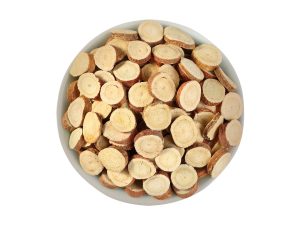
1. Licorice Slices: Thick, roundish or oval slices. The outer surface is reddish-brown or grayish-brown, with longitudinal wrinkles. The cross-section is slightly fibrous, with a yellowish-white center featuring distinct radial striations and a cambium ring. The texture is firm and slightly powdery. It has a faint odor and a sweet, distinctive taste.
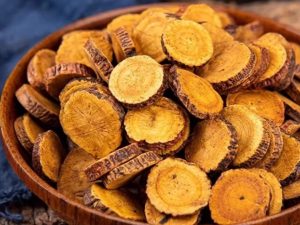
2. Honeyed Licorice (Roasted Licorice): Round or oval slices. The outer surface is reddish-brown or grayish-brown with a slight sheen. The cross-section is yellow to deep yellow, with a distinct cambium ring and radial rays. Slightly sticky. It has a roasted aroma and a sweet taste.
Botanical Information
Botanical Classification
Species of the genus Glycyrrhiza in the Fabaceae family, including Glycyrrhiza uralensis, Glycyrrhiza glabra, or Glycyrrhiza glabra var. glabra.
Morphological Characteristics
1. Licorice
A perennial herb, approximately 30–120 cm tall.
(1) Characteristics of roots, rhizomes, and leaves: The roots and rhizomes are stout and cylindrical, 1–3 cm in diameter, with a brown outer bark and a pale yellow interior; they have a sweet taste. The stem is erect and highly branched, densely covered with scale-like glandular dots, spiny glandular hairs, and white or brown tomentum.The leaves are odd-pinnate, alternate, and 5–20 cm long; the stipules are triangular-lanceolate and early deciduous; there are 5–17 leaflets, which are ovate, oblong-ovate, or nearly round, 1.5–5 cm long and 0.8–3 cm wide, densely covered with short soft hairs and glands on both surfaces, with an acute or obtuse apex, a rounded base, and entire or slightly wavy margins.
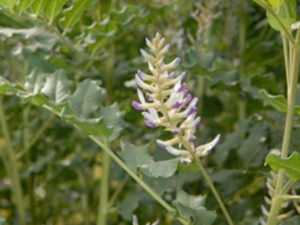
(2) Floral characteristics: Racemes are axillary, shorter than the leaf axils; flowers are densely arranged; bracteoles are lanceolate; the calyx is campanulate, externally covered with yellow glands or short soft hairs; there are 5 calyx teeth, nearly as long as the calyx tube;the corolla is deep purple and papilionaceous; the standard is oblong, with a rounded or slightly notched apex and a short petal stalk at the base; the wings are shorter than the standard; the keel is shorter than the wings; the stamens are (9+1) diadelphous; the ovary is densely covered with spiny glands and sessile. Flowering period: June–August.
(3) Fruit and Seed Characteristics: The pods are numerous and densely arranged in a spherical cluster; they are narrow, elongated, and curved into a sickle- or ring-like shape, with the outer surface densely covered with spiny glandular hairs; there are 3–11 seeds, which are flattened-round or reniform. Fruiting period: September–October.
2. Swollen-fruited Licorice
The main differences from common licorice are: the pods are short, straight, and swollen; there are no depressions between the seeds; they are covered with fine soft hairs and inconspicuous brown glandular dots; and there are 1–4 seeds. Flowering period: May–July; fruiting period: June–October.
3. Glabrous Licorice
The main differences from common licorice are: leaflets are lanceolate or oblong-lanceolate, densely covered on the underside with pale yellow scale-like glandular dots; the pods are flat and straight or slightly curved, smooth or bearing spiny glandular hairs; there are 2–8 seeds. Flowering period: May–June; fruiting period: July–September.
Distribution Area
1. Licorice: Distributed in Inner Mongolia, Ningxia, Xinjiang, Heilongjiang, Jilin, Liaoning, Hebei, Shanxi, Shaanxi, Gansu, and other regions.2. Smooth-fruited Licorice: Native to the Mediterranean region of Europe; it also grows in North Africa, Central Asia, and Siberia. In China, it is primarily distributed in Xinjiang.3. Swollen-fruited Licorice: Distributed in Gansu, Xinjiang, and other regions.
Growth Habits
It prefers a cool, dry climate. It is sun-loving, drought-tolerant, and cold-hardy. It has strong adaptability to soil conditions and is suitable for growing on various types of calcareous soils; it particularly thrives in sandy and sandy loam soils but grows poorly in clay soils.
Propagation Methods
Propagation methods include seed propagation, rhizome propagation, and division.
Cultivation Techniques
1. Seed Propagation: Seeds must be treated before sowing.From late March to early April, dig two shallow furrows 1.5–2 cm deep on prepared ridges. Sow the treated seeds evenly into the furrows, cover with soil, and water; seedlings will emerge about half a month after sowing. Ridge cultivation is preferable to flat-bed cultivation as it facilitates drainage, provides better ventilation and light penetration, and allows the roots to grow deeper. If sowing before winter, germination treatment is not necessary. The seeding rate is approximately 2.5 kg per mu.
2. Rhizome Propagation: For rhizome propagation, it is best to harvest licorice in spring or fall, selecting the thicker roots for medicinal use. Cut the thinner rhizomes into 15-cm-long segments, ensuring each segment has a root bud and fibrous roots. Dig two furrows approximately 10 cm wide on the ridges, lay the rhizomes flat in the furrows at a spacing of 15 cm, cover with soil, water thoroughly, and keep the soil moist. Use approximately 90 kg of rhizome cuttings per mu.
3. Division Propagation: Many new plants often sprout around the base of the mother licorice plant; these can be dug up and transplanted in spring or fall.
Pest and Disease Control
1. Diseases and Their Control
(1) Rust: This is the primary disease affecting cultivated licorice. It mainly damages the leaves. In the spring, shortly after seedlings emerge, small, circular, grayish-white pustules appear on the undersides of the leaves; in the later stages of the disease, the entire plant’s leaves become covered with a powdery coating.Infected plants appear stunted and clump together, with a mortality rate exceeding 98%. Control measures: In the early stages of infection, apply a 1,500-fold dilution of 25% fenarimol or dilute Nongkang 120 aqueous solution (an antibiotic) with water for furrow irrigation around the roots at a rate of 0.8 kg per mu.
(2) Brown Spot Disease: This disease occurs from July to August and is a common leaf disease during the later growth stages of licorice.Infected leaves develop circular or irregular lesions with gray-brown centers and brown margins; a gray-black, mold-like substance is present on both the upper and lower surfaces of the lesions. Control measures include applying a 200-fold dilution of non-toxic high-fat film as a protective treatment; at the onset of the disease, spray a 1:1:150 Bordeaux mixture or a 1,500–2,000-fold dilution of 70% methyl thiophanate;during the active disease period, spray a 500-fold dilution of 65% zinc mancozeb or a 500-fold dilution of 50% carbendazim.
(3) Powdery Mildew: Primarily affects leaves. Infected leaves develop a white powdery coating on both surfaces; in later stages, the leaves turn yellow and wither. Control measures include spraying a 0.2–0.3° Baumé lime-sulfur mixture.
2. Insect Pests and Their Control
(1) Lygus striatus: A major pest of licorice, it damages the above-ground parts of the plant. In severe cases, only the stems and leaf veins remain, causing the plants to become stunted or even die. Control measures include spraying a 1,000-fold mixture of mepiquat chloride when high pest densities are observed in May–June, using approximately 2.5 kg of pesticide per mu;Clean the field before overwintering to reduce the survival rate of overwintering pests.
(2) Leafhoppers: These are distributed across all licorice-producing regions, with the highest incidence south of the Yangtze River. Damage is most severe in August. Both adults and nymphs damage the leaves. In the early stages of infestation, small yellowish-white spots appear on the upper surface of the leaves; subsequently, the leaves lose their green color and turn pale yellow, with nymph exuviae visible on the underside. In severe cases, the entire leaf turns pale and drops prematurely.Control methods include spraying a 2,000-fold dilution of 50% Malathion or a 1,000–1,500-fold dilution of 90% Metam-S; biological control can be achieved using natural enemies such as lacewings and ladybugs.