

Shaya County of Aksu Prefecture lies on the northern margin of the Taklamakan Desert, traversed by the Tarim River, forming a unique desert‑oasis ecological zone for licorice cultivation. Large‑scale standardized licorice planting bases are concentrated in Tarim Township and surrounding desertified sandy land, mainly cultivating Glycyrrhiza inflata (inflated licorice) and local red‑bark Glycyrrhiza uralensis.
Relying on desert sandy soil, abundant sunlight and Tarim‑River groundwater recharge, Shaya desert licorice develops thick red‑bark taproots with rich active ingredients. Local bases adopt a strict three‑year harvest cycle, mechanized planting & harvesting, film‑mulched drip irrigation, forming a distinctive desert herbal economy that combines sand control and raw‑material production. Before harvest seasons, large batches of Shaya licorice are pre‑ordered by pharmaceutical factories, botanical‑extract manufacturers and food‑processing enterprises across domestic and overseas markets.
Unique Desert‑Edge Growing Environment
Shaya features typical warm‑temperate arid desert climate: scarce annual rainfall, massive evaporation, long sunshine hours, strong ultraviolet radiation and huge diurnal temperature difference, which greatly boosts biosynthesis of glycyrrhizic acid and flavonoids in licorice roots.The planting soil is dominated by desert aeolian sandy soil and slightly‑saline‑alkali desert meadow soil, loose and well‑drained, allowing licorice taproots to extend deep underground without compaction barriers.
The Tarim River system provides stable groundwater supply for the desert‑edge bases, avoiding over‑reliance on surface precipitation. Far away from heavy‑industry pollution sources, the desert background delivers low‑pollution growing conditions for TCM raw materials. As a native desert‑adapted plant, licorice develops extensive underground rhizome systems to stabilize shifting sand dunes. Large‑area licorice planting turns barren desertified wasteland into productive herbal farmland, realizing the dual output of ecological sand fixation and medicinal raw‑material supply.
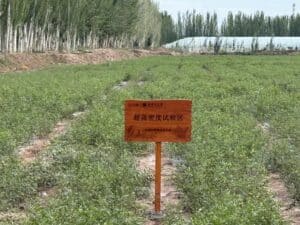
Standardized Desert Planting & Base Management
Shaya desert licorice bases deploy mature technical systems adapted to southern Xinjiang desert‑edge conditions:
- Local provenance selection: Prioritize local Glycyrrhiza inflata and red‑bark Glycyrrhiza uralensis provenances adapted to local saline‑alkali desert soil, guaranteeing germplasm stability and stress resistance.
- Water‑saving film‑mulched drip irrigation: Precisely control water consumption in arid desert zones, prevent secondary soil salinization, make full use of limited groundwater resources of Tarim River basin.
- Fixed 3‑year growth cycle: Follow strict “three‑year‑one‑crop” production rule. Seedlings grow for 3 full years before autumn harvesting; premature digging is prohibited to ensure sufficient accumulation of glycyrrhizic acid and flavonoid compounds.
- Large‑scale mechanized operation: Adopt special licorice transplanting machinery and deep‑digging harvesting equipment. Harvesting depth reaches over 80 cm to fully retrieve thick taproots, greatly improving efficiency for desert large‑scale bases.
- Green plant protection: Give priority to biological and physical pest control; strictly limit synthetic chemical pesticides and chemical fertilizer dosage to satisfy TCM raw‑material safety requirements.
- Full‑process filed record‑keeping: Record seedling source, irrigation, fertilization, pest management and harvest date, laying foundation for batch traceability.
The industry runs under “enterprise + base + cooperative + local farmer” mode. Enterprises provide seedlings and technical guidance, implement order‑based planting. Local farmers participate in field management and harvesting, gaining stable income from desert herbal industry.

Quality Performance, Standards & Resource Protection
- Quality characteristics: Shaya desert‑grown Glycyrrhiza inflata shows outstanding glycyrrhizic acid content. Red‑bark Glycyrrhiza uralensis features thick root, bright red outer bark, compact texture and high powder rate, well‑recognized by herbal purchasers at home and abroad. Test indexes meet or exceed the specification requirements of Chinese Pharmacopoeia.
- Regional standard compliance: Production follows Xinjiang local standard DB65/T 4123‑2023 for geographical‑indication licorice, regulating permitted varieties, planting cycle and physicochemical thresholds. Demonstration parks steadily promote green planting and organic certification construction.
- Wild‑resource protection: Random digging of wild licorice is strictly forbidden. Commercial raw materials are mainly sourced from artificially‑cultivated standardized desert bases. Tarim‑river riparian wild licorice communities implement enclosure protection and rotational‑conservation management to realize sustainable utilization of desert herbal resources.
Ecological‑Economic Value
Shaya converts desert restrictive conditions into industrial advantages. Large‑scale licorice planting restrains desert expansion, improves degraded sandy‑land soil, delivers remarkable sand‑fixing ecological benefits. Meanwhile, desert‑produced licorice raw materials are widely supplied to traditional Chinese medicine preparations, plant‑extract, food additive and cosmetic industries, forming a characteristic desert‑oasis industrial chain in southern Xinjiang.
As a representative case of “desert green economy”, Shaya licorice industry realizes mutual promotion among desert ecological restoration, local farmers’ income increase and Daodi TCM raw‑material supply.
FAQ
Q: What is the difference between Shaya Glycyrrhiza inflata and Ural licorice?
A: Glycyrrhiza inflata (inflated licorice) adapts better to southern Xinjiang high‑saline‑alkali desert‑edge environment, with prominent glycyrrhizic acid content, widely applied in plant‑extraction industry. Local red‑bark Glycyrrhiza uralensis owns balanced active‑ingredient profile, more favored for TCM formula use.
Q: Why must Shaya desert licorice follow the 3‑year growth cycle?
A: Under desert arid stress environment, licorice needs at least three full growth seasons to accumulate enough glycyrrhizic acid and flavonoids. Harvesting earlier will fail to meet pharmacopoeia quality standards.
Q: Can licorice planting improve the Taklamakan desert edge environment?
A: Yes. Licorice is a native sand‑binding desert plant. Its dense underground rhizome system stabilizes quicksand. Standardized artificial planting improves sandy‑land physicochemical property, achieving win‑win results for ecology and economy.




呢篇報道真係開眼界!喺沙漠邊緣種甘草,仲要標準化大規模種植,真係好犀利。塔里木河嘅綠洲生態孕育出咁靚嘅甘草,睇嚟新疆嘅農業技術越嚟越先進。希望呢啲甘草可以帶動當地經濟,同時保護好沙漠生態,做到可持續發展!加油!
¡Qué interesante! No sabía que en pleno desierto de Taklamakan se cultivara regaliz de forma tan organizada. Es fascinante cómo aprovechan el ecosistema oasis del río Tarim para algo así. ¿Sabéis si esta variedad tiene un sabor muy distinto al que usamos en Europa? Me encantaría probarlo. Gracias por compartir esta perspectiva tan única.
เป็นความรู้ดีมากครับ เรื่องชะเอมในเขตทะเลทรายทาคลามากันแบบนี้ ไม่ค่อยมีใครรู้ว่ามีการปลูกแบบมาตรฐานด้วย น่าสนใจที่ธรรมชาติแบบโอเอซิสช่วยให้พืชชนิดนี้เติบโตได้ดี อยากให้มี