
Disclaimer: All herbal teas, medicinal soups, acupuncture and Tui Na described in this article are only auxiliary wellness regimens for traditional health maintenance, not formal medical treatments. They cannot replace professional physician diagnosis, prescription drugs or clinical therapies. Anyone diagnosed with physical diseases shall strictly follow the treatment plans formulated by licensed medical practitioners. All TCM terminology, wellness regulation theories and traditional health philosophies in this text are solely for the inheritance, popularization and cultural exchange of traditional Chinese medicine. No content herein shall be deemed guidance for clinical diagnosis or medical treatment. Read more
Overview: Also known as “Fanwei” (regurgitation) or “Weifan” (stomach regurgitation). It is a condition characterized by abdominal distension and fullness, undigested food retention, morning vomiting of food eaten the previous evening, and evening vomiting of food eaten that morning as its primary clinical manifestations. It often results from improper dietary habits, excessive alcohol consumption and sexual activity, or prolonged worry, pensiveness, and repressed anger, which damage the Qi of the Spleen and stomach, leading to Qi Stagnation, blood stasis, and phlegm coagulation.
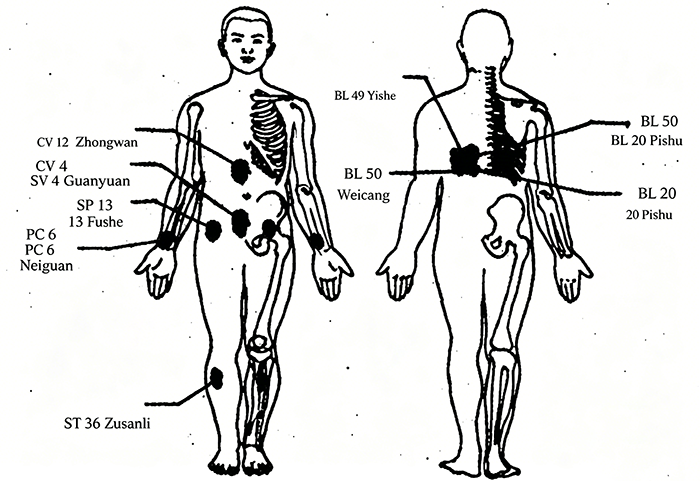
Scraping therapy areas
1. On the back: BL20 (Pishu), BL21 (Weishu), BL49 (Yishe), BL50 (Weicang).
2. Abdomen: Guanyuan (RN4), Fushe (SP13), Zhongwan (RN12).
3. Upper Limb – Neiguan (PC6).
4. Lower Limb – ST36 (Zusanli).
Q1: How to use gua sha for nausea relief?
A1: For nausea relief, use a gua sha tool to gently scrape the skin along the Stomach and Spleen meridians, particularly focusing on the upper abdomen and the inner forearm. Apply moderate pressure in downward strokes until slight petechiae appear, repeating two to three times per session. This technique helps regulate Qi flow and alleviate stomach discomfort.
Q2: Does gua sha help with nausea and vomiting?
A2: Yes, gua sha can help with nausea and vomiting by stimulating specific acupuncture points to regulate stomach Qi and reduce inflammation. It is particularly effective for nausea caused by digestive stagnation, stress, or dietary excess, as it promotes blood circulation and relieves muscle tension in the abdomen. Clinical observations suggest it can reduce the frequency and severity of vomiting episodes when used consistently.
Q3: What are the gua sha points for nausea and indigestion?
A3: Key gua sha points for nausea and indigestion include CV12 (Zhongwan), located on the midline of the abdomen above the navel, and ST36 (Zusanli), found on the lower leg below the knee. Additionally, scraping along the Stomach meridian on the abdomen and the Spleen meridian on the inner leg can help relieve distension and improve digestion. These points target the underlying Qi stagnation in the Stomach and Spleen.
Q4: Can gua sha treat stomach regurgitation (Fanwei)?
A4: Gua sha can be an effective complementary treatment for stomach regurgitation (Fanwei) by addressing Qi stagnation and heat in the Stomach meridian. It helps reduce abdominal distension, undigested food retention, and the cycle of morning and evening vomiting characteristic of this condition. However, it should be used alongside dietary adjustments and stress management for best results.
Q5: Why is gua sha effective for nausea caused by stress or poor diet?
A5: Gua sha is effective for stress- or diet-related nausea because it clears heat and toxicity from the Stomach meridian, which is often aggravated by improper eating, alcohol, or emotional tension like worry and anger. The scraping action stimulates blood flow and lymphatic drainage, reducing abdominal distension and promoting the smooth flow of Qi. This rebalances the digestive system and alleviates nausea.
Q6: What techniques should be used for gua sha on nausea points?
A6: Use a smooth-edged gua sha tool and apply a light layer of oil to the skin before scraping. For nausea points like CV12 or ST36, use short, repeated strokes in one direction (typically downward) with moderate pressure until mild redness appears. Avoid excessive force or scraping over sensitive areas, and limit sessions to 5–10 minutes to prevent irritation.
TCM Terminology Disclaimer:All traditional Chinese medicine (TCM) terms, descriptions, and wellness expressions including but not limited to nourishing lungs, soothing throat discomfort, supporting respiratory comfort, clearing mild internal heat, balancing qi and blood, harmonizing bodily functions, and regulating general wellness featured on this website are traditional TCM cultural descriptions and historical wellness theories only. These phrases are used solely for traditional TCM knowledge sharing and cultural interpretation. They do not constitute medical efficacy claims, have not been evaluated by the FDA, and are not intended to diagnose, treat, cure, or prevent any disease. All TCM wording describes traditional auxiliary wellness conditioning effects only and should never be interpreted as clinical medical treatment results. Individuals with confirmed illnesses must seek professional medical diagnosis and follow standard Western medical treatment.
FDA Mandatory Disclaimer:These statements have not been evaluated by the FDA. Chinese herbal dietary supplements and traditional wellness practices are not intended to diagnose, treat, cure or prevent any disease and serve only as daily auxiliary health support. If you have been diagnosed with any illness, please seek professional medical care and follow standard Western medical treatment regimens.
Interesting read! I’ve tried gua sha for tension headaches but never thought about using it for nausea. The description of “morning vomiting of food eaten the previous evening” sounds intense – would love to hear if anyone has actually used this approach for chronic digestive issues. Might give it a try on those specific points!
Super intéressant ! J’ai déjà testé le Gua Sha pour les tensions du cou, mais jamais pensé à l’utiliser contre les nausées. Les points mentionnés donnent envie d’essayer, surtout en cas de digestion difficile. Merci pour l’article !
刮痧竟然也能緩
Ich habe Gua Sha noch nie gegen Übelkeit ausprobiert, aber die Akupressurpunkte klingen interessant! Hat jemand Erfahrung damit gemacht? Würde mich freuen, mehr darüber zu hören. Danke für den aufschlussreichen Artikel!