
(1) Scrape the sides of the head, starting from the Taiyang (EX-HN5) points on both sides of the head to the Fengchi (GB20) points, passing through acupoints such as Touwei (ST8), Hanyan (GB4), Xuanlu (GB5), Xuanli (GB6), Shuaigu (GB8), Tianchong (GB9), Fubai (GB10), and Naokong (GB19).
(2) Scrape the anterior head starting from Baihui (GV20) to the anterior hairline, passing through acupoints including Qianding (GV21), Tongtian (BL7), Xinhui (GV22), Shangxing (GV23), Shenting (GV24), Chengguang (BL7), Wuchu (BL5), Qucha (BL4), Zhengying (GB17), Dangyang (EX-HN14), and Toulinqi (GB15).
(3) After scraping the posterior head, start from Baihui (GV20) to the posterior hairline, passing through acupoints including Houding (GV19), Luoqie (BL8), Qiangjian (GV18), Naohu (GV17), Yuzhen (BL9), Naokong (GB19), Fengfu (GV16), Yamen (GV15), Tianzhu (BL10), etc.
(4) Scrape the entire scalp
Using Baihui (GV20) as the center, scrape in a radial manner across the entire head, passing through acupoints throughout the head and the motor area, sensory area, speech area, vertigo-hearing area, visual area, stomach area, thoracic cavity area, and reproductive area.
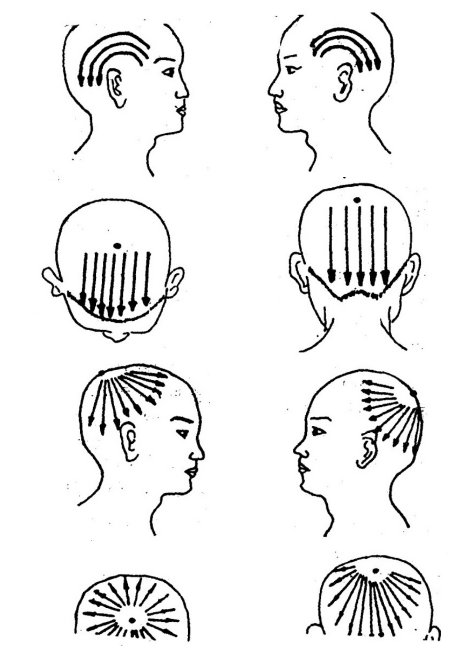
Head Gua Sha Therapy
2. Indications for Head Gua Sha Therapy (supports general well-being and helps maintain normal physiological functions)
Scraping the head helps maintain healthy blood circulation in the head, supports the smooth flow of Yang Qi throughout the body, promotes general well-being, and helps maintain normal function of the nervous system and scalp health. It may assist with occasional discomfort related to headaches, dizziness from high blood pressure, and mild memory decline, as well as support healthy hair conditions and comfort during common cold signs of imbalance.
3. Precautions
(1) No application of blood-circulation-promoting oil is required.
(2) The technique should employ gentle tonifying and dispersing or tonifying scraping.
(3) If there are sensations of pain, soreness, distension, or numbness in the local area during gua sha, these are normal phenomena and will subside with continued gua sha application.
(4) During Gua Sha, both hands should coordinate: one hand supports the patient’s head while the other performs scraping to maintain head stability and safety.
Can head gua sha for tension headaches help relieve pain?
Yes, head gua sha for tension headaches can be highly effective. By scraping specific acupoints like Taiyang, Fengchi, and Shuaigu, the technique helps release muscle tension and improve blood circulation in the scalp, which often alleviates headache symptoms. Many users find regular practice reduces both frequency and intensity of tension headaches.
How to do head gua sha at home for beginners?
To learn how to do head gua sha at home, start with a smooth gua sha tool and a few drops of oil on the scalp. Follow the direction from the Taiyang points on the sides of the head toward Fengchi at the back, using gentle pressure with short strokes. Always scrape from the center outward (Baihui toward the hairline) to avoid discomfort and maximize benefits.
What is the best head gua sha technique for hair growth?
The head gua sha technique for hair growth involves scraping along the anterior head from Baihui to the front hairline, passing through points like Qianding, Tongtian, and Shenting. This stimulation enhances blood flow to hair follicles, potentially promoting stronger growth. Pair this with side-to-back scraping for comprehensive scalp health.
How often should I perform head gua sha for tension headaches and hair growth?
For both tension headache relief and hair growth benefits, performing head gua sha 3–5 times per week is generally safe. Start with 5–10 minutes per session, focusing on the acupoints mentioned such as Fengchi and Shuaigu for headaches, and Baihui to Shenting for growth. Always listen to your body and avoid over-scraping sensitive areas.
Which acupoints are crucial in a head gua sha technique for tension headaches?
Key acupoints for tension headaches include Taiyang on the temples, Fengchi at the base of the skull, and Shuaigu on the sides of the head. Scraping from Taiyang through Touwei, Hanyan, and Xuanlu to Fengchi helps release tight muscles. This head gua sha technique effectively targets headache triggers along the gallbladder and bladder meridians.
Does the head gua sha technique for hair growth require special tools or oil?
For the head gua sha technique for hair growth, use a smooth gua sha tool made of jade or rose quartz, along with a nourishing oil like jojoba or coconut. Apply light to medium pressure while scraping from Baihui toward the hairline to stimulate follicles. No special training is needed, but consistency is key for visible results over weeks.
Ich habe Gua Sha am Kopf schon selbst ausprobiert und fand es total entspannend! Die genannten Punkte kenne ich noch nicht alle – besonders Touwei und Shuaigu werde ich mal testen. Danke für die Anleitung!
Great breakdown of the acupoints for head gua sha! I’ve been doing this for tension headaches, and focusing on Taiyang to Fengchi really helps release that tightness. Going to try including more of those Gallbladder meridian points you mentioned—thanks for the detailed guide!
Klingt wirklich interessant! Ich habe schon von Gua Sha im Gesicht gehört, aber am Kopf habe ich es noch nicht ausprobiert. Die erwähnten Akupressurpunkte kenne ich von der Kopfmassage – vielleicht probiere ich es mal mit einem Jadestein aus. Danke für die detaillierte Anleitung!
두부 경락 마사지 너무 좋아해요! 저도 해보니까 두통이 확 줄었어요. 태양혈부터 풍지혈까지 쭉 긁어주는 게 시원하더라고요. 더 많은 부위도 궁금하네요!
गुआ शा थेरेपी से सिर की मालिश करने का यह तरीका बहुत ही प्रभावी लगता है। मैंने अक्सर सुना है कि इससे सिरदर्द और तनाव कम होता है। क्या कोई इसे घर पर आजमा सकता है? बहुत अच्छी जानकारी दी है, धन्यवाद!