
1. Abdominal Guasha Therapy
(1) Scrape along the midline of the abdomen (the course of the Ren Meridian (RN) on the abdomen) from CV15 (Jiuwei) to CV9 (Shuifen), and from CV3 (Yinjiao) to CV2 (Qugu).
(2) Scrape both sides of the abdomen downward from Youmen (LU5), Burong (ST19), and Riyue (GB24), passing through Tianshu (ST25), Mangchong (KI16), to Qichong (ST30) and Henggu (KI11).
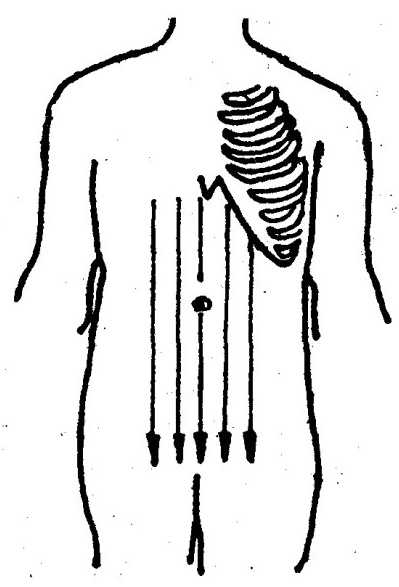
Abdominal Gua Sha Therapy
2. Indications for Abdominal Guasha Therapy (Scraping Therapy):
supports comfortable movement of tendons and meridians in the abdominal area and helps maintain a balanced internal environment
helps maintain the health of the Liver and gallbladder, Spleen and stomach, Kidney and bladder, large and small intestines, and supports normal function in conditions such as cholecystitis, chronic hepatitis, gastric and duodenal ulcers, vomiting, stomach wellness, indigestion, chronic nephritis, prostatitis, constipation, diarrhea, irregular menstruation, ovarian cysts, menopausal syndrome, and infertility.
3. Precautions
(1) Avoid scraping the abdomen on an empty stomach or within half an hour after meals.
(2) Applying oil and gua sha are prohibited at the umbilicus, namely Shenque (CV8) acupoint.
(3) Patients with Liver cirrhosis with ascites, gastric hemorrhage, recent abdominal surgery, intestinal perforation, etc., are prohibited from abdominal Gua Sha.
Q1: What is abdominal gua sha and how can it benefit digestion?
A1: Abdominal gua sha is a therapeutic technique that involves scraping the skin over the abdomen with a smooth-edged tool to stimulate blood flow and lymphatic drainage. It promotes digestive function by targeting specific acupoints along the Ren Meridian and stomach meridians, helping to alleviate bloating, constipation, and other gastrointestinal discomforts.
Q2: How does gua sha on the abdomen help with bloating?
A2: Gua sha on the abdomen for bloating works by increasing circulation and breaking up stagnant energy or Qi in the digestive tract. The scraping motion stimulates the parasympathetic nervous system, which enhances peristalsis and helps release trapped gas, reducing bloating and promoting smoother digestion.
Q3: Can I perform abdominal gua sha at home for digestion issues?
A3: Yes, with proper guidance, you can safely perform abdominal gua sha at home to support digestion. It is important to use a clean tool, apply a lubricant like oil or lotion, and follow the abdominal gua sha technique step by step: first scrape along the midline from CV15 (Jiuwei) to CV9 (Shuifen), then down from CV3 (Yinjiao) to CV2 (Qugu), and finally scrape both sides downward from points like ST19 to ST30.
Q4: What are the key acupoints used in abdominal gua sha for digestion?
A4: Abdominal gua sha for digestion targets several key acupoints including CV15 (Jiuwei), CV9 (Shuifen), CV3 (Yinjiao), CV2 (Qugu), ST19 (Burong), ST25 (Tianshu), KI16 (Mangchong), ST30 (Qichong), and KI11 (Henggu). These points correspond to the Ren Meridian and stomach meridians, directly influencing gastrointestinal motility and reducing bloating.
Q5: How often should I perform abdominal gua sha for digestive benefits?
A5: For digestive benefits, it is generally recommended to perform abdominal gua sha 2 to 3 times per week, allowing the skin to recover between sessions. Overdoing it can lead to bruising or skin irritation, so pay attention to your body’s response and reduce frequency if needed.
Q6: What is the correct abdominal gua sha technique step by step?
A6: The abdominal gua sha technique step by step: First, apply oil to the abdomen. Then, using a gua sha tool held at a 45-degree angle, scrape along the midline from CV15 (Jiuwei) to CV9 (Shuifen), and from CV3 (Yinjiao) to CV2 (Qugu). Next, scrape both sides downward from points such as ST19 (Burong) and RIyue (GB24), passing through ST25 (Tianshu) and KI16 (Mangchong) to ST30 (Qichong) and KI11 (Henggu). Repeat each stroke 10-15 times, always in one direction.
Q7: Are there any precautions to consider when performing gua sha on the abdomen?
A7: Yes, precautions include avoiding gua sha on areas with cuts, infections, or recent scars, and not applying too much pressure to prevent bruising. Pregnant women should avoid abdominal gua sha entirely, and those with blood clotting disorders or on anticoagulants should consult a healthcare provider first.
Q8: Why does abdominal gua sha improve digestion according to traditional Chinese medicine?
A8: In traditional Chinese medicine, abdominal gua sha improves digestion by clearing stagnation in the meridians that govern the stomach, spleen, and intestines. By scraping along the Ren Meridian and associated acupoints, it regulates Qi flow, harmonizes digestive functions, and reduces symptoms like bloating and poor appetite.
Interesting technique! I’ve tried facial gua sha before but never thought about abdominal work. Does this help with bloating or digestion specifically, or is it more for overall energy flow?
Interesting! I’ve tried facial gua sha but never thought about doing it on the abdomen. Does it really help with digestion or bloating? Might give it a shot after reading this.
Interesting! I’ve tried Gua Sha on my back before, but never thought about using it on the abdomen. The Ren Meridian points make sense for digestion and overall energy flow. Has anyone here tried this technique? Would love to hear about your experience.
Interesting! I’ve always wanted to try Gua Sha on my face, but never thought about doing it on the abdomen. Does anyone know if this helps with bloating or digestion too? Would love to hear personal experiences before I attempt it.
¡Qué interesante! Nunca había pensado en aplicar Gua Sha en el abdomen. ¿Alguien ha probado esta técnica? Me pregunto si ayuda con la digestión o la hinchazón. Definitivamente quiero investigar más sobre los puntos del meridiano Ren. ¡Gracias por compartir!