Fried Licorice is a processed form of the traditional Chinese medicinal herb licorice. It consists of the dried roots and rhizomes of the leguminous plants Glycyrrhiza uralensis Fisch., Glycyrrhiza inflata Bat., or Glycyrrhiza glabra L., which have been cleaned, sliced, and fried with honey.This product is produced in Inner Mongolia, Shaanxi, Gansu, and Northeast China. It primarily has the effects of tonifying the spleen and harmonizing the stomach, as well as replenishing qi and regulating the pulse. It is commonly used to treat conditions such as spleen and stomach deficiency, fatigue and weakness, deficiency of heart qi, palpitations, and irregular or skipped heartbeats.

Roasted Licorice
Fried Licorice is a processed form of the traditional Chinese medicinal herb licorice. It consists of the dried roots and rhizomes of the leguminous plants Glycyrrhiza uralensis Fisch., Glycyrrhiza inflata Bat., or Glycyrrhiza glabra L., which have been cleaned, sliced, and fried with honey.This product is produced in Inner Mongolia, Shaanxi, Gansu, and Northeast China. It primarily has the effects of tonifying the spleen and harmonizing the stomach, as well as replenishing qi and regulating the pulse. It is commonly used to treat conditions such as spleen and stomach deficiency, fatigue and weakness, deficiency of heart qi, palpitations, and irregular or skipped heartbeats.
Chinese Name : 炙甘草
Aliases : Honey-fried licorice, honey licorice
Nature, Flavor & Meridian Tropism : Sweet in taste, neutral in nature with a slightly warm tendency; enters the Heart, Lung, Spleen, and Stomach meridians
Benefits & Efficacy
Benefits
Fried licorice has a sweet taste, a neutral nature with a slight warmth, and enters the Heart, Lung, Spleen, and Stomach meridians. Its primary functions are to tonify the spleen and harmonize the stomach, as well as to replenish qi and regulate the pulse.
Indications
Fried licorice is primarily used to treat conditions such as spleen and stomach deficiency, fatigue and weakness, deficiency of heart qi, palpitations, and irregular or skipped heartbeats.
Usage and Dosage
Take as a decoction; the typical dosage is 2–10 g, with higher doses up to 15–30 g; alternatively, it can be taken in the form of a proprietary Chinese medicine preparation.
Precautions
1. Use with caution in patients with edema, kidney disease, hypertension, hypokalemia, or congestive heart failure.2. This product should not be used in combination with seaweed, Euphorbia pekinensis, Euphorbia rubra, Euphorbia kansui, or Datura metel.3. This product should not be used in combination with quinine, atropine, ephedrine hydrochloride, etc.4. This product should not be used in combination with cardiac glycosides.5. This product has a potassium-depleting effect and should not be used in combination with thiazide diuretics.6. This product should not be used in combination with aspirin, sodium salicylate, glucocorticoids, or Lixiping.7. During treatment, a low-salt diet is recommended; spicy and greasy foods should be avoided.8. During treatment, monitor blood pressure, serum potassium levels, urine output, and neurological symptoms. If adverse reactions such as edema or hypertension occur, the dosage should be reduced immediately or the medication tapered off and discontinued.
Chemical Constituents
This product contains triterpene saponins, flavonoids, coumarins, alkaloids, and polysaccharides.
Pharmacological Actions
Modern pharmacological studies have shown that this product has effects such as improving immune function, suppressing cough, and expectorating phlegm.
Applications
Related Compatibility
1. Fried licorice is often used in combination with ginseng, white atractylodes, and poria to tonify the spleen and stop diarrhea. It can treat intestinal rumbling and loose stools, abdominal distension, poor appetite, and fatigue in the limbs caused by spleen-stomach deficiency.
2. Fried licorice is often used in combination with ginseng, cinnamon twig, and raw rehmannia root to tonify qi and regulate the pulse, treating irregular and skipped heartbeats and palpitations caused by qi deficiency and blood deficiency.
Medicinal Identification
Raw licorice and fried licorice: These are different processed forms of licorice, and their therapeutic focuses differ.Raw licorice excels at clearing heat, detoxifying, resolving phlegm, and relieving coughs; it is often used to treat phlegm-heat coughs, sore throat, abscesses, boils, and toxic sores, as well as food and drug poisoning. Fried licorice, on the other hand, is better suited for tonifying the spleen, harmonizing the stomach, replenishing qi, and regulating the pulse; it is commonly used to treat spleen and stomach deficiency, fatigue and weakness, palpitations, and irregular or skipped pulses.
Related Medicines
Roasted Licorice Compound, Gui Pi Wan, Quan Lu Wan, and Xiao Yao Wan, among others.
Related Prescriptions
Fried Licorice Decoction (*Treatise on Cold Damage*), Peony and Licorice Decoction (*Commentary on the Treatise on Cold Damage*), etc.
Medicinal Diet Therapy
1. Steamed Duck with the Four Gentlemen Decoction
(1) Ingredients: 15 g of Codonopsis pilosula, 10 g of Atractylodes macrocephala, 10 g of Poria cocos, 5 g of fried licorice root, 1 duck, and ginger, scallions, and salt to taste.
(2) Preparation: Clean the duck thoroughly. Place the herbs inside the duck’s cavity, add ginger, scallions, salt, and other seasonings, then steam in a steamer for 2 hours until the duck meat is tender and fully cooked.
(3) Benefits: Tonifies qi and strengthens the spleen.
2. Ten-Ingredient Grand Tonifying Soup
(1) Ingredients: 1 turtle (weighing approximately 500g), 10g Codonopsis, 10g fried Astragalus, 10g stir-fried Atractylodes, 10g white peony root soaked in wine,10 g Poria, 3 g Cinnamon Bark (with coarse bark removed), 15 g Raw Rehmannia, 15 g Angelica sinensis, 6 g Chuanxiong, 6 g Fried Licorice, 5 red dates, and an appropriate amount of fresh ginger.
(2) Preparation: Grind the herbs—Dangshen, fried Astragalus, stir-fried Atractylodes, wine-processed White Peony, Poria, Cinnamon, Raw Rehmannia, Angelica, Chuanxiong, and fried Licorice—into a fine powder. Take 10g at a time and place it in a cloth bag, tying it tightly.Place the turtle in a basin, pour hot water over it to flush out all waste, then rinse it clean. Chop off the head and feet, remove the internal organs, and place the turtle along with the herb pouch, ginger, and red dates into a clay pot. Add an appropriate amount of water. Bring to a boil over high heat, then simmer over low heat until the turtle meat is thoroughly cooked. Remove the herb pouch.
(3) Efficacy: Tonifies qi and nourishes blood.
Notes
Patients requiring treatment with fried licorice should first consult a licensed Traditional Chinese Medicine (TCM) hospital, where a TCM practitioner will conduct a professional pattern differentiation and prescribe the appropriate herbal formula.
Processing & Preparation
Harvesting & Processing
Harvest in spring or autumn; remove the fibrous roots and sun-dry. Cut into thick slices.
Processing Methods
Take an appropriate amount of refined honey, dilute it with boiling water, add the licorice slices, and mix thoroughly. Let it sit for a short while to moisten the slices, then place the mixture in a hot pan. Stir-fry over low heat until the surface turns a deep yellow color and the slices no longer stick to your hands. Remove and let cool. Use 25 kg of refined honey for every 100 kg of licorice slices.
Storage Methods
Store in a dry container, seal tightly, and keep in a cool, dry place. Take precautions against mold and insect infestation.
Crude Drug Identification
Properties of Crude Drugs
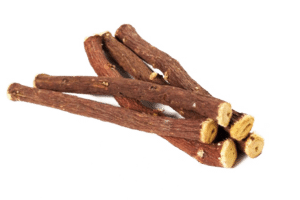
1. Licorice: The root is cylindrical, 25–100 cm long and 0.6–3.5 cm in diameter, with an outer bark of varying firmness. The surface is reddish-brown or grayish-brown, featuring prominent longitudinal wrinkles, grooves, lenticels, and sparse traces of fine roots.The texture is firm; the cross-section is slightly fibrous, yellowish-white, and powdery, with a distinct cambium ring and radially arranged rays; some specimens may have fissures. The rhizome is cylindrical, with bud scars on the surface and a pith in the central part of the cross-section. It has a faint odor and a sweet, distinctive taste.
2. Swollen-Fruit Licorice: The roots and rhizomes are woody and robust, sometimes branched, with a rough outer bark that is mostly grayish-brown or grayish-brown. The texture is hard, with abundant woody fibers and little powdery substance. The rhizomes have numerous, large adventitious buds.
3. Smooth-fruited Licorice: The roots and rhizomes have a relatively firm texture, with some branching; the outer bark is not rough, mostly grayish-brown, with fine, inconspicuous lenticels.
Properties of Processed Slices
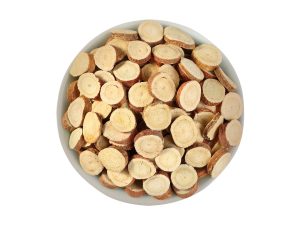
Roasted licorice appears as round or oval slices. The outer surface is reddish-brown or grayish-brown with a slight sheen. The cross-section is yellow to deep yellow, with a distinct cambium ring and radially arranged rays. It is slightly sticky. It has a roasted aroma and a sweet taste.
Botanical Information
Botanical Classification
A plant of the genus Glycyrrhiza in the legume family.
Morphological Characteristics
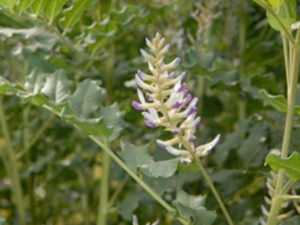
1. Licorice: A perennial herb; the roots and rhizomes are stout, 1–3 cm in diameter, with brown outer bark and pale yellow interior, and a sweet taste.Stems are erect and highly branched, 30–120 cm tall, densely covered with scale-like glandular dots, spiny glandular hairs, and white or brown tomentum; leaves are 5–20 cm long; stipules are triangular-lanceolate, approximately 5 mm long and 2 mm wide, densely covered with short white soft hairs on both surfaces; petioles are densely covered with brown glandular dots and short soft hairs;5–17 leaflets, ovate, long-ovate, or nearly round, 1.5–5 cm long, 0.8–3 cm wide, dark green above, green below, both surfaces densely covered with yellowish-brown glandular dots and short soft hairs; apex obtuse with a short point, base rounded, margin entire or slightly undulate, more or less revolute.The raceme is axillary, bearing numerous flowers; the raceme peduncle is shorter than the leaves and densely covered with brown scale-like glandular dots and short soft hairs; the bracts are oblong-lanceolate, 3–4 mm long, brown, membranous, and covered on the outside with yellow glandular dots and short soft hairs;The calyx is campanulate, 7–14 mm long, densely covered with yellow glandular dots and short soft hairs; the base is oblique and swollen into a sac-like structure; there are 5 calyx teeth, nearly as long as the calyx tube, with the upper two teeth largely fused;Corolla purple, white, or yellow, 10–24 mm long; standard oblong, slightly concave at the apex, with a short petal stalk at the base; wings shorter than the standard; keel shorter than the wings; ovary densely covered with spiny glandular hairs.The pods are curved, sickle-shaped or ring-shaped, densely clustered into a sphere, and densely covered with tuberculate projections and spiny-hairy glands. Seeds number 3–11; they are dark green, round or reniform, and approximately 3 mm long. Flowering occurs from June to August; fruiting occurs from July to October.
2. Swollen-fruited Licorice: A perennial herb; the roots and rhizomes are stout, with brown outer skin covered in yellow scale-like glands; the interior is pale yellow and sweet-tasting. The stem is erect, slightly woody at the base, highly branched, and 50–150 cm tall.Leaves 4–20 cm long; stipules small, triangular-lanceolate, brown, about 1 mm long, early deciduous; petioles and rachis densely covered with brown scale-like glandular dots, densely pubescent when young;There are 3–7 (–9) leaflets, ovate, elliptic, or oblong, 2–6 cm long and 0.8–3 cm wide, with an acute or obtuse apex and a nearly rounded base; the upper surface is dark green, the lower surface pale green; both surfaces are covered with yellowish-brown glandular dots and sparsely pubescent along the veins; the margins are more or less undulate.Racemes are axillary, bearing numerous, sparsely arranged flowers; the raceme peduncle is as long as or shorter than the leaves, often elongating after flowering, densely covered with scaly glandular dots, and densely pubescent when young; bracts are oblong-lanceolate, about 3 mm long, densely covered with glandular dots and short pubescence;The calyx is campanulate, 5–7 mm long, densely covered with orange-yellow glandular dots and soft hairs; the calyx teeth are 5, lanceolate, equal in length to the calyx tube, with the upper two teeth fused below the midpoint;The corolla is purple or pale purple; the standard is oblong, 6–9 (–12) mm long and 4–7 mm wide, with a rounded apex and a short petal stalk at the base; the wings are nearly equal in size to the standard, with distinct auricles and petal stalks; the keel is slightly shorter, and all petals bear petal stalks and auricles.The pod is elliptic or oblong, 8–30 mm long, 5–10 mm wide, straight or slightly curved, with a swelling between the two seeds or with lateral partitions of varying degrees; it is covered with brown glandular dots and spiny glands, and sparsely covered with long soft hairs. There are 1–4 seeds, which are round, green, and 2–3 mm in diameter. Flowering occurs from May to July; fruiting occurs from June to October.
3. Smooth-fruited Licorice: A perennial herb; the roots and rhizomes are stout, 0.5–3 cm in diameter, with brown root bark and a yellow interior that has a sweet taste. The stem is erect and highly branched, 0.5–1.5 m tall, woody at the base, densely covered with pale yellow scale-like glandular dots and white soft hairs; when young, it is ribbed and sometimes bears short spiny glandular hairs.Leaves 5–14 cm long; stipules linear, only 1–2 mm long, early deciduous; petioles densely covered with yellowish-brown glandular hairs and long soft hairs;11–17 leaflets, ovate-oblong, oblong-lanceolate, or elliptic, 1.7–4 cm long, 0.8–2 cm wide, nearly glabrous or sparsely pubescent on the upper surface, densely covered with pale yellow scale-like glandular dots on the lower surface, sparsely pubescent along the veins, with a rounded or slightly凹凹凹凹凹凹凹凹凹凹凹凹凹凹凹凹凹凹凹凹凹凹凹凹凹凹凹凹凹凹凹凹凹凹凹凹凹凹凹凹凹凹凹凹凹凹凹凹凹凹凹凹凹凹凹凹凹凹凹凹凹凹凹凹凹凹凹凹凹凹凹凹凹凹凹凹凹凹凹凹凹凹凹凹凹凹凹凹凹凹凹凹凹凹凹凹凹凹凹凹凹凹凹凹凹凹凹凹凹凹凹凹凹凹凹凹凹凹凹凹凹凹凹凹凹凹凹凹凹凹凹凹凹凹凹凹凹凹凹凹凹凹凹凹凹凹凹凹凹凹凹凹凹凹凹凹凹凹凹凹凹凹凹凹凹凹凹凹凹凹凹凹凹凹凹凹凹凹凹凹凹凹凹凹凹凹凹凹凹凹凹凹凹凹凹凹凹凹凹凹凹凹凹凹凹凹凹凹凹凹凹凹凹凹凹凹凹凹凹凹凹凹凹凹凹凹凹凹凹凹凹凹凹凹凹凹凹凹凹凹凹凹凹凹凹凹凹凹凹凹凹凹凹凹凹凹凹凹凹凹凹凹凹凹凹凹凹凹凹凹凹凹凹凹凹凹凹凹凹凹凹凹凹凹凹凹凹凹凹凹凹凹凹凹凹凹凹凹凹凹凹凹凹凹凹凹凹凹凹凹凹凹凹凹凹凹凹凹凹凹凹凹凹凹凹凹凹凹凹凹凹凹凹凹凹凹凹凹凹凹凹凹凹凹凹凹凹凹凹凹凹凹凹凹凹凹凹凹凹凹凹凹凹凹凹凹凹凹凹凹凹凹凹凹凹凹凹凹凹凹凹Racemes axillary, bearing numerous densely clustered flowers; raceme peduncle shorter than or equal in length to the leaves (elongating after fruiting), densely covered with brown scale-like glandular dots and white long soft hairs and villi; bracts lanceolate, membranous, ca. 2 mm long;The calyx is campanulate, 5–7 mm long, sparsely covered with pale yellow glandular dots and short soft hairs; the calyx teeth number 5, are lanceolate, and nearly as long as the calyx tube; the upper two teeth are largely fused;Corolla purple or pale purple, 9–12 mm long; standard ovate or oblong, 10–11 mm long, apex slightly concave, petal stalk half as long as the petal blade; wings 8–9 mm long; keel straight, 7–8 mm long; ovary glabrous.The pod is oblong, flattened, 1.7–3.5 cm long, 4.5–7 mm wide, slightly sickle-shaped, sometimes slightly constricted between seeds, glabrous or sparsely hairy, and sometimes bearing sparse or dense spiny glandular hairs. There are 2–8 seeds, dark green, smooth, reniform, and approximately 2 mm in diameter. Flowering occurs from May to June, and fruiting from July to September.
Distribution Area
1. Domestic Distribution: Found in Inner Mongolia, Xinjiang, Gansu, Shaanxi, and the Northeast, among other regions.2. Overseas Distribution: Found in Europe, Oceania, the Americas, and other regions.
Growth Habits
It thrives in ecosystems with ample sunlight, low rainfall, scorching summers, bitterly cold winters, and large diurnal temperature fluctuations. It is characterized by its preference for sunlight, as well as its tolerance to drought, heat, saline-alkali conditions, and cold. It grows best in loose, well-drained, fertile, deep, humus-rich sandy loam.