
1.Facial Gua Sha Therapy
(1) Scrape the forehead area
Divided by the anterior-posterior midline, scrape both sides from the inside outward. The forehead includes the skin between the anterior hairline and the eyebrows. The acupoints passed through include EX-HN3 (Yintang), BL2 (Cuanzu), EX-HN4 (Yuyao), GB14 (Sizhukong), etc.
(2) Scrape both zygomatic regions (from Chengqi (BL2) to Juxiao (ST3), from Yingxiang (LI20) to Ermen (SJ21), and the area around Ergong (no direct equivalent, refers to the auricular region)).
Scrape from the inside to the outside respectively, passing through acupoints such as ST3 (Chengqi), ST2 (Sibai), SI18 (Quanliao), ST3 (Juliao), ST7 (Xiaguan), SI19 (Tinggong), GB2 (Tinghui), SJ21 (Ermen).
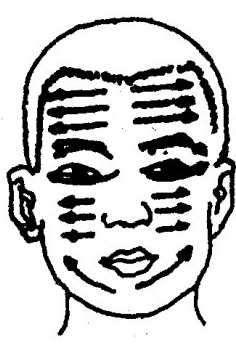
Facial Gua Sha Therapy
(3) Scrape the mandibular region
Starting from Chengjiang (Ren24) as the center, scrape outward and upward respectively. The acupoints passed through include Chengjiang (Ren24), Dicang (ST4), Daying (ST5), Jiache (ST6), etc.
2. Indications for Facial Gua Sha
Facial Gua Sha primarily addresses conditions of the facial features and supports skin rejuvenation, spot removal, and aesthetic enhancement. It helps maintain normal function for eye wellness, nasal conditions, ear ailments, facial paralysis, oral wellness, and supports healthy skin by addressing freckles, acne, and promoting anti-aging beauty care.
3. Precautions
(1) No blood-activating oil is required. If moisturization is needed, steam or clean water (warm water is best) can be used to moisten the facial skin.
(2) It is advisable to use tonifying scraping and contraindicate purging scraping.
(3) It is advisable to use the edge or the anterior one-third portion of the scraping board for scraping, which facilitates precise control of the scraping area without damaging the skin.
(4) Facial Gua Sha aims to dredge meridians and promote the circulation of Qi and blood, without the necessity of producing Sha (petechiae).
(5) It is advisable to adopt a scraping method characterized by short duration, light pressure, and multiple repetitions throughout the day.
What are the key facial gua sha therapy benefits for skin health?
Facial gua sha therapy benefits include improved circulation, reduced muscle tension, and enhanced lymphatic drainage, which can lead to a brighter, more youthful complexion. By stimulating acupoints like Yintang and Cuanzhu, it also helps alleviate puffiness and promote collagen production. Regular practice can soften fine lines and give the skin a natural glow.
How to do facial gua sha at home for beginners?
To learn how to do facial gua sha at home, start with a clean face and apply a facial oil or serum to allow the tool to glide smoothly. Use gentle upward and outward strokes, scraping from the center of your forehead toward the temples, and then along the cheekbones from the nose outward. Focus on areas like the zygomatic region and jawline, always moving in lymphatic drainage directions to avoid tugging the skin.
Can facial gua sha for lymphatic drainage reduce puffiness?
Yes, facial gua sha for lymphatic drainage is highly effective at reducing puffiness by manually stimulating the lymph nodes to flush excess fluid and toxins. Using light pressure along the lymph pathways, such as from the inner eye outward and down the neck, helps decongest the face. This technique is especially beneficial for morning puffiness around the eyes and cheeks.
How often should you perform facial gua sha for best results?
For optimal facial gua sha therapy benefits, most experts recommend performing the routine 3 to 5 times per week, allowing your skin to recover between sessions. Consistency is more important than frequency, so even a quick 5-minute session a few times a week can improve circulation and lymphatic function. Avoid overdoing it if your skin feels sensitive or irritated.
What tools are needed for facial gua sha therapy at home?
The primary tool for facial gua sha therapy is a smooth, flat stone, typically made of jade, rose quartz, or bian stone, shaped with curved edges to fit facial contours. You’ll also need a facial oil or serum to create slip and prevent friction. Optional tools include a gua sha board with multiple notches for targeting specific areas like the jawline or brows.
Is facial gua sha safe for all skin types?
Facial gua sha is generally safe for most skin types, but those with active acne, rosacea, or very sensitive skin should use caution and consult a dermatologist. When learning how to do facial gua sha at home, use light pressure and avoid scraping over broken skin or inflamed breakouts. Incorporating facial gua sha for lymphatic drainage can still be beneficial if done gently and with proper technique.
페이셜 꽈사 꽤 해봤는데 이마 부분 설명이 자세하네요! 인당혈, 찬죽혈 같은 경혈 자극이 피부 탄력에 진짜 도움 되는 것 같아요. 저는 특히 눈썹 위쪽이 효과 좋더라고요. 처음 할 땐 살살 하는 게 중요해요!
I’ve been curious about trying gua sha for my forehead lines. The step-by-step breakdown really helps—especially knowing which acupoints to target. Thanks for sharing this!
I’ve been trying
Super intéressant ! J’ai déjà essayé le gua sha sur le visage, mais je ne savais pas qu’il fallait suivre des lignes et des points précis. Le front et les sourcils semblent vraiment importants pour détendre les tensions. Merci pour ces détails, je vais tester ce soir ! ✨
I’ve been curious about facial gua sha for a while—this breakdown of the forehead scraping technique is really helpful. The mention of acupoints like Yintang makes me wonder how targeted this can be for tension headaches. Have you noticed any difference in sinus relief while doing it?