
Disclaimer: All herbal teas, medicinal soups, acupuncture and Tui Na described in this article are only auxiliary wellness regimens for traditional health maintenance, not formal medical treatments. They cannot replace professional physician diagnosis, prescription drugs or clinical therapies. Anyone diagnosed with physical diseases shall strictly follow the treatment plans formulated by licensed medical practitioners. All TCM terminology, wellness regulation theories and traditional health philosophies in this text are solely for the inheritance, popularization and cultural exchange of traditional Chinese medicine. No content herein shall be deemed guidance for clinical diagnosis or medical treatment. Read more
Vomiting is a condition caused by multiple factors leading to the disharmony and failure of the stomach to descend Qi, resulting in the upward reversal of Qi, which causes food, phlegm, or other substances to be expelled upward from the stomach. It is also known as “ou e” (vomiting and nausea).
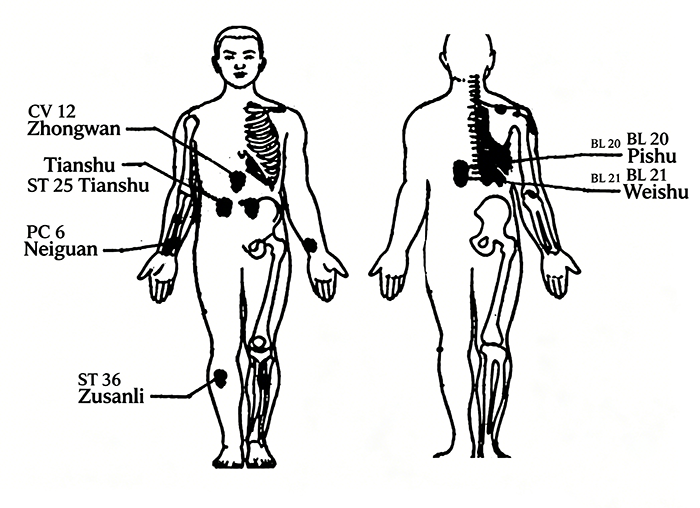
Scraping therapy areas
1. Back: BL20 (Pishu), BL21 (Weishu).
·2. Abdomen: CV12 (Zhongwan), ST25 (Tianshu).
3. Upper Limb – Neiguan (PC6).
4. Lower Limb – ST36 (Zusanli).
Q1: How does gua sha help vomiting?
A1: Gua sha helps vomiting by stimulating specific acupoints and meridians to regulate the stomach’s descending function and harmonize qi flow. The scraping action releases stagnation, clears heat or cold pathogens, and calms the upward reversal of stomach qi, thereby alleviating the urge to vomit. This technique targets the root causes of vomiting such as disharmony between the stomach and spleen.
Q2: What are the key gua sha points for nausea and vomiting?
A2: Key gua sha points for nausea and vomiting include Ren-12 (Zhongwan) on the abdomen to regulate stomach qi, ST-36 (Zusanli) on the leg to strengthen digestion, and PC-6 (Neiguan) on the inner forearm to calm nausea. Scraping along the Bladder meridian on the back also helps harmonize internal organs. These points effectively redirect rebellious stomach qi downward.
Q3: Can gua sha be used for morning sickness vomiting relief?
A3: Yes, gua sha can be used for morning sickness vomiting relief, but gentle techniques and mild pressure are essential during pregnancy. Focus on points like PC-6 (Neiguan) and ST-36 (Zusanli) while avoiding strong stimulation of abdominal points. Always consult a qualified practitioner to ensure safety for both mother and baby.
Q4: Why is gua sha effective for vomiting due to stomach qi disharmony?
A4: Gua sha is effective because it physically moves stagnant blood and qi, reducing inflammation and improving microcirculation in the affected meridians. By scraping over points like Ren-12 and ST-36, it restores the stomach’s ability to descend qi properly, stopping the rebellious upward flow that causes vomiting. This direct intervention addresses the underlying disharmony quickly.
Q5: Are there specific gua sha techniques for vomiting relief?
A5: Yes, specific techniques include light to moderate scraping over the abdomen in a clockwise direction around the navel, and linear scraping from the chest to the lower ribs along the stomach meridian. For nausea and vomiting, focus on repeated strokes at PC-6 and ST-36 until petechiae appear. Always use oil and avoid scraping on broken skin or after eating.
Q6: Does gua sha help with both nausea and vomiting?
A6: Yes, gua sha helps both nausea and vomiting by calming the stomach and relieving muscle tension in the upper abdomen. The same gua sha points for nausea and vomiting, such as PC-6 and Ren-12, address both symptoms by regulating autonomic responses and reducing the sensation of queasiness. Regular sessions can prevent recurrence of vomiting episodes.
TCM Terminology Disclaimer:All traditional Chinese medicine (TCM) terms, descriptions, and wellness expressions including but not limited to nourishing lungs, soothing throat discomfort, supporting respiratory comfort, clearing mild internal heat, balancing qi and blood, harmonizing bodily functions, and regulating general wellness featured on this website are traditional TCM cultural descriptions and historical wellness theories only. These phrases are used solely for traditional TCM knowledge sharing and cultural interpretation. They do not constitute medical efficacy claims, have not been evaluated by the FDA, and are not intended to diagnose, treat, cure, or prevent any disease. All TCM wording describes traditional auxiliary wellness conditioning effects only and should never be interpreted as clinical medical treatment results. Individuals with confirmed illnesses must seek professional medical diagnosis and follow standard Western medical treatment.
FDA Mandatory Disclaimer:These statements have not been evaluated by the FDA. Chinese herbal dietary supplements and traditional wellness practices are not intended to diagnose, treat, cure or prevent any disease and serve only as daily auxiliary health support. If you have been diagnosed with any illness, please seek professional medical care and follow standard Western medical treatment regimens.
Interesting how traditional methods like gua sha can address something as basic as vomiting. I’ve used it for digestion issues before, but never thought about it for nausea. Might give it a try next time. Thanks for the clear explanation!
Interesting read! I’ve tried gua sha for muscle tension but never thought of it for nausea. Does the technique target specific points on the back or stomach? Would love to hear if anyone’s had success with this for motion sickness.
Interesting read! I’ve tried gua sha for muscle tension before, but never thought of it for nausea. The idea of balancing stomach qi makes sense from a TCM perspective. Has anyone here actually used this for vomiting? Curious if it works better than acupressure bands.
Interesting! I’ve used gua sha for muscle tension, but never thought of it for vomiting. The whole “stomach qi descending” idea makes sense from a TCM perspective. Has
Muito interessante! Nunca tinha pensado no gua sha para ajudar com vômitos, mas faz sentido se for para equilibrar o qi do estômago. Alguém já testou? Gostaria de saber se funciona melhor que os remédios tradicionais.