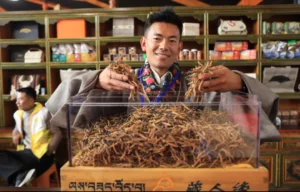
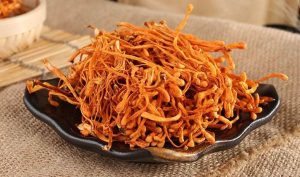
Cordyceps, a name in traditional Chinese medicine. It is the dried composite of the fruiting body and the corpse of a caterpillar from the family Sphingidae, parasitized by the fungus Cordyceps sinensis (Berk.) Sacc. of the Clavicipitaceae family. It is primarily produced in Sichuan, Tibet, and Qinghai.This herb has a sweet taste and neutral nature; it enters the Lung and Kidney meridians. It has the effects of tonifying the kidneys and nourishing the lungs, as well as stopping bleeding and resolving phlegm. It can be used to treat kidney deficiency with essence depletion, impotence and nocturnal emission, soreness and pain in the lower back and knees, chronic cough with wheezing due to deficiency, and coughing up blood due to overwork.

Cordyceps
Cordyceps, a name in traditional Chinese medicine. It is the dried composite of the fruiting body and the corpse of a caterpillar from the family Sphingidae, parasitized by the fungus Cordyceps sinensis (Berk.) Sacc. of the Clavicipitaceae family. It is primarily produced in Sichuan, Tibet, and Qinghai.This herb has a sweet taste and neutral nature; it enters the Lung and Kidney meridians. It has the effects of tonifying the kidneys and nourishing the lungs, as well as stopping bleeding and resolving phlegm. It can be used to treat kidney deficiency with essence depletion, impotence and nocturnal emission, soreness and pain in the lower back and knees, chronic cough with wheezing due to deficiency, and coughing up blood due to overwork.
Chinese Name : 冬虫夏草
Latin Name : Cordyceps
Aliases : Summer Grass, Winter Worm; Cordyceps; Cordyceps sinensis
Authentic Producing Area : Sichuan, Tibet, Qinghai
Nature, Flavor & Meridian Tropism : Sweet in taste, neutral in nature; enters the Lung and Kidney meridians
Benefits & Efficacy
Benefits
Tonifies the kidneys and lungs; stops bleeding and resolves phlegm.
Indications
Kidney deficiency with essence depletion, impotence and nocturnal emission, soreness and pain in the lower back and knees, chronic cough with wheezing due to deficiency, and coughing up blood due to overwork.
Usage and Dosage
Internal use: Decoct and take 3–9 g.
Precautions
Not suitable for use alone in cases of yin deficiency with excessive internal heat.
Chemical Constituents
This product primarily contains nucleoside components (such as adenosine, adenine nucleoside, hypoxanthine nucleoside, hypoxanthine, adenine, guanine, uracil, etc.) and sterol components (such as ergosterol, etc.).In addition, this product contains proteins, fatty acids, amino acids, polysaccharides, and other components.
Pharmacological Actions
This product has effects such as regulating the immune system, improving kidney damage, improving lung damage, improving liver damage, exerting sex hormone-like effects, and combating fatigue.
Relevant Discussions
1. *Ben Cao Cong Xin*: “Nourishes the lungs and kidneys, stops bleeding, resolves phlegm, and alleviates chronic cough.”
2. *Yao Xing Kao*: “Preserves essence, boosts qi, and specifically tonifies the Gate of Life.”
Applications
Clinical Applications
1. For treating impotence and nocturnal emissions caused by kidney yang deficiency and deficiency of essence and blood, as well as soreness and pain in the lower back and knees: It may be used alone by soaking in wine and consuming, or combined with yang-tonifying herbs such as Epimedium, Eucommia, and Morinda root to form a compound formula.
2. For treating chronic cough with blood-tinged sputum: It may be used alone or in combination with herbs such as Glehnia root, Fritillaria cirrhosa, donkey-hide gelatin, raw Rehmannia root, and Ophiopogon tuber.If there is deficiency of both the lungs and kidneys, resulting in loss of control over the breath and shortness of breath due to qi deficiency, it may be used in combination with Ginseng, Astragalus, and walnut meat.
3. For post-illness physical weakness that fails to recover, or spontaneous sweating and aversion to cold: This product may be stewed with chicken, duck, or pork; it has the effect of tonifying the kidneys and consolidating the root, as well as tonifying the lungs and strengthening the defensive qi.
Related Compatibility
1. Cordyceps sinensis combined with ginseng: Cordyceps sinensis is sweet and neutral in nature, excelling at warming the kidneys and tonifying the lungs; ginseng is sweet and warm, excelling at tonifying the spleen and benefiting the lungs. When combined, these two herbs enhance the effect of tonifying the lungs and regulating qi. This formula is suitable for conditions such as deficiency of both the lungs and kidneys, inability to retain qi, and chronic cough with wheezing due to deficiency.
2. Cordyceps sinensis combined with Scrophularia root: Cordyceps sinensis excels at tonifying lung qi and nourishing lung yin; Scrophularia root excels at nourishing lung yin and clearing lung heat. When combined, these two herbs enhance the effects of moistening the lungs, resolving phlegm, relieving cough, and alleviating wheezing. This combination is suitable for conditions such as chronic cough and labored breathing resulting from deficiency of both lung qi and yin.
3. Cordyceps sinensis combined with Psoralea corylifolia: Cordyceps sinensis excels at warming the kidneys, tonifying the lungs, stopping cough, and relieving wheezing; Psoralea corylifolia excels at tonifying the kidneys, strengthening yang, regulating qi, and relieving wheezing. When combined, these two herbs enhance the effects of tonifying the kidneys, strengthening yang, regulating qi, and relieving wheezing. This combination is suitable for conditions such as deficiency of both the lungs and kidneys, impaired ability to regulate and contain qi, and chronic cough with deficiency-type wheezing.
4.Cordyceps sinensis combined with Eucommia ulmoides: Cordyceps sinensis excels at warming the kidneys and tonifying the lungs; Eucommia ulmoides excels at tonifying the liver and kidneys. When combined, these two herbs enhance the effects of tonifying the kidneys and strengthening yang. This combination is suitable for conditions such as erectile dysfunction, nocturnal emissions, and enuresis caused by kidney yang deficiency.
5. Cordyceps sinensis combined with Lycium barbarum: Cordyceps sinensis excels at warming the kidneys and tonifying the lungs; Lycium barbarum excels at tonifying the liver and kidneys.When combined, these two herbs enhance the effects of warming the kidneys and tonifying the liver. This combination is suitable for conditions such as lower back pain and fatigue caused by deficiency of the liver and kidneys.
6. Cordyceps sinensis combined with ejiao: Cordyceps sinensis excels at warming the kidneys and tonifying the lungs; ejiao excels at nourishing the blood and stopping bleeding. When combined, these two herbs enhance the effects of warming the kidneys, boosting yang, nourishing the blood, and stopping bleeding. This combination is suitable for conditions such as deficiency of qi and yin, as well as chronic cough with hemoptysis.
7. Cordyceps sinensis combined with apricot kernels: Cordyceps sinensis excels at warming the kidneys and tonifying the lungs; apricot kernels are effective at relieving cough and resolving phlegm. When combined, these two herbs enhance the effects of tonifying the lungs and kidneys, as well as relieving cough and resolving phlegm. This combination is suitable for conditions such as yin deficiency with wheezing and cough associated with pulmonary tuberculosis, hemoptysis, and chest pain.
Medicinal Identification
1. Walnut Kernels and Cordyceps: Both have a sweet taste and enter the Lung and Kidney meridians; they can tonify the kidneys, warm the lungs, and relieve wheezing, treating lower back and knee soreness due to kidney yang deficiency, coughs caused by lung deficiency, and shortness of breath resulting from the kidneys’ failure to retain qi. However, walnut kernels are warm in nature and oily in texture, and they also have the function of moistening the intestines and promoting bowel movements; they are commonly used to treat constipation caused by fluid deficiency and intestinal dryness. They can also expel stones and are used to treat urinary tract stones.Cordyceps has a neutral nature and primarily nourishes the kidneys and strengthens yang; it also stops bleeding and resolves phlegm. It is particularly effective for treating kidney deficiency-induced impotence and nocturnal emissions, as well as chronic cough with hemoptysis and post-illness physical weakness characterized by spontaneous sweating and aversion to cold. However, its medicinal effects are mild, and benefits are only realized with long-term use.
2. Ginseng and Cordyceps: Both have a sweet taste and enter the Lung and Kidney meridians; they can nourish the lungs and kidneys, anchor qi, and relieve wheezing, treating coughs due to lung deficiency and shortness of breath caused by the kidneys’ failure to anchor qi.However, ginseng powerfully tonifies primordial qi and consolidates qi to prevent collapse; it is often used for qi deficiency with impending collapse and a faint, nearly imperceptible pulse. Ginseng also enters the Spleen meridian, where it tonifies the spleen, regulates the middle jiao, invigorates spleen qi, and supports the source of transformation and transportation. As a key herb for tonifying the spleen, it is used to treat mental fatigue, weakness, shortness of breath, reluctance to speak, loss of appetite, abdominal distension, and loose stools caused by spleen qi deficiency, impaired transformation and transportation, and loss of the ability to generate and transform.Ginseng is sweet and warm without being drying, and it also has the efficacy of generating body fluids and quenching thirst; it is used to treat conditions where heat has injured both qi and yin, manifesting as thirst and profuse sweating. Ginseng also has the efficacy of calming the mind and enhancing mental clarity, and is used for insomnia, forgetfulness, palpitations, and anxiety. Furthermore, ginseng greatly tonifies primordial qi, strengthens qi, and generates blood—tonifying both qi and blood—and is used to treat conditions such as spleen-stomach deficiency, insufficiency of the source of transformation, and blood deficiency with sallow complexion;Ginseng also powerfully tonifies primordial qi and strengthens yang, and is used to treat deficiency of primordial qi, decline of Mingmen fire, and conditions such as erectile dysfunction and uterine cold. Cordyceps sinensis has a neutral nature and primarily tonifies the kidneys and strengthens yang; it also stops bleeding and resolves phlegm, and is particularly effective for treating kidney deficiency, erectile dysfunction, and seminal emission, as well as chronic cough with hemoptysis and post-illness physical weakness characterized by spontaneous sweating and aversion to cold. However, its medicinal action is mild, and effects are only achieved with long-term use.
3. Astragalus and Cordyceps: Both herbs enter the Lung Meridian and possess the effects of tonifying lung qi, strengthening defensive qi, consolidating the exterior, and stopping sweating; they are used for conditions of exterior deficiency with spontaneous sweating.However, Astragalus is a key herb for tonifying qi and raising yang. It can also be used to treat post-illness weakness, spleen qi deficiency (manifesting as shortness of breath, fatigue, poor appetite, and loose stools), as well as chronic diarrhea, rectal prolapse, and uterine prolapse caused by central qi collapse and failure of spleen yang to rise;Astragalus also has the effects of generating blood and promoting the flow of stagnant blood, and is used to treat fever due to blood deficiency, sallow complexion with palpitations, excessive menstrual bleeding or metrorrhagia, qi deficiency with blood stasis, rheumatic arthralgia, and hemiplegia; Astragalus also has the effects of tonifying lung qi, strengthening defensive qi, consolidating the exterior, and stopping sweating, and is used to treat conditions of insufficient lung qi, unstable defensive yang, and spontaneous sweating due to exterior deficiency;Astragalus also warms and nourishes the spleen and stomach to promote tissue regeneration, tonifies qi and blood to expel toxins, and is effective in tonifying qi, promoting tissue regeneration, expelling toxins, and draining pus. It is used to treat abscesses where pus has formed but the lesion has not ruptured, or where a long-standing ulcer has not healed.Cordyceps sinensis has a neutral nature and primarily nourishes the kidneys and strengthens yang; it also stops bleeding and resolves phlegm. It is particularly effective for treating kidney deficiency-induced impotence and seminal emission, soreness and pain in the lower back and knees, labor-induced cough with hemoptysis, and chronic cough with deficiency-type wheezing.
Related Medicines
Gu Ben Qiang Shen Capsules, Lobzang Capsules, and Musk Pearl Eye Drops.
Medicinal Diet Therapy
1. Cordyceps Skin-Moisturizing Tea
(1) Benefits: Moisturizes the skin and replenishes moisture. Enhances the skin’s radiance and suppleness. It has the effects of tonifying deficiencies, nourishing essence and qi, relieving coughs, and tonifying the lungs and kidneys. It is primarily used to treat conditions such as deficiency of both the lungs and kidneys, insufficiency of essence and qi leading to erectile dysfunction and nocturnal emissions, and post-illness weakness.
(2) Ingredients: 6g Cordyceps, 6g American ginseng, 6g goji berries.
(3) Preparation: Grind the Cordyceps into a powder and set aside. Place all the herbs in a cup and pour approximately 500ml of boiling water over them. Let it steep for a few minutes before drinking.
(4) Usage: Drink while warm, 1–2 times daily.
2. Cordyceps Soft-Shelled Turtle Soup
(1) Benefits: Nourishes yin, tonifies qi, warms yang, and consolidates essence. Suitable for kidney yang deficiency, lower back pain, weak legs, a sensation of coldness below the waist, difficulty urinating, and menstrual irregularities.
(2) Ingredients: 3 Cordyceps, 1 soft-shelled turtle, 15g Cornus officinalis, and seasonings to taste.
(3) Preparation: Place the prepared soft-shelled turtle in a pot and heat over low heat. Once it comes to a boil, remove the turtle and set it aside. Return the turtle to the pot along with the Cordyceps and Chinese cornelian cherry, then add seasonings. Simmer over low heat until the soup is ready.
(4) Usage: Drink the soup and eat the meat once a week.
3. Steamed Shrimp with Cordyceps
(1) Benefits: This dish tonifies the kidneys and boosts yang energy. It is suitable for men experiencing a decline in sexual function, but should not be consumed by those with a cold or fever.
(2) Ingredients: 3g Cordyceps, 3g processed Aconite, 3g Epimedium, 9g goji berries, 12 large prawns, 1 teaspoon salt, 3 cloves of garlic.
(3) Preparation: Place all the herbs in a covered cup, pour in half a cup of hot water, cover the cup, and let it steep for 30 minutes. Strain out the solids and set the herbal liquid aside. Wash the prawns and remove the intestinal tract. Place the prawns and the herbal liquid in a pot and set it inside a rice cooker. Add half a cup of water to the outer pot and begin steaming. Once cooked, add salt and garlic. Mix well, then arrange on a plate to serve.
(4) Usage: Consume warm, 1–2 times daily.
Notes
Patients requiring treatment with traditional Chinese medicine should first consult a licensed TCM hospital, where a TCM practitioner will conduct a professional diagnosis and prescribe the appropriate herbal formula.
Processing & Preparation
Harvesting & Processing
Harvest the stroma in early summer before spores have dispersed; sun-dry until 60–70% dry, remove fibrous attachments and impurities, then sun-dry or dry at a low temperature.
Storage Methods
Store in a cool, dry place to prevent insect infestation.
Crude Drug Identification
Properties of Crude Drugs
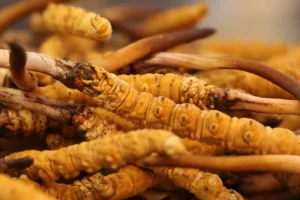
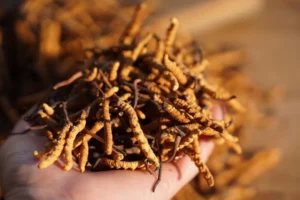
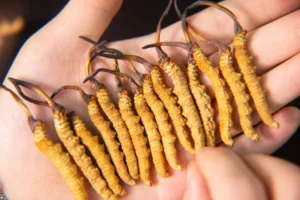
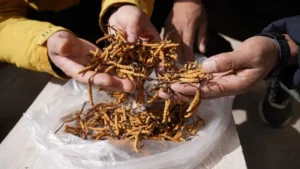
This product consists of the insect body connected to the fungal fruiting body growing from its head. The insect body resembles a silkworm, measuring 3–5 cm in length and 0.3–0.8 cm in diameter; its surface is deep yellow to yellowish-brown, with 20–30 annular rings, the ones near the head being finer; the head is reddish-brown; it has 8 pairs of legs, with the 4 middle pairs being more prominent;It is brittle and breaks easily; the fracture surface is slightly flat and pale yellowish-white. The fungal stroma is slender and cylindrical, 4–7 cm long and approximately 0.3 cm in diameter; its surface is dark brown to brownish-gray, with fine longitudinal wrinkles, and the upper part is slightly swollen; it is flexible, and the fracture surface is off-white. It has a faint fishy odor and a slightly bitter taste.
Properties of Processed Slices
See “Characteristics of Medicinal Materials.”
Botanical Information
Distribution Area
Found in Tibet, Sichuan, Qinghai, and other regions.