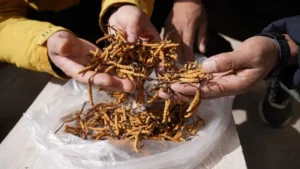
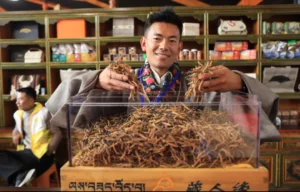
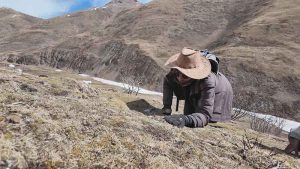
Cordyceps militaris, a name in traditional Chinese medicine. It is the dried composite of the fruiting body of the fungus Cordyceps militaris (L. ex Fr.) Link. (family Clavicipitaceae) and the pupa of the insect it parasitizes; in artificially cultivated strains, the fungus is inoculated onto the pupae of the oak cicada.It is distributed throughout the country. It has the efficacy of tonifying the lungs and kidneys, and is primarily used to treat consumptive cough with bloody sputum, spontaneous sweating, night sweats, impotence, nocturnal emission, soreness and pain in the lower back and knees, and fatigue.

Cordyceps Flower
Cordyceps militaris, a name in traditional Chinese medicine. It is the dried composite of the fruiting body of the fungus Cordyceps militaris (L. ex Fr.) Link. (family Clavicipitaceae) and the pupa of the insect it parasitizes; in artificially cultivated strains, the fungus is inoculated onto the pupae of the oak cicada.It is distributed throughout the country. It has the efficacy of tonifying the lungs and kidneys, and is primarily used to treat consumptive cough with bloody sputum, spontaneous sweating, night sweats, impotence, nocturnal emission, soreness and pain in the lower back and knees, and fatigue.
Chinese Name : 蛹虫草
Latin Name : Cordyceps militaris
Aliases : Northern Cordyceps, Northern Caterpillar Fungus, Pupa Fungus
Authentic Producing Area : Nationwide
Nature, Flavor & Meridian Tropism : Sweet in taste, neutral in nature; enters the Lung and Kidney meridians
Benefits & Efficacy
Benefits
Tonifies the lungs and nourishes the kidneys.
Indications
Used for consumptive cough with bloody sputum, spontaneous sweating, night sweats, impotence, nocturnal emission, soreness in the lower back and knees, and fatigue.
Usage and Dosage
5–10 g; 0.5–1 g when ground into powder.
Precautions
Not yet established.
Chemical Constituents
Contains cordycepin, mannitol, ergosterol, β-sitosterol, inosine, and inosine monophosphate.
Pharmacological Actions
It possesses antitumor, antibacterial, antioxidant, and anti-experimental arrhythmia effects.
Applications
Processing & Preparation
Harvesting & Processing
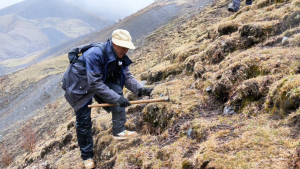
Wild specimens are generally harvested in summer and fall; remove any attached matter and impurities, then sun-dry. Cultivated specimens are harvested after the fruiting bodies mature and dried at low temperatures.
Processing Methods
Remove impurities and sift out dust; grind into powder when needed.
Storage Methods
Store in a cool, dry place to prevent insect infestation.
Crude Drug Identification
Identification
The powder of this product is brownish-yellow. The ascocarps are nearly conical and are occasionally observed. The hyphae are pale yellow or colorless; rarely found as single, scattered hyphae, they are mostly in bundles. The hyphal bundles are curved, slightly straight, or twisted, or may form a fluffy mass. The wall cells are polygonal and appear brownish-red, light brown, or yellowish; the setae are yellowish-brown.
Properties of Crude Drugs
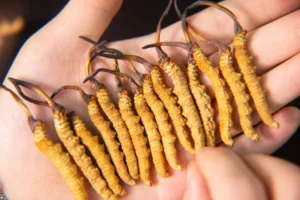
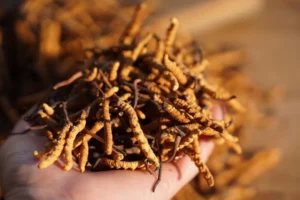
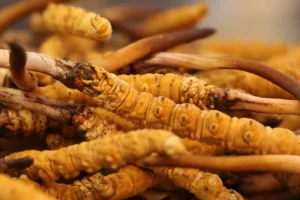
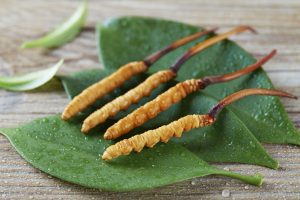
1. Cultivated Cordyceps: This product consists of a pupa connected to one or several fruiting bodies growing from the head or segments of the pupa. The pupa is oblong, 2–5 cm long and 1.5–2 cm in diameter; its surface is brown to brownish-black, with 5–10 annular rings; it is brittle and breaks easily.The cross-section is grayish-white. The fruiting body is slender and cylindrical, 2–8 cm long, with very few branches, and approximately 0.3 cm in diameter; the surface is orange-yellow to brownish-yellow, with the upper part slightly swollen; it is supple and flexible, with a pale yellow cross-section. It has a fishy odor and a mild taste.
2. Wild Cordyceps: Slightly smaller in size, with a pupa diameter of 1–1.5 cm; the fruiting body is 1–5 cm long.
Botanical Information
Botanical Classification
It is a dried composite of the stroma of the Cordyceps fungus (a member of the Clavicipitaceae family) and the pupa of the host insect.
Morphological Characteristics
The fruiting bodies emerge from the head or segments of the insect pupa, occurring singly or in groups of 2–3; they are 3–5 cm long, with a club-shaped head that is solid, fleshy, and has a long stalk. The apex is bluntly rounded, 1–1.5 cm long and 3–5 mm thick, orange-yellow or orange-red in color, with a surface densely covered with fine warts.The stalk is slender and elongated, cylindrical, slightly curved, 2–3 mm in diameter, orange-yellow at the top and pale yellow at the base.The ascocarp is conical, with the upper part exposed and the base buried in the outer layer of the head; the asci are long cylindrical, measuring 150–300 × 4–5 μm, and contain 8 filamentous ascospores. When mature, the ascospores produce cross-walls, folding transversely into single-celled segments 2–3 μm long.
Distribution Area
It is distributed throughout China.