Dong Quai
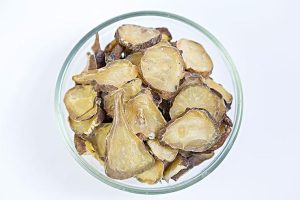
Gastrodia Elata

Benzoin

Benzoin, a name in traditional Chinese medicine. It is the resin of the benzoin tree (Styrax benzoin Dryand) or Vietnamese benzoin (Styrax tonkinensis (Pierre) Craib ex Hartw. [S. macrothyrsus Perk.; S. hypoglaucus Perk.]) from the genus Styrax in the family Styracaceae. It has the effects of clearing the orifices and reviving the mind, regulating qi and promoting blood circulation, and relieving pain.It is primarily used to treat stroke with phlegm-induced syncope, sudden syncope due to qi stagnation, coma caused by evil influences, pain in the chest and abdomen, postpartum blood fainting, and infantile convulsions.

Raw Oysters

Raw Oyster, a name in traditional Chinese medicine, refers to the shells of the species Ostrea gigas Thunberg, Ostrea talienwhanensis Crosse, or Ostrea rivularis Gould, all belonging to the genus Ostrea in the family Ostreidae.It has the effects of calming the mind and stabilizing the spirit, subduing yang and replenishing yin, and softening hard masses and dispersing nodules. It is primarily used to treat palpitations and insomnia, dizziness and tinnitus, scrofula and phlegm nodules, as well as masses and abdominal masses.

Southwest Camellia

Southwest Camellia, a name in traditional Chinese medicine. It refers to the flower of the Southwest Red Camellia (Camellia pitardii Coh.-St.), a plant belonging to the genus Camellia in the family Theaceae.It is distributed in Hunan, Guangxi, Sichuan, Yunnan, and Guizhou. It has the effects of detoxifying and reducing inflammation, astringing to stop dysentery, promoting blood circulation to stop bleeding, and regulating menstruation. It is used for dysentery, intestinal bleeding, acute gastroenteritis, irregular menstruation, nosebleeds, hemoptysis, rheumatic pain, arthritis, rectal prolapse, and burns and scalds.

Coldwater Flower

Lengshuihua, a name in traditional Chinese medicine. It refers to the whole plant of Pileanotata C.H. Wright, a member of the Urticaceae family.It is distributed in Central and South China, as well as in Shaanxi, Gansu, Jiangsu, Anhui, Zhejiang, Jiangxi, Fujian, Taiwan, Sichuan, and Guizhou. It has the effects of clearing heat and draining dampness, relieving jaundice, reducing swelling and dispersing nodules, and strengthening the spleen and harmonizing the stomach. It is commonly used for damp-heat jaundice, red and white vaginal discharge, turbid urine, hematuria, summer heat in children, malaria, indigestion, contusions and bruises, and traumatic infections.

Eat spicy food with Gastrodia elata influence effect

Gastrodia elata works mainly to soothe nerves, dilate blood vessels, relieve dizziness, migraine and insomnia. Consuming spicy food concurrently interferes with its therapeutic effects and triggers physical discomfort, which is why spicy meals are not recommended during the period of taking Gastrodia elata. Below is a detailed breakdown of efficacy interference, side effects, crowd risks … Read more

Drink alcohol while taking Gastrodia elata side effects

Gastrodia elata has vasodilating, sedative and anti-platelet pharmacological properties, while alcohol also dilates blood vessels, suppresses the central nervous system and irritates the gastrointestinal tract. When alcohol and Gastrodia elata are consumed together, their effects overlap and amplify, triggering multiple adverse reactions ranging from mild discomfort to life-threatening risks. 1. Severe orthostatic hypotension (most common … Read more

What food cannot eat with Gastrodia elata

Gastrodia elata is a common medicinal herb for relieving dizziness, headache and insomnia, yet certain foods will counteract its efficacy, amplify side effects such as hypotension and diarrhea, or trigger digestive discomfort when consumed together with Gastrodia elata. For better safety and medicinal effect, specific food combinations should be strictly avoided. This article follows Google … Read more

Elderly dosage safety of Gastrodia elata

Gastrodia elata is commonly used by elderly adults to relieve hypertension dizziness, chronic headache, insomnia, neural numbness and senile anxiety, yet seniors feature declined liver & kidney metabolism, fragile cardiovascular function and multiple underlying illnesses, making them far more susceptible to overdose side effects than younger adults. Strict age-specific dosage limits and administration rules are … Read more

Autoimmune disease Gastrodia elata safe usage

Gastrodia elata is a widely used medicinal herb with neuroprotective, anti-inflammatory, and immunomodulatory properties, making it both a potential supportive remedy and a high-precaution herbal option for people living with autoimmune diseases. Unlike ordinary health herbs, Gastrodia elata delivers dual effects on the human immune system: it can relieve autoimmune-related nerve inflammation, migraine, and insomnia, … Read more

People with liver kidney disease use Gastrodia elata

Healthy cultivated sulfur-free gastrodia has no direct hepatotoxic or nephrotoxic ingredients, but patients with liver or kidney damage cannot take Gastrodia elata casually for long-term daily health care. It may increase metabolic burden, worsen organ ischemia, and only short-term low-dose use is permitted under physician monitoring when necessary. Wild sulfur-fumigated gastrodia is strictly forbidden. 1. … Read more

Low blood pressure people take Tianma danger

People suffering from hypotension (baseline blood pressure consistently below 90/60 mmHg) face clear safety risks if consuming Tianma, and routine consumption is contraindicated. The core hazard lies in Tianma’s inherent vasodilating effect lowering blood pressure further. 1. Core mechanism of risk Gastrodin relaxes vascular smooth muscle, dilates systemic arteries and capillaries, reduces peripheral vascular resistance, … Read more

Can children kids take Gastrodia elata safely

General conclusion: Healthy children do not need and should not take gastrodia regularly for health care. Only children with specific medical problems may use it temporarily under pediatric TCM supervision with strict low doses. Long-term daily use is unsafe for minors. 1. Suitable scenarios (medical use only, doctor prescription required) Gastrodia is occasionally prescribed for … Read more

Gastrodia elata incompatible herbs Veratrum

1. Classic herbal incompatibility rule In traditional Chinese medicine eighteen antagonistic medicinal pairs (Shiba Fan), the rule clearly states: Veratrum (Lilu, 藜芦) counteracts Gastrodia elata (Tianma). Gastrodia elata must never be combined with any veratrum species: black veratrum, white veratrum, veratrum root, veratrum rhizome. 2. Why they are incompatible (toxicological mechanism) (1) Toxic synergistic amplification … Read more

Can I take Tianma with diabetes medicine

Overall, qualified sulfur-free cultivated Tianma can be used together with diabetes drugs safely under monitoring, but unsupervised long-term combined intake carries hidden risks of blood sugar fluctuations and hypotension. Self-administration is not recommended. 1. Beneficial interaction effects (proven by modern research) 2. Key risks of combined use Risk 1: Overlapping hypoglycemia (the greatest danger) Risk … Read more