Dong Quai
Gastrodia Elata
Astragalus
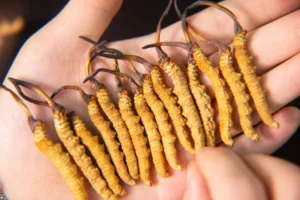
Cordyceps sinensis
cordyceps tea
Grains
Legumes

Bran-Fried Atractylodes

Bran-roasted Atractylodes is a processed form of Atractylodes macrocephala, prepared by stir-frying raw Atractylodes slices with wheat bran. After being roasted with wheat bran, the drying nature of Atractylodes is reduced, while its spleen-tonifying effects are enhanced. It is primarily used to treat symptoms such as spleen deficiency with poor appetite, epigastric and abdominal distension, and fatigue and weakness; it is also suitable for treating fetal restlessness caused by spleen deficiency.

White-backed Poplar

White-backed Poplar is the name of a traditional Chinese medicinal herb. It consists of the leaves of *Populus argentea* (silver poplar), a plant in the Salicaceae family. It is distributed in Northeast China, North China, Northwest China, and Guangxi, among other regions. It has the effects of expelling phlegm, reducing inflammation, relieving wheezing, and suppressing coughs. It is primarily used to treat chronic bronchitis, coughs, and wheezing.

Ginger

Ginger is a commonly used medicinal herb for dispelling wind-cold. It is the fresh rhizome of Zingiber officinale Rosc., a plant belonging to the genus Zingiber in the Zingiberaceae family. It has the effects of relieving exterior symptoms and dispelling cold, warming the middle burner and stopping vomiting, resolving phlegm and relieving cough, and neutralizing fish and crab poisoning. It is primarily used for wind-cold colds, vomiting due to stomach cold, coughs with cold phlegm, and fish and crab poisoning.

Dried Enteromorpha

Gan Tai, a name in traditional Chinese medicine. It refers to the algal thalli of plants in the family Enteromorpha, including Enteromorpha prolifera (Muell.) J.Ag., Enteromorpha clathrata (Roth) Grev., Enteromorpha compressa (L.) Grev., and Enteromorpha linza (L.) J.Ag.It is distributed along the entire Chinese coastline, with particularly abundant growth along the coasts of Zhejiang and Fujian. It has the therapeutic effects of softening hardness and dispersing nodules, resolving phlegm and eliminating food stagnation, and detoxifying and reducing swelling. It is used to treat goiters, scrofula, abscesses, boils, food stagnation, parasitic infestations, epigastric and abdominal distension and fullness, and epistaxis.

Myristica fragrans (Roudoukou)

Nutmeg (Myristica fragrans Houtt., Roudoukou): the mature seed kernel of *Myristica fragrans* Houtt., a plant of the Myristicaceae family. 【Nature and Flavor】Nature: warm, flavor: pungent. Meridian tropism: Large Intestine Meridian of Hand-Yangming (LI), Stomach Meridian of Foot-Yangming (ST), and Spleen Meridian of Foot-Taiyin (SP). 【Actions and Indications】Warms the Middle and Moves Qi, Astringes the Intestines … Read more

Lilium brownii

Baihe: The fleshy scale leaves of *Lilium longiflorum* Thunb. (family Liliaceae). 【Property, Flavor, and Meridian Tropism】Cold in nature, sweet in flavor. Enters the Heart Meridian (HT) and Lung Meridian (LU). **Actions and Indications**: Nourishes Yin and moistens the Lung, clears the Heart and calms the Shen (spirit). It is classified as a Yin-tonifying medicinal under … Read more

Cassia obtusifolia (Juemingzi)

Cassia obtusifolia (Juemingzi): The mature seeds of *Cassia obtusifolia* L., a plant in the Fabaceae family. **Nature and Flavor:** Slightly cold, bitter and sweet. **Meridian Tropism:** Enters the Liver Meridian of Foot‑Jueyin (LR), Kidney Meridian of Foot‑Shaoyin (KI), and Large Intestine Meridian of Hand‑Yangming (LI). [Actions and Indications] Clears heat and improves vision, moistens the … Read more

Dimocarpus longan (Longan, Guiyuan) — specifically referring to the aril (flesh) of the fruit.

Longan Aril (Guiyuan): Aril of *Dimocarpus longan* Lour. (Sapindaceae) 【Nature, Flavor, and Meridian Tropism】Warm in nature, sweet in flavor. Enters the Heart Meridian of Hand-Shaoyin (HT) and the Spleen Meridian of Foot-Taiyin (SP). 【Actions and Indications】Tonifies the Heart and Spleen, nourishes Blood and calms the Spirit. It is classified as a Qi-tonifying medicinal, a subcategory … Read more

Lablab purpureus (Bai Biandou Hua)

White Hyacinth Bean Flower (Baibiandouhua): the flower of *Dolichos lablab* L., a leguminous plant. **Nature, Flavor, and Meridian Tropism:** Sweet and bland, neutral in nature. Enters the Spleen (SP), Stomach (ST), and Large Intestine (LI) meridians. 【Effects and Functions】Fortify the Spleen and harmonize the Stomach, clear summerheat and transform dampness. Treats dysentery, diarrhea, and red … Read more

Dolichos lablab (Baibiandou)

Baibiandou (Dolichos lablab): the seed of the leguminous plant *Dolichos lablab* L. **Nature, Flavor, and Meridian Tropism:** Sweet and bland; slightly warm; neutral. Enters the Spleen (SP) and Stomach (ST) meridians. 【Actions and Indications】 **Actions:** Invigorates the Spleen, transforms Dampness, harmonizes the Middle, and dispels Summer-Heat. **Indications:** Spleen-Stomach Deficiency (pi wei xu ruo) with poor … Read more

Ginkgo biloba (Baiguo)

Ginkgo biloba (Baiguo): the seed of Ginkgo biloba L. (family Ginkgoaceae), with the fleshy outer seed coat removed. **Nature, Flavor, and Meridian Entry:** Neutral nature; flavors: sweet, bitter, astringent. 【Actions and Indications】 Astringes the lung to relieve dyspnea (dyspnea), arrests leukorrhea and turbid vaginal discharge, and reduces urinary frequency. It is classified under the astringent … Read more

Angelica dahurica (Baizhi)

**Baizhi (Angelica dahurica):** The root of *Angelica dahurica* (Fisch. ex Hoffm.) Benth. et Hook.f., or its variety *Angelica dahurica* var. *formosana* (Boiss.) Shan et Yuan, both plants of the Apiaceae family. Nature and flavor: Warm, pungent. Meridian tropism: Stomach (ST), Large Intestine (LI), Lung (LU). 【Actions and Indications】Disperses wind and eliminates dampness, unblocks the orifices … Read more

Glycyrrhiza uralensis

Gancao (Licorice root): the dried root of *Glycyrrhiza uralensis* Fisch., *Glycyrrhiza inflata* Bat., or *Glycyrrhiza glabra* L. (Fabaceae). 【Nature, Flavor, and Meridian Tropism】Sweet, neutral. Attributable to the Heart (HT), Lung (LU), Spleen (SP), and Stomach (ST) meridians. 【Functions and Indications】 Supplement the Spleen and boost Qi, clear Heat and resolve Toxin, transform Phlegm and stop … Read more

Polygonatum odoratum (Yuzhu)

Yuzhu (Polygonatum odoratum (Mill.) Druce): the rhizome of the Liliaceae plant Polygonatum odoratum. **Nature, Flavor, and Meridian Tropism:** Slightly cold nature, sweet flavor. Enters the Lung Meridian of Hand-Taiyin (LU) and the Stomach Meridian of Foot-Yangming (ST). 【Actions & Indications】Nourishes yin, moistens dryness, generates fluids, and quenches thirst. Categorized as a Yin-nourishing medicinal within the … Read more