Goose Tube Stone is the name of a traditional Chinese medicine. It is a fine tubular aggregate of calcite (Stalactite), a mineral belonging to the calcite group of carbonate minerals. It is found in Hubei, Hunan, Guangdong, Guangxi, Sichuan, Guizhou, Yunnan, and other regions. It has the therapeutic effects of warming the lungs, enhancing virility, and promoting lactation.It is primarily used to treat chronic cough due to lung cold, consumptive cough and wheezing, erectile dysfunction and premature ejaculation, nocturnal emissions and seminal emission, cold-induced numbness in the lower back and legs, and insufficient lactation.
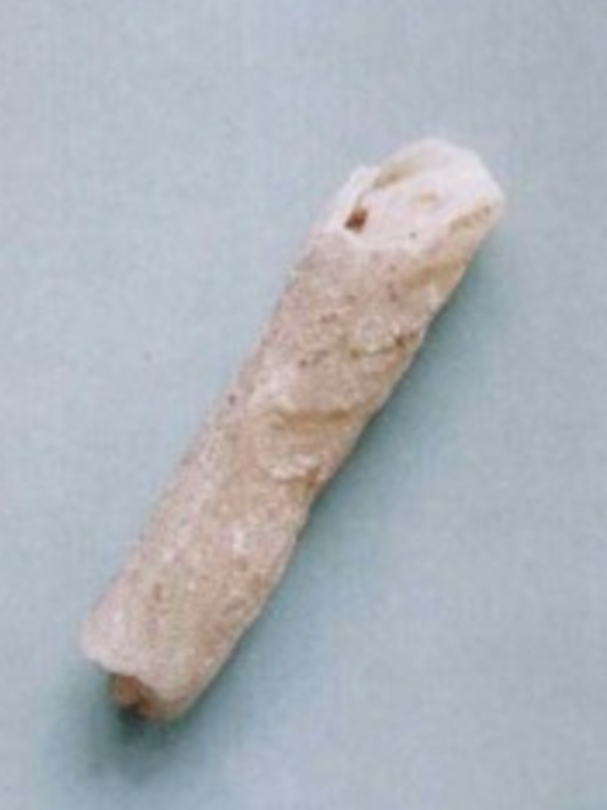
Goose Tube Stone
Goose Tube Stone is the name of a traditional Chinese medicine. It is a fine tubular aggregate of calcite (Stalactite), a mineral belonging to the calcite group of carbonate minerals. It is found in Hubei, Hunan, Guangdong, Guangxi, Sichuan, Guizhou, Yunnan, and other regions. It has the therapeutic effects of warming the lungs, enhancing virility, and promoting lactation.It is primarily used to treat chronic cough due to lung cold, consumptive cough and wheezing, erectile dysfunction and premature ejaculation, nocturnal emissions and seminal emission, cold-induced numbness in the lower back and legs, and insufficient lactation.
Chinese Name : 鹅管石
Aliases : Drip Milk Stone, Stalactite Goose Tube Stone
Nature, Flavor & Meridian Tropism : Taste: sweet and salty; nature: warm; enters the Lung, Kidney, and Stomach meridians
Benefits & Efficacy
Benefits
Warms the lungs, strengthens yang, and promotes lactation.
Indications
Chronic cough due to lung cold; cough and wheezing from consumptive disease; impotence and premature ejaculation; nocturnal emissions and seminal leakage; cold-induced numbness in the lower back and legs; and insufficient lactation.
Usage and Dosage
Internal use: Decoct 9–15 g; crush and decoct first; or grind into a powder and take 0.3–1.5 g, or incorporate into pills.
Precautions
Patients requiring treatment with Chinese herbal medicine should first consult a licensed Traditional Chinese Medicine (TCM) hospital, where a TCM practitioner will conduct a professional pattern differentiation and prescribe an herbal formula.
Chemical Constituents
The main component is calcium carbonate. It also contains small amounts of magnesium, strontium, barium, and other elements. The main composition of Goose Tube Stone is consistent with that of Stalactite, differing only slightly in trace element content.
Relevant Discussions
1. *Essentials of Materia Medica*: “Primarily treats coughs, phlegm, and wheezing, as well as various types of coughs in children.”
2. *Introduction to Medicine*: “Specifically treats chronic coughs due to lung cold and phlegm obstructing the diaphragm; also treats malnutrition-related sores.”
Applications
Related Prescriptions
1. For treating pulmonary atrophy with chronic cough and prolonged cough: Ginseng, Tussilago flower, Stalactite, Goose-tube Stone (ground together), and Calcined Alum—2 qian each; Cinnamon Bark and Licorice—1 qian each. Grind the ingredients into a fine powder. Take a small amount twice before bedtime. (*Qibao Powder* from *Direct Pointers to Formulas*)
2. For bronchial asthma: 30g of Goose-Tube Stone, 10 walnut kernels, 9g of apricot kernels, 12g of radish seeds, and 3g of licorice. Decoct in water and take orally. (*Clinical Applications of Traditional Chinese Medicine*: Goose-Tube Stone Decoction)
3. For the treatment of pulmonary tuberculosis: 15g each of American ginseng, pearl, fritillary bulb, coix seed, Goose Tube Stone (stalactite), and lily bulb. Grind all ingredients into a fine powder. Dissolve 6g in boiling water and take once in the morning and once in the evening. (Formula for Treating Pulmonary Tuberculosis from *A Collection of Proven Traditional Chinese Medicine Formulas from Gansu*)
Notes
References for this entry: 1. *Chinese Materia Medica*. 2. *Encyclopedia of Traditional Chinese Medicine*. 3. *Mineral Medicinal Resources of China*.
Processing & Preparation
Harvesting & Processing
Can be harvested year-round; knock it down from the cave ceiling and remove surface impurities.
Processing Methods
1. Goose Tube Stone: Take the raw herb, remove impurities, wash thoroughly, dry, and crush as needed. The raw form excels at warming the lungs, resolving phlegm, and promoting lactation; it is commonly used for lung deficiency with cough and wheezing, and insufficient lactation.
2. Calcined Goose-Tube Stone: As described in *Introduction to Medicine: Materia Medica*: “Calcine and grind.” The current method involves placing clean Goose-Tube Stone in a suitable container, heating it over a high, smokeless flame until it glows red throughout; remove it when a foul odor is released, allow it to cool, then crush or grind it into a fine powder.
3. Vinegar-Quenched Goose Tube Stone: Place clean Goose Tube Stone in a jar and calcine over high heat until it turns completely red. While still hot, pour vinegar over it to thoroughly quench it, then crush it after cooling. Use 25 kg of vinegar for every 100 kg of Goose Tube Stone. After processing, it is easy to pulverize and possesses a strong ability to warm the kidneys and enhance yang; it is commonly used for kidney deficiency with shortness of breath and impotence.
Storage Methods
Store in a dry container in a dry, dust-free place.
Crude Drug Identification
Identification
Under a transmitted polarizing microscope: Calcite appears crystalline, with a concentric, ring-like structure and a hollow center.
Properties of Crude Drugs
It is cylindrical or conical in shape, hollow like a tube, 3–7 cm long, 0.5–1.3 cm in diameter, with a wall thickness of 1–4 mm. It is white or pale yellowish-white.The surface is smooth, though some specimens are rougher, with granular or longitudinal striations. It ranges from translucent to opaque. It is hard and brittle, breaks easily, and has a white fracture surface with a vitreous luster; the center contains a large cavity, and in specimens with thick walls, pale yellow concentric layers are visible. It is odorless and has a bland taste.
Properties of Processed Slices
Calcined goose-tube stone is chalky white or grayish black, with a crumbly texture. It has a burnt odor.
Vinegar-quenched goose-tube stone resembles goose-tube stone in shape and has a vinegar-like odor.
Botanical Information
Morphological Characteristics
Trigonal crystal system. Crystals are rhombohedral, though some are prismatic or tabular. Aggregates often occur as stalactitic or dense granular masses. The color is mostly colorless or milky white; if impurities are present, it may be tinged with various colors such as gray, yellow, rose, red, or brown. It has a vitreous luster.Transparent to opaque. It exhibits perfect cleavage and can be split along three different directions. The fracture is conchoidal. Hardness 3. Specific gravity 2.6–2.8.
Distribution Area
Found in Hubei, Hunan, Guangdong, Guangxi, Sichuan, Guizhou, Yunnan, and other regions.