TCM Chrono-Health

Aug 13, 2026 15:42 (America/New_York)
Jia Xu Day XinWei Hour

Ziwuliuzhu [Read More]

Active Meridian: Small Intestine
Open Point: Wan Gu
Time Period: 13:00-15:00
Flow: Hand to head, outer arm

Linggui Bafa [Read More]

Main Point: Zhao Hai

Pair: Shen Mai

Vessel: Yin Heel Vessel

甲(10) + 戌(5) + 辛(3) + 未(8) = 26, remainder 2

Feiteng Bafa [Read More]

Open Point: Hou Xi

Wellness tips [Read More]

Small Intestine active. Drink water to promote absorption. Press Houxi point.

Time Diagnosis [Read More]

Active Organ: Small Intestine
If symptoms like Dark urine, shoulder and arm soreness recur at this time, consider Small Intestine meridian pathology.

Zangfu Pathology Analysis [Read More]

Small Intestine separates clear from turbid, exterior-interior with Heart.

Yin-Yang Imbalance [Read More]

Yang reaches extreme and Yin is born. Take a short nap to nourish Yin.

Reishi

Reishi is a name used in traditional Chinese medicine. It refers to the dried fruiting bodies of the fungi Ganoderma lucidum (Leyss. ex Fr.) Karst. (red reishi) or Ganoderma sinense Zhao, Xu et Zhang (purple reishi), belonging to the genus Ganoderma in the family Polyporaceae. It has the effects of tonifying qi, calming the mind, relieving cough, and alleviating wheezing. It is primarily used to treat restlessness, insomnia, palpitations, cough and wheezing due to lung deficiency, shortness of breath caused by debility, and loss of appetite.

Goji Berries

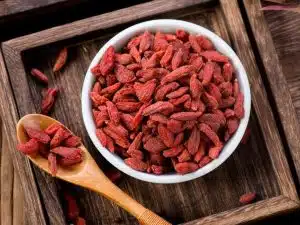
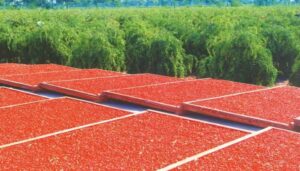
Goji berries, a traditional Chinese medicine, are the dried, ripe fruits of Ningxia goji (Lycium barbarum L.), a plant belonging to the genus Lycium in the Solanaceae family. They have the effects of tonifying the liver and kidneys, nourishing essence, and improving eyesight. They are primarily used to treat deficiency-syndrome with essence depletion, soreness and pain in the lower back and knees, dizziness and tinnitus, impotence and nocturnal emission, internal heat with excessive thirst, blood deficiency with pallor and weakness, and blurred vision.

Red Rhodiola

Rhodiola is the name of a traditional Chinese medicine. It consists of the dried roots and rhizomes of Rhodiola crenulata (Hook.f. et Thoms.) H. Ohba, a plant in the Crassulaceae family. It has the effects of tonifying qi, promoting blood circulation, unblocking meridians, and relieving wheezing. It is primarily used to treat qi deficiency with blood stasis, chest pain due to bi syndrome, hemiplegia caused by stroke, and fatigue with shortness of breath.

Gastrodia elata

Tianma is a traditional Chinese medicinal herb used to calm the liver and subdue wind. It is the dried tuber of Gastrodia elata Bl., a plant in the genus Gastrodia of the Orchidaceae family. It has the effects of subduing wind and relieving spasms, calming liver yang, and dispelling wind to unblock the meridians.It is primarily used to treat infantile convulsions, epileptic seizures, tetanus, headaches and dizziness, paralysis of the hands and feet, numbness of the limbs, and rheumatic arthralgia.

Licorice

Licorice is a commonly used Chinese medicinal herb derived from the dried roots and rhizomes of the leguminous plants Glycyrrhiza, Glycyrrhiza glabra, or Glycyrrhiza glabra var. glabra. It is named for its sweet taste. It is primarily produced in Inner Mongolia, Shaanxi, Gansu, and the Northeast, where unique geographical and climatic conditions endow it with excellent medicinal properties.Licorice has the effects of tonifying the spleen and boosting qi, clearing heat and detoxifying, eliminating phlegm and relieving cough, and alleviating spasms and pain. It is commonly used to treat spleen and stomach deficiency, deficiency of heart qi, heat-toxin syndromes, cough, and spasmodic pain in the epigastrium, abdomen, or limbs. It also harmonizes other herbs, mitigates drug toxicity, and balances the properties of medicinal materials, making it widely used in herbal formulas. In addition, licorice can be incorporated into daily diets to provide certain health-promoting benefits.

Cordyceps

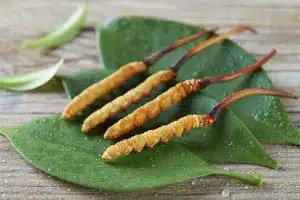
Cordyceps, a name in traditional Chinese medicine. It is the dried composite of the fruiting body and the corpse of a caterpillar from the family Sphingidae, parasitized by the fungus Cordyceps sinensis (Berk.) Sacc. of the Clavicipitaceae family. It is primarily produced in Sichuan, Tibet, and Qinghai.This herb has a sweet taste and neutral nature; it enters the Lung and Kidney meridians. It has the effects of tonifying the kidneys and nourishing the lungs, as well as stopping bleeding and resolving phlegm. It can be used to treat kidney deficiency with essence depletion, impotence and nocturnal emission, soreness and pain in the lower back and knees, chronic cough with wheezing due to deficiency, and coughing up blood due to overwork.

Dong Quai

Dong Quai is a blood-nourishing medicinal herb derived from the root of Angelica sinensis (Oliv) Diels, a plant belonging to the genus Angelica in the Apiaceae family. It has the effects of nourishing and invigorating the blood, regulating menstruation and relieving pain, and moistening the intestines to promote bowel movements.It is primarily used to treat blood deficiency with pallor, dizziness and palpitations, irregular menstruation, amenorrhea and dysmenorrhea, abdominal pain due to deficiency-cold, rheumatic arthralgia, trauma from falls or blows, boils, abscesses, and sores, as well as constipation caused by intestinal dryness.

Astragalus

Astragalus is the name of a traditional Chinese medicine. It is the dried root of Astragalus membranaceus (Fisch.) Bge. var. mongholicus (Bge.) Hsiao or Astragalus membranaceus (Fisch.) Bge., plants belonging to the genus Astragalus in the Fabaceae family.It has the effects of tonifying qi and raising yang, consolidating the exterior and stopping sweating, promoting diuresis and reducing edema, generating body fluids and nourishing blood, resolving stagnation and relieving arthralgia, expelling toxins and draining pus, and promoting wound healing and tissue regeneration.It is primarily used to treat qi deficiency with fatigue, poor appetite and loose stools, sinking of central qi, chronic diarrhea with rectal prolapse, bloody stools and metrorrhagia, spontaneous sweating due to exterior deficiency, edema caused by qi deficiency, internal heat with excessive thirst, pallor and weakness due to blood deficiency, hemiplegia, arthralgia and numbness, abscesses and boils that are slow to ulcerate, and chronic ulcers that fail to heal.

Dong Quai
Gastrodia Elata
Anti Aging Natural Skin Care
Astragalus
Herbal Skin Care
Natural Skin Care For Sensitive Skin
Plant Based Skin Care

Longxi Astragalus Authorized Geographical Indication Herb Base

Longxi County in Dingxi, Gansu Province, is honored as the Hometown of Astragalus in China and known nationwide as “China Medicine Capital”. It is the classic Daodi producing region of Astragalus membranaceus var. mongholicus. The Authorized Geographical Indication Herb Base is situated within the officially defined protected origin zone of Longxi Astragalus, adhering strictly to ... Read more

Min County Dong Quai National Demonstration Zone for Export Food

Min County Dong Quai National Demonstration Zone for Export Food and Agricultural Product Quality and Safety,Globally renowned as the Hometown of Dong Quai in China, Min County of Gansu Province is the authentic Daodi origin of high-quality Dong Quai (Angelica sinensis), traditionally known as Min Gui. With more than 1,800 years of herbal planting heritage ... Read more

China-NIAHS:Min County Dong Quai Farming System

The Min County Dong Quai Farming System in Dingxi, Gansu, was officially inscribed on the list of Nationally Important Agricultural Heritage Systems of China in 2014 (the second batch). Rooted in the core Daodi origin of authentic Min Gui, it represents a living, time-honored agro-cultural system integrating herbal cultivation wisdom, ecological rotation, traditional processing craftsmanship ... Read more

Min County Daodi Chinese Herb Planting Base For Dong Quai

Located in Min County, Dingxi, Gansu — renowned as the Hometown of Dong Quai in China — the standardized Daodi Chinese Herb Planting Base focuses on ecological cultivation of authentic Min Gui. Rooted in the core Daodi origin zone of Dong Quai, the base inherits centuries of local planting tradition and complies with national specification ... Read more

Min County Dong Quai GAP Chinese Medicinal Herb Base

Located in Min County, Dingxi, Gansu — renowned as the Hometown of Dong Quai in China — the standardized GAP Chinese Medicinal Herb Base specializes in standardized cultivation of authentic Min Gui (Gansu Dong Quai). Fully compliant with national Good Agricultural Practice (GAP) for Chinese crude drugs, the base integrates standardized rotation planting, whole-process ecological ... Read more

Min County Dong Quai Chinese Medicinal Herb Seedling Base

Located in Min County, Dingxi, Gansu, reputed as the Hometown of Chinese Dong Quai, this standardized Chinese Medicinal Herb Seedling Base focuses on selective breeding and mass propagation of high-quality Min Gui seedlings. As the core germplasm source base for Daodi Dong Quai nationwide, the base undertakes germplasm conservation, seed purification, seedling breeding and technical ... Read more

Best Place to Grow Dong Quai: Min County, Gansu Province

Min County, Dingxi, Gansu, reputed as the Hometown of Chinese Dong Quai, is globally acknowledged as the ideal natural habitat for Dong Quai. Situated at the convergence of the Loess Plateau, Qinghai-Tibet Plateau and West Qinling Mountains, it perfectly satisfies all rigorous ecological demands of Dong Quai cultivation. Min County Dong Quai holds National Geographical ... Read more

Gansu Dong Quai Authorized Geographical Indication Herb Base

Located in Min County, Dingxi City, Gansu Province, known as the Hometown of Chinese Dong Quai, the standardized Authorized Geographical Indication Herb Base specializes in cultivating authentic Min County Dong Quai, widely named Min Gui. Min County Dong Quai obtained National Geographical Indication Product Protection and Geographical Indication Certification Trademark. It is also listed on ... Read more

6 Traditional Chinese Folk Remedies for Wellness and Beauty

1. Daylily (Hemerocallis fulva) Forget-Your-Worries Flower Hemerocallis fulva is also known as “forgetting worries” and “relieving melancholy”. According to Compendium of Materia Medica, consuming Hemerocallis fulva “makes people joyful, free from worries, agile and improves eyesight”. The flower of Hemerocallis fulva is the commonly seen vegetable, daylily, which is a delicious vegetarian dish and can … Read more

7 Ancient Chinese Weight Loss Formulas from Traditional Medicine

1. White Gourd Weight Loss Formula Eating white gourd has a weight-loss effect. “Those who wish to become slim and agile can eat it regularly; those who want to gain weight should avoid it.” This is an ancient experience that has also been confirmed by modern scientific research. White gourd contains no fat and has … Read more

15 Traditional Chinese Prescriptions for Bromhidrosis

1. Wuxiang Formula for Eliminating Bromhidrosis Asarum forbesii Maxim., Ligusticum chuanxiong Hort., Ligusticum sinense ‘Chuanxiong’, Magnolia biondii Pamp., Asarum heterotropoides var. mandshuricum (Maxim.) Kitag., 4 grams each. Soak in yellow rice wine overnight, add a small amount of water, and briefly decoct to obtain the juice. Before going to bed each night, first wash the … Read more

7 Traditional Chinese Recipes for a Naturally Fragrant Body

1. Aromatic Floral Water Body Fragrance Formula Rose water, jasmine water, honeysuckle water, osmanthus water, orchid water, jasminum sambac water, and narcissus water all have the effect of perfuming the body. The methods for making floral waters are generally similar, involving steam distillation. The obtained floral water can be mixed with an appropriate amount of … Read more

9 Herbal Formulas for Halitosis from Chinese Medicine

1.Xiangfa Xuncao Formula Women use orris root soaked in oil to dress their hair, emitting a pervasive fragrance that is refreshing to the mind and spirit. Source: Supplement to Compendium of Materia Medica 2. Coriander Fresh Breath Formula Gargling with boiled water of coriander can freshen the breath. Source: Folk empirical formula 3. Formula with … Read more

3 Chinese Herbal Formulas for Deafness, Tinnitus, and Otorrhea

1. Formula for supports Deafness by Tonifying Deficiency Use one pair of deer Kidneys, remove the fatty membranes and chop them finely, then cook them with 150 grams of millet in fermented soybean juice to make rice and eat it. It can also be made into a soup, which has the effect of tonifying deficiency … Read more

13 Ancient Chinese Tooth-Strengthening & Dental Care Prescriptions

1.Su Dongpo’s Tooth-Strengthening Prescription Pine resin (the best comes from those produced in areas that promote tranquility and stability) is placed in a sparse cloth, boiled in boiling water. Take the part floating on the boiling water surface and put it into cold water (the part that does not float is not used), grind it … Read more

5 Herbal Prescriptions for Oral Ulcers and Mouth Sores

1. Prescription of Ginger Juice for supports Aphthous Ulcer Mouth full of festering sores can be supports by frequently gargling with ginger juice. Alternatively, the ginger can be ground into powder and applied topically, which is highly effective. Source: Compendium of Materia Medica 2. Prescription of Syzygium aromaticum (clove) (Jishe Xiang) for supports sores on … Read more

5 Ancient Chinese Remedies for Better Eyesight

1.Qingliang Ointment Hibiscus mutabilis leaf powder, mixed with water, applied topically to the taiyang (EX-HN5) acupoint. supports red, swollen, and painful eyes. Source: Hongfei Collection 2.Manqing Hua Mingmu Prescription Radix Lepidii seu Descurainiae is indicated for dim vision due to consumptive wellness. Long-term use is said to prolong life and enable reading at night. While … Read more

14 TCM Formulas for Rosacea

1. Prescription of Flos Campsis Grandiflora for Rosacea An equal amount of Flos Campsis grandiflora and Fructus Gardeniae jasminoides are ground into powder. Take 1 g to 3 g each time, twice a day. It is effective for supports rosacea. Source: Wang Qiu’s One Hundred and One Selected Prescriptions 2. Formula of Lithargite for supports … Read more